

whorled milkweed
Table of Contents
Asclepias verticillata, L.
Alternate Common Name: eastern whorled milkweed
Family: dogbane family (Apocynaceae), formerly milkweed family (Asclepiadaceae)
Functional Group: forbs (wildflowers)
Description
- Life cycle and growth form
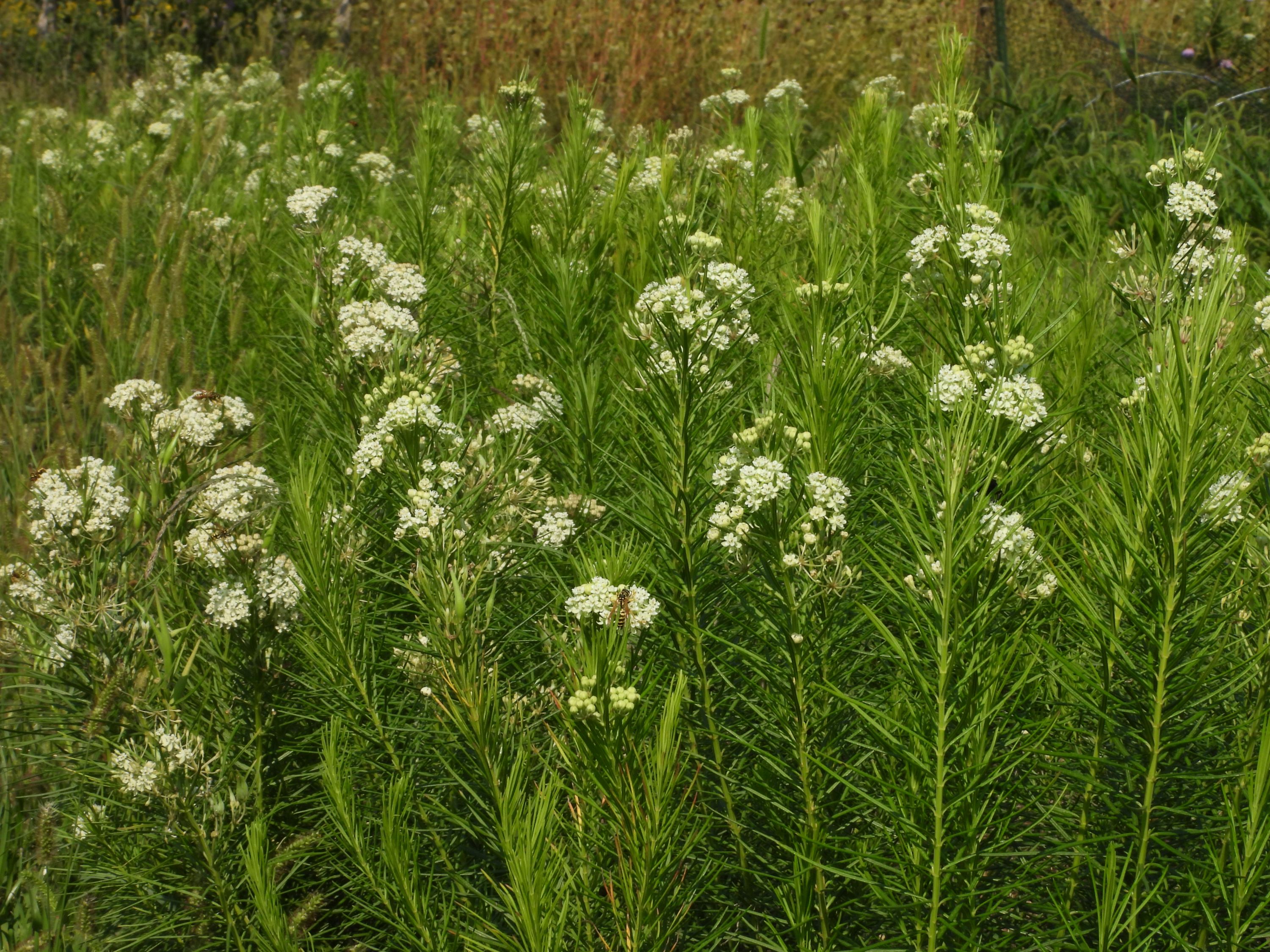
Perennial that forms extensive clonal patches from deep, spreading rhizomes.
Height: 1 - 2 ft
- Leaves and stem

Bright green needle-like leaves, up to 2-3 in long, with margins that are rolled to the underside, in whorls of 4-6 at nodes; slender stem, usually unbranched, with short hairs in vertical lines.
- Flower, fruit and seedhead
Flower: Typical milkweed flower, slightly greenish white, with a central reproductive column surrounded by a 5-part corona of nectar-filled hoods, 5 downcurved petals, and 5 sepals (hidden by the petals when in bloom); multiple 1-3 in rounded clusters of flowers (umbels) in upper leaf axils.
Fruit/seed head: Fruit is a slender, hairless, elongated follicle (commonly called a “pod”) up to 3-4 in long, releasing plumed oval brown seeds at maturity; seed is wind-dispersed.
Pollination: Insects, especially bees and wasps, as well as flies, butterflies, and moths. We have observed the endangered rusty patched bumble bee using these flowers.

- Seed
Seed characteristics
Seed weight:
Seeds per ounce: 11,000 (IA NRCS)
1000 seed weight: 2.20g (Seed Information Database)
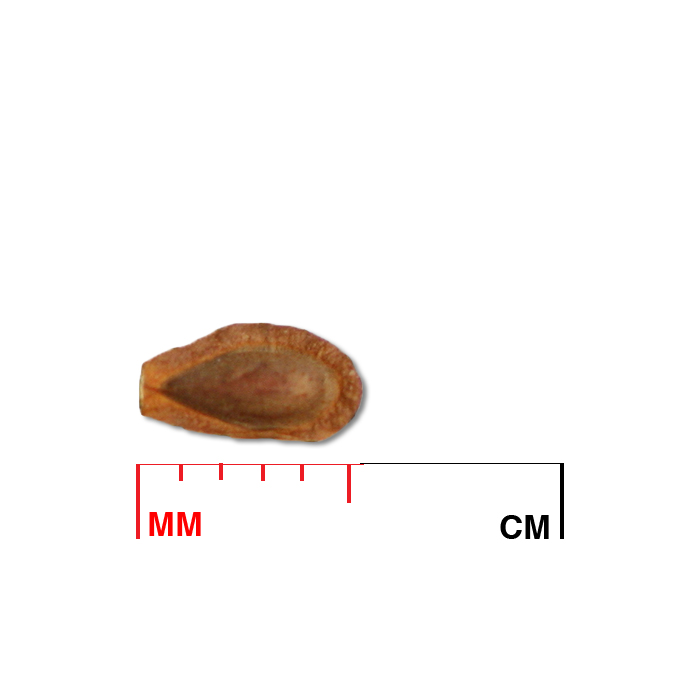
Description: Seeds are dark brown, teardrop-shaped with a flattened wing, about 5 mm long, with a tuft of silky fluff (coma or floss) prior to cleaning.
Typical seed test
PLS: 92% (n = 11)
Purity: 97% (n = 10)
Germination: 19% (n = 5)
Dormancy: 36% (n = 5)
(averages obtained from n tests of purchased seed lots)
- Habitat and range
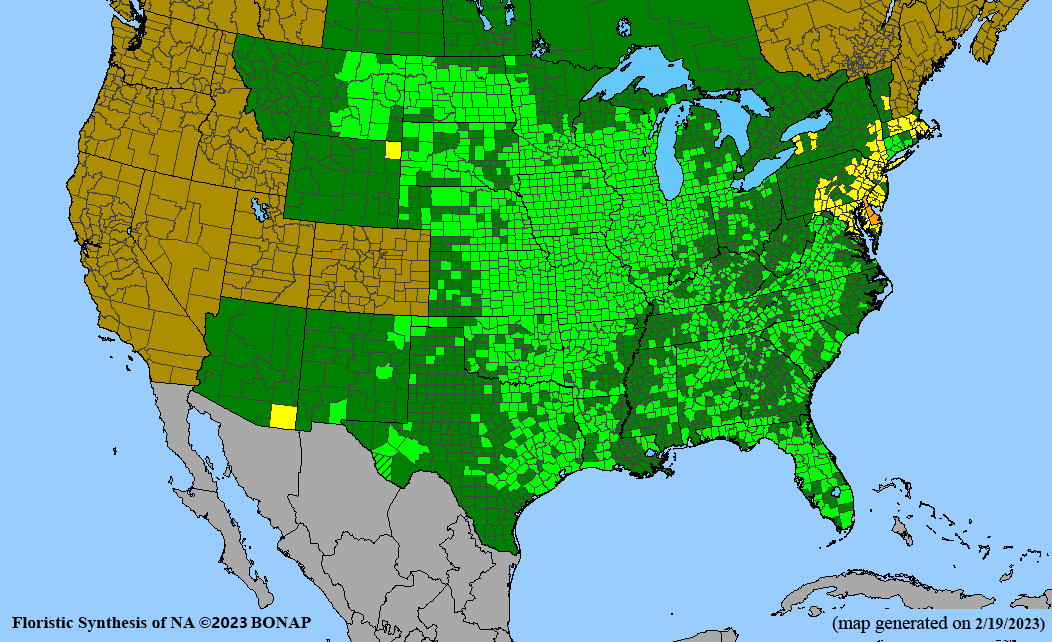
Habitat: Dry to mesic soil; partial to full sun; dry to dry-mesic prairies, woodlands openings, sandy savannas, limestone glades, rocky bluffs, fields, roadsides; Wetland Indicator Status is Facultative Upland (FACU) for the Midwest; moist to dry loamy to sandy soils are recommended for seed production.
Conservation status: Global- G5, secure; Delaware- SH, possibly extirpated; Rhode Island and Vermont- S1, critically imperiled; Massachusetts, New Jersey, New York, and Pennsylvania- S2, imperiled; Maryland and West Virginia- S3, vulnerable; in all other states within its natural range, status is S4 (apparently secure) to S5 (secure) or unranked (NatureServe).
General Comments
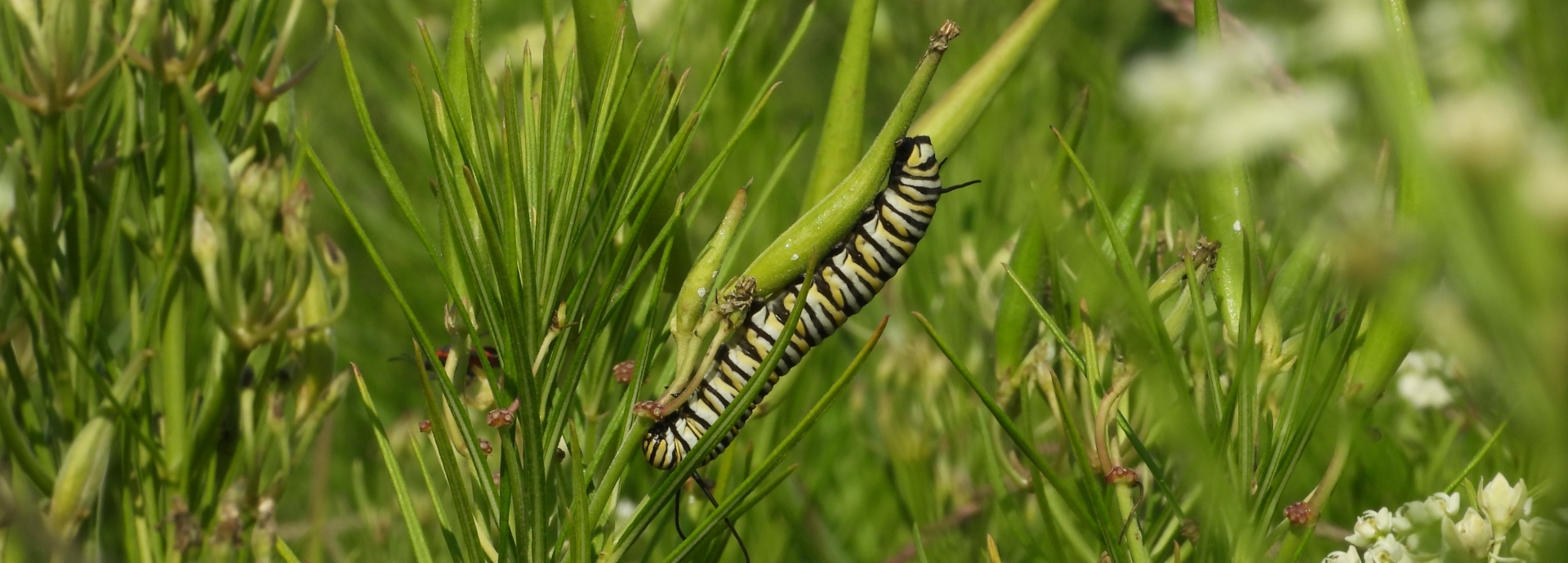
In the late summer to early fall in the Tallgrass Prairie Center seed production fields, one of the best places to look for monarch butterfly caterpillars is on whorled milkweed plants. It may seem surprising to find large, late-instar caterpillars on these slender plants with their needle-like leaves, so unlike their robust cousin common milkweed. Each whorled milkweed stem is small, but the plant’s clonal nature means that an individual plant can have many stems, and a large caterpillar can simply mow down one after another. We often see clones of whorled milkweed on roadsides and highway medians that are mowed in spring, as well as in parts of native prairies where the vegetation is a bit sparse. In single-species, densely planted production plots, this species is productive for a year or two, then declines rapidly. We plan to investigate other methods, such as planting at low density within a grassy matrix, to see if the plants will remain productive for a longer period of time.
Recommendations for Seed Production
- Establishment for seed production
Direct seeding
We do not have experience with direct seeding this species for seed production.
Greenhouse
Seed pre-treatment: 60 days cold/moist stratification or 24-hour treatment with 250 ppm GA-3 just prior to sowing.
Sowing: Sow seed, lightly covered, in the greenhouse about 2 months before the typical frost free date.
Transplanting: When plugs are well-rooted, move them outside to harden off, then transplant into prepared rows. We have planted them at 12 in spacing in plasticulture rows in the past, but the plants decline in year 2 and 3. We are planning to replant at a 3-4 ft spacing in an open, grassy matrix to allow vegetative spread.
- Stand management
Weeds: Prepare a clean, weed-free bed. Plastic mulch suppresses weeds in the first growing season but must be removed at the end of the year to allow new growth and vegetative spread. We will be attempting a new planting in an existing grassy area where the perennial grasses may help to suppress weeds. Since we hand collect the fruits as they ripen, weeds are of little concern for seed purity.
Pests: Invasive oleander aphids (bright yellow-orange) can form dense infestations on stems and flower heads. Native milkweed bug adults and their gregarious nymphs (young) pierce developing seed pods and damage the seeds. Monarch caterpillars and milkweed beetles feed on the foliage, but their density is rarely high enough to cause measurable damage.
Diseases: Plants in dense plantings appear unhealthy and stressed after the second year. We have not identified any particular diseases in these plots, but milkweeds are known to be susceptible to a variety of plant diseases.
Hybridization risk: This species may hybridize with other members of the milkweed genus, Asclepias. Maintain separation distances between plots of these species.
- Seed production
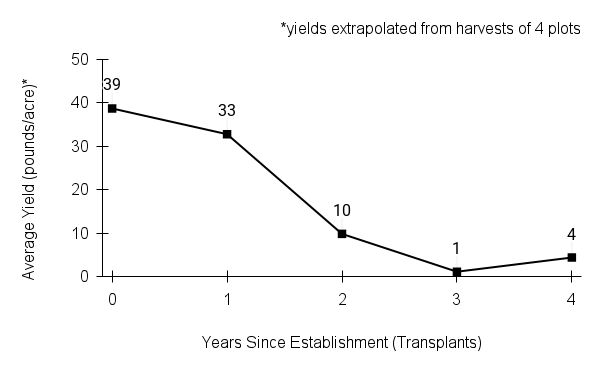 First harvest: Expect abundant flowering and seed set in the establishment year.
Yield/acre: 30-40 pounds per acre during peak yield (extrapolated from harvests of four plots at TPC)
Stand life: Plants are most productive in the establishment year and their second year but decline rapidly thereafter.
Flowering date: late June through early September in northeast Iowa
Seed maturity/harvest date: Late August through early October in northeast Iowa; however, seed maturity may be delayed in the planting year or if plants are mowed in early summer.
Seed retention: High risk of shattering. Fluffy seed disperses from pods as they split open at maturity.
Harvest date range at TPC (2015-2023): August 29 - November 20, though usually completed by early October.
Recommended harvest method: Check fields several times per week during the harvest window and hand pick fruits when nearly mature but not yet open. The pods become lighter and yellower in color and soften as they ripen and pop easily when gently squeezed. Combining should be successful when about 10-20% of the pods in a plot have opened, though we have not attempted this.
- Seed cleaning and storage
Cleaning process: Protect eyes and airways from the abundant fluff that is released during the cleaning process. Large amounts of hand collected pods can be run through a debearder to break up the pods and remove the fluff from the seeds. Pass the material through 1/2 in and 1/4 in mesh to remove larger particles. If possible, do this step outside on a day with a light, steady wind. Finish by airscreening.
Seed storage: cool/dry (33-50° F, 30-50% RH)
Released Germplasm
Source Identified material: Natural Selections/Iowa Ecotype Zone 1 (northern Iowa), Zone 2 (central Iowa)
- References
Borders, B. & Lee-Mäder, E. (2014). Milkweeds, A Conservation Practitioners Guide. Xerces Society for Invertebrate Conservation. https://www.xerces.org/publications/guidelines/milkweeds-conservation-practitioners-guide
Chayka, K. (n.d.). Asclepias verticillata (whorled milkweed). Minnesota Wildflowers. https://www.minnesotawildflowers.info/flower/whorled-milkweed
Cochrane, T. S., Elliot, K., & Lipke, C. S. (2014). Whorled milkweed. In Prairie plants of the University of Wisconsin-Madison Arboretum (3rd ed., p. 59). University of Wisconsin-Madison Arboretum.
Kartesz, J.T., The Biota of North America Program (BONAP). 2023. North American Plant Atlas. (http://bonap.net/napa). Chapel Hill, N.C. [maps generated from Kartesz, J.T. 2023. Floristic Synthesis of North America, Version 1.0. Biota of North America Program (BONAP). (in press)]
Lady Bird Johnson Wildflower Center - The University of Texas at Austin. (2022). Asclepias verticillata. Plant Database. https://www.wildflower.org/plants/result.php?id_plant=asve
NatureServe. 2024. NatureServe Network Biodiversity Location Data accessed through NatureServe Explorer [web application]. NatureServe, Arlington, Virginia. Available https://explorer.natureserve.org/. (Accessed: February 28, 2024).
USDA NRCS National Plant Data Team. (n.d.). Asclepias verticillata L. USDA plants database. https://plants.usda.gov/home/plantProfile?symbol=ASVE
Species Guide Updated 12/23/2025