

winged lythrum
Table of Contents

Lythrum alatum, Pursh
Alternate Common Names: winged loosestrife, wing-angled loosestrife, blue waxweed
Family: loosestrife family (Lythraceae)
Functional Group: forbs (wildflowers)
Description
- Life cycle and growth form
Perennial from a somewhat woody rootstock.
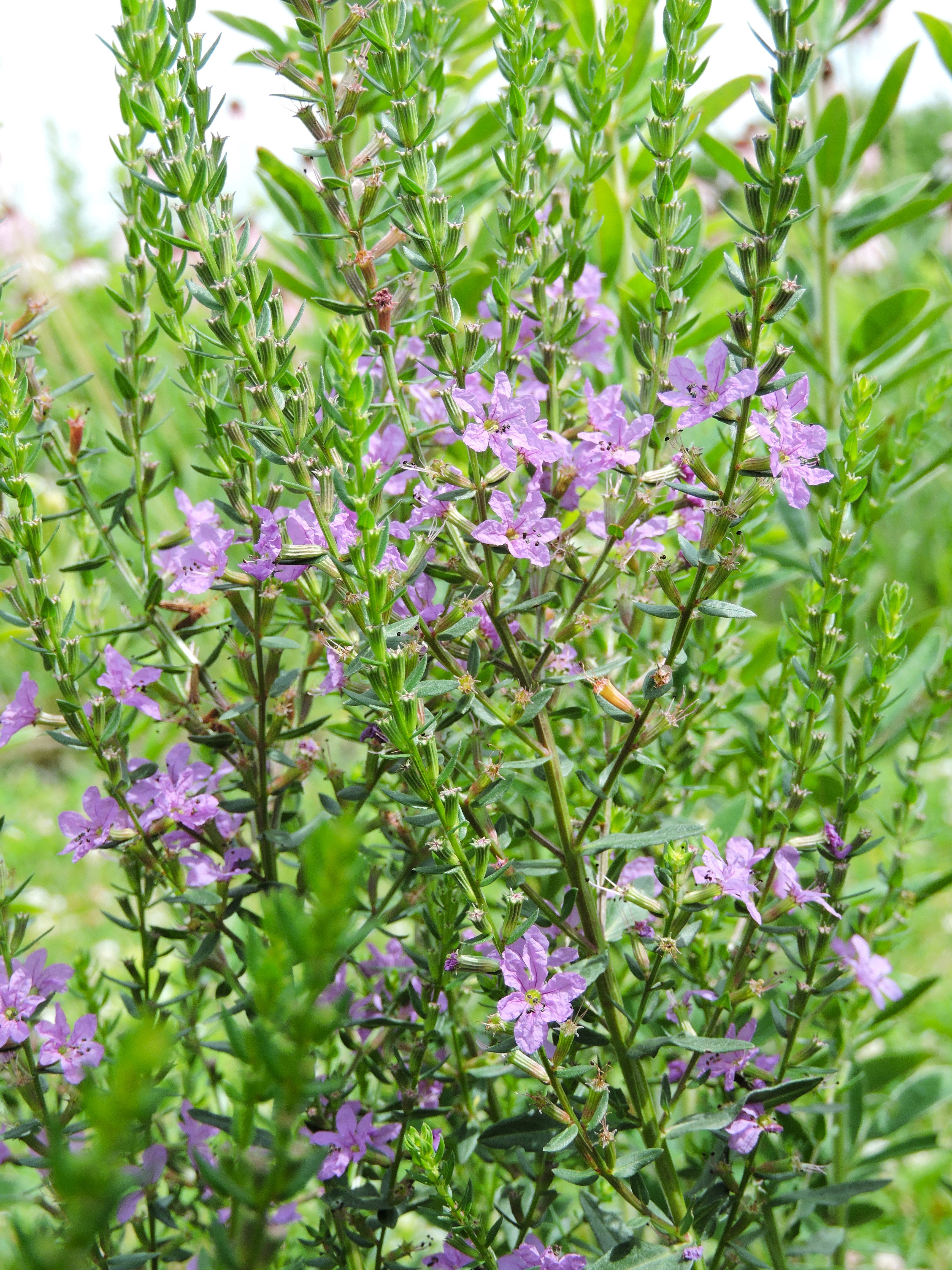
Height: 1 - 4 ft
- Leaves and stem
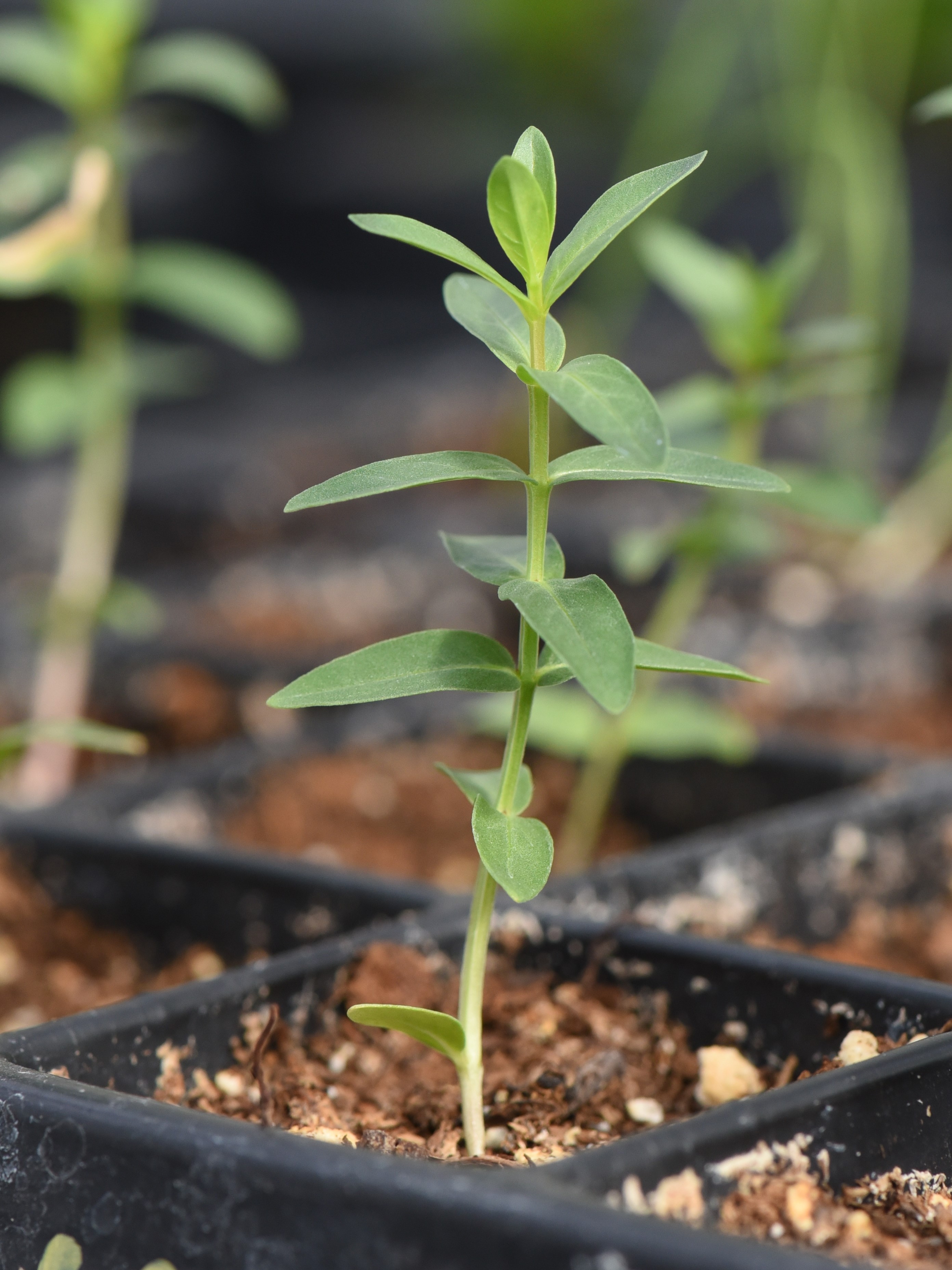
Leaves opposite on the lower half of the stem, becoming alternate in the inflorescence (upper stem); leaves hairless, stalkless, up to 3 1/2 in long and 1/2 in wide (smaller above), lanceolate to oval with rounded bases tapering to a pointed tip; stem is branched, hairless, 4-angled with the edges winged (expanded and flattened).
- Flower, fruit and seedhead
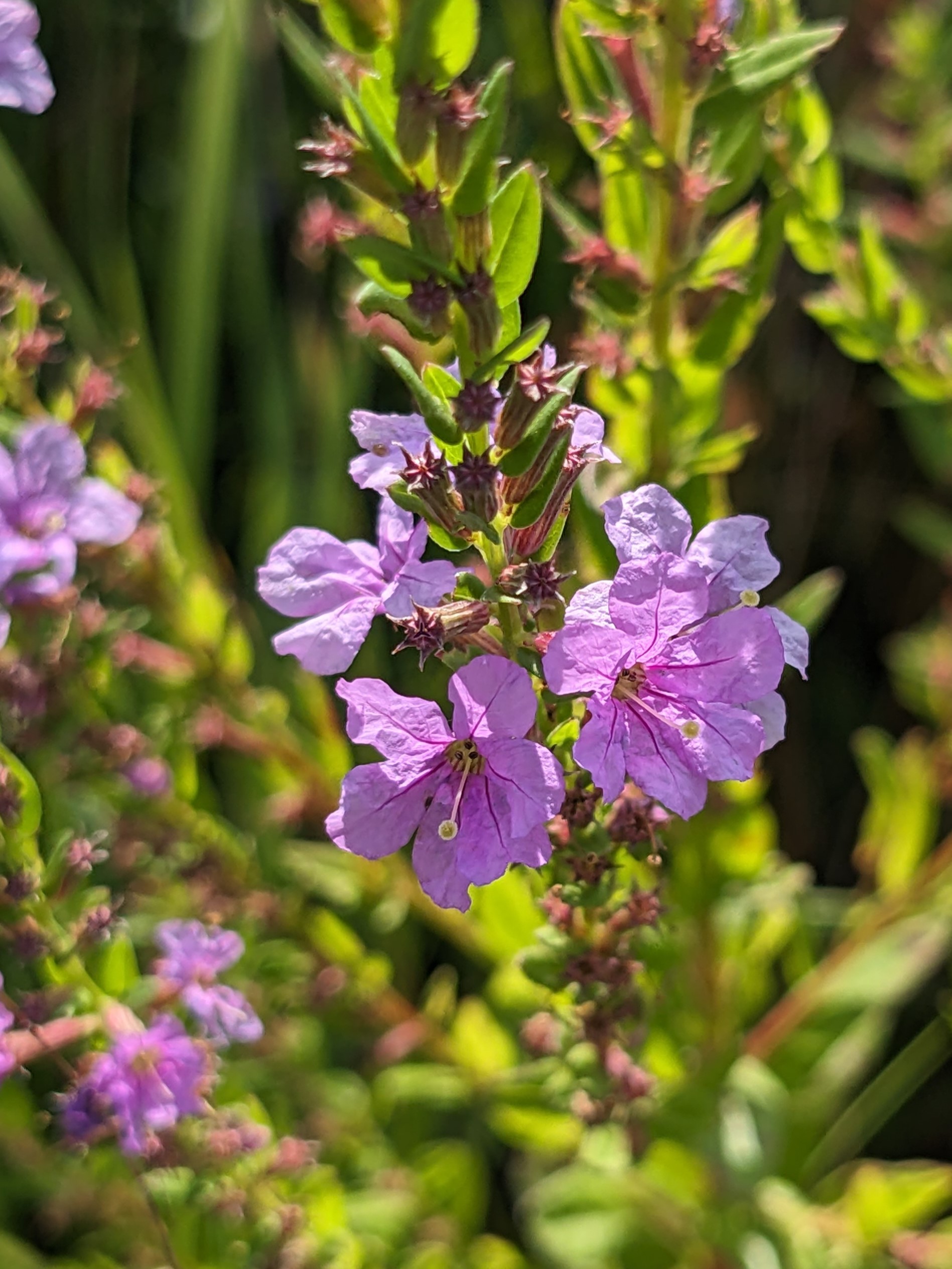
Flower: Flowers in axils of upper stem leaves in spikelike inflorescence up to 1 1/2 ft long; tubular flowers 1/2 in wide, usually 6-parted, lavender to pink; calyx is a persistent, narrow tube with six short, pointed lobes.
Fruit/seed head: Many-seeded, cylindrical capsule matures within the narrow calyx tube.
Pollination: Insects, especially long-tongued bees.
- Seed
Seed characteristics
Seed weight:
Seeds per ounce: 3,000,000 (IA NRCS)
1000 seed weight: 0.05g (Seed Information Database)
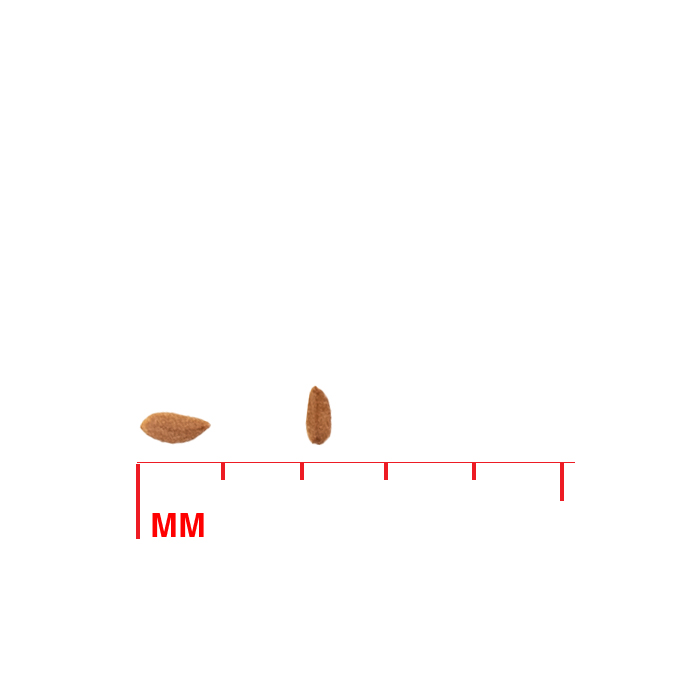
Description: Seed is less than a millimeter long, narrow and light tan in color.
Typical seed test
PLS: 81% (n = 5)
Purity: 86% (n = 5)
Germination: 11% (n = 4)
Dormancy: 60% (n = 4)
(averages obtained from n tests of purchased seed lots)
- Habitat and range
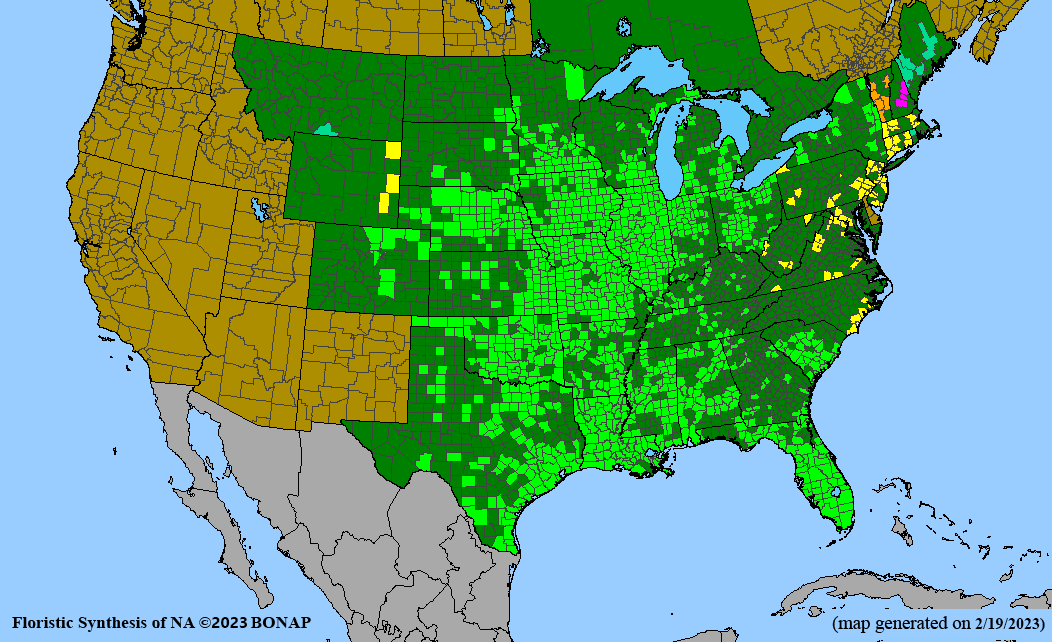
Habitat: Moist to wet soils; part shade to full sun; wet meadows or prairies, marshes, wet roadside ditches; Wetland Indicator Status is Obligate Wetland (OBL) for the Midwest; irrigation is required for seed production.
Conservation status: Global- G5, secure; Connecticut, District of Columbia, Maryland, Massachusetts, Pennsylvania, Vermont, and Wyoming- S1, critically imperiled; Colorado, Virginia, and West Virginia- S2, imperiled; in all other states within its natural range, status is S4 (apparently secure) to S5 (secure) or unranked (NatureServe).
General Comments
Winged lythrum is a native species found in moist to wet prairies, sedge meadows, and wet ditches in Iowa. It should not be confused with purple loosestrife (L. salicaria), an aggressive introduced species that invades wetlands. The flowers of winged lythrum are less densely packed, it is generally a smaller, less conspicuous plant, and its stems have thin, flattened ridges on the edges (winged).
Recommendations for Seed Production
- Establishment for seed production
Direct seeding
Not recommended for this species.
Greenhouse
Seed pre-treatment: Cool/moist stratification for 60 to 90 days.
Sowing: Surface sow in the greenhouse about 2-3 months before the last frost. Use caution when watering to avoid splashing the seed out of the soil.
Transplanting: When seedlings form well-rooted plugs, move them outside to harden off, then transplant at 8-12 in spacing in an irrigated row with plastic mulch.
- Stand management
Weeds: Prepare a clean, weed-free bed prior to planting. Plastic mulch reduces weed pressure in the first year or two. A healthy stand of robust, well branched plants suppresses many weeds. Mow or cultivate between rows. Hand weed or rogue small seeded weeds that could contaminate the seed crop.
Pests: None noted.
Diseases: None noted.
- Seed production
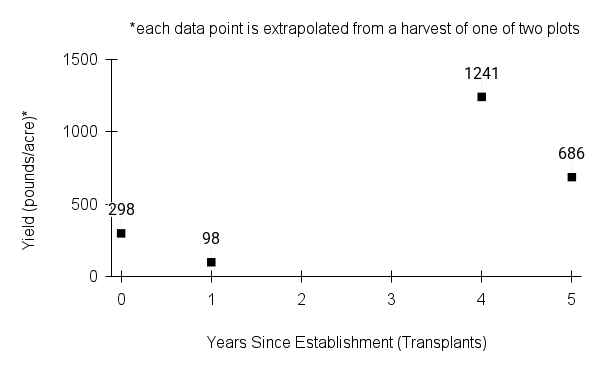 First harvest: Plants flower and set seed in the first year (from transplants).
Yield/acre: 100 - 1200 pounds per acre (This range is based on harvest records of 2 plots. The highest values were extrapolated from harvests of a very small plot. More reasonable estimates are probably in the 300-400 pound range.)
Stand life: Uncertain, but production in one small plot remained high into the 4th and 5th years after transplanting.
Flowering date: late June through September in northeast Iowa
Seed maturity/Harvest date: mid September through late October (later in establishment year)
Seed retention: Moderate risk of shattering. Seed is released from capsules as they open. Plants flower and set seed from the bottom up, so that some seed will be lost from capsules lower on the stem as seed is still maturing higher on the stem.
Harvest date range at TPC (2010-2025): September 10 - October 27
Recommended harvest method: Combine when most plants have more mature fruits than immature. Saving the stems that pass through the combine, drying them for a couple of weeks, and running them through the combine again can yield about 1/4 as much seed as the initial harvest. Check fields frequently in fall as the foliage turns red and senesces. Recall that fruits (capsules) mature within the narrow calyx tubes. Immature capsules are closed at the end and contain wet seeds, but mature capsules are open at the end, and the seed is dry and loose. Capsules closer to the bottom of the plant will be more mature at any point in time.
- Seed cleaning and storage
Cleaning process: Pass combined material through 1/2 in and 1/4 in mesh to remove larger stemmy material, then airscreen repeatedly. The seeds are small enough that some of them pass through the smallest sifting screen we have on hand. We save the sifting fraction and reclean it to keep small, filled seed in the seedlot.
Seed storage: cool/dry (33-50° F, 30-50% RH)
Released Germplasm
Source Identified material: Natural Selections/Iowa Ecotype Zone IOWA
- References
Chayka, K. (n.d.). Lythrum alatum (winged loosestife). Minnesota Wildflowers. https://www.minnesotawildflowers.info/flower/winged-loosestrife
Cochrane, T. S., Elliot, K., & Lipke, C. S. (2014). Winged loosestrife. In Prairie plants of the University of Wisconsin-Madison Arboretum (3rd ed., p. 237). University of Wisconsin-Madison Arboretum.
Graham, S. A. (2022, May 9). Lythrum alatum Pursh. Flora of North America. http://floranorthamerica.org/Lythrum_alatum
Hilty, J. (2019). Winged loosestrife - Lythrum alatum. Illinois Wildflowers. https://www.illinoiswildflowers.info/wetland/plants/wng_loosestrife.htm
Kartesz, J.T., The Biota of North America Program (BONAP). 2023. North American Plant Atlas. (http://bonap.net/napa). Chapel Hill, N.C. [maps generated from Kartesz, J.T. 2023. Floristic Synthesis of North America, Version 1.0. Biota of North America Program (BONAP). (in press)]
NatureServe. 2024. NatureServe Network Biodiversity Location Data accessed through NatureServe Explorer [web application]. NatureServe, Arlington, Virginia. Available https://explorer.natureserve.org/. (Accessed: February 29, 2024).
USDA NRCS National Plant Data Team. (n.d.). Lythrum alatum Pursh. USDA plants database. https://plants.usda.gov/home/plantProfile?symbol=LYAL4
Species Guide Updated 12/29/2025