

closed bottle gentian
Table of Contents
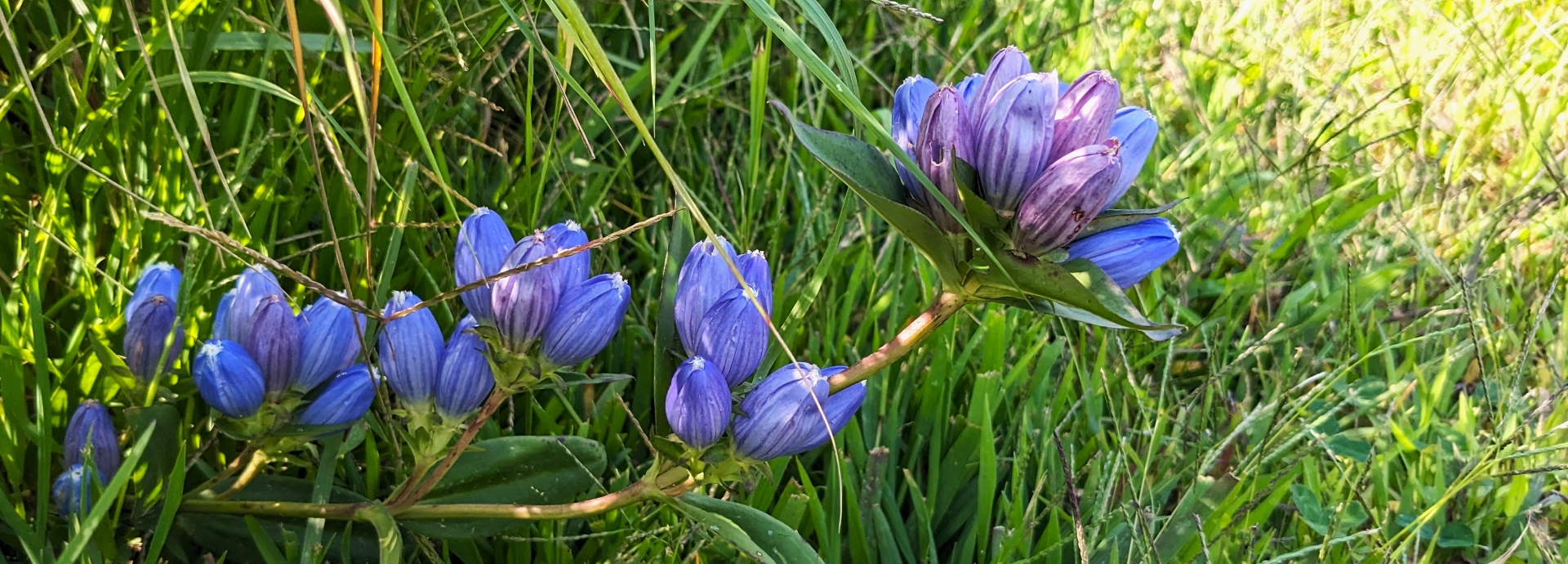
Gentiana andrewsii, Griseb.
Alternate Common Names: bottle gentian, closed gentian, barrel gentian, blind gentian, cloistered gentian, Andrew’s gentian, fringe-top bottle gentian
Family: gentian family (Gentianaceae)
Functional Group: forbs (wildflowers)
Description
- Life cycle and growth form
Perennial from a stout taproot.
Height: 1-2 ft

- Leaves and stem
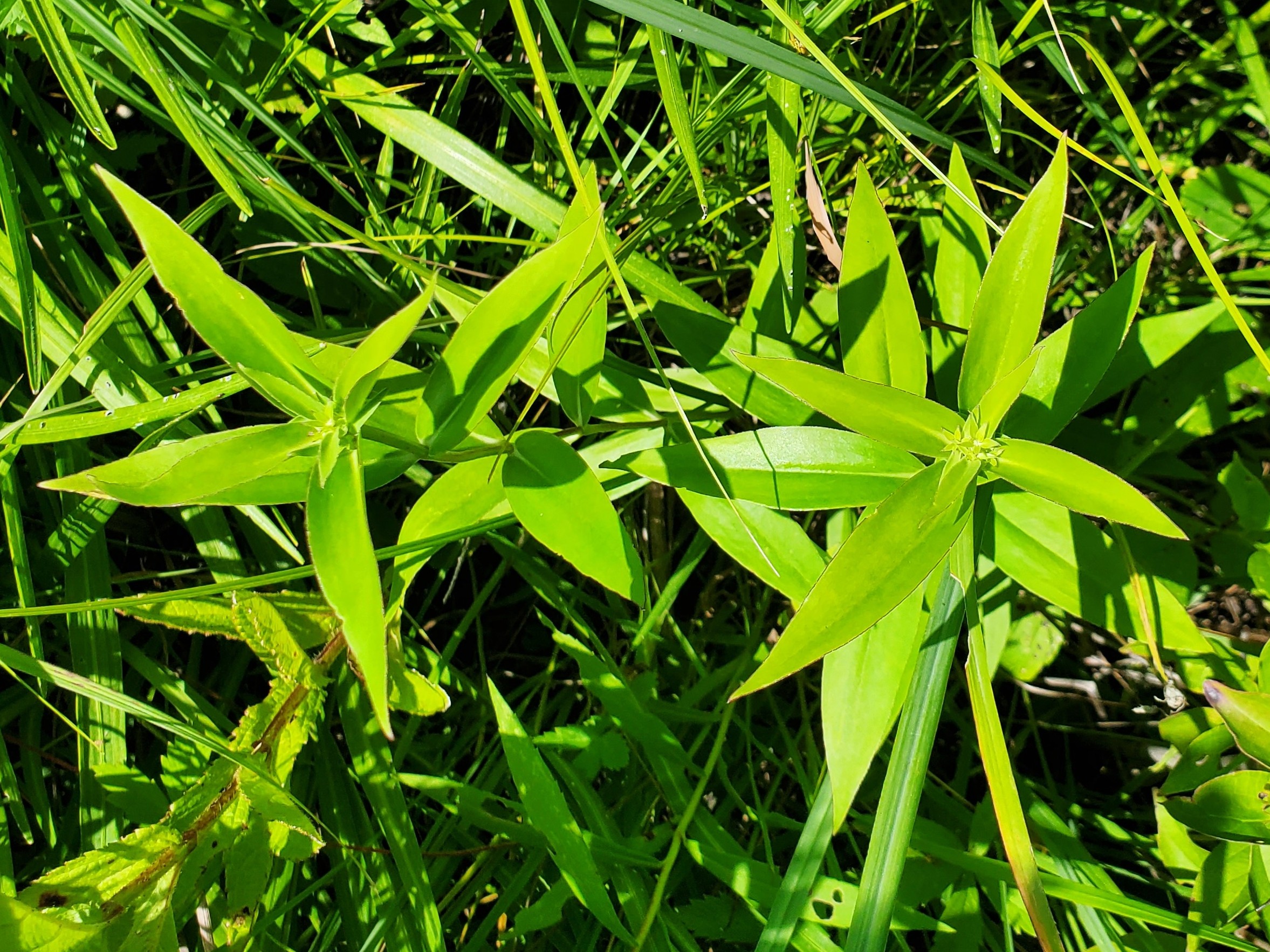
Leaves opposite, lance-shaped, 4 in long and up to 2 in wide, with a smooth margin, glossy and hairless surface, and sessile (stalkless) on the stem but not clasping; stem smooth, light green or purple, unbranched.
- Flower, fruit and seedhead
Flower: Five petals fused into a tube with an elongated, balloon-like shape that never opens, 1 to 1 1/2 in long, violet-blue (occasionally white or pink), in dense clusters at stem ends and upper leaf axils.
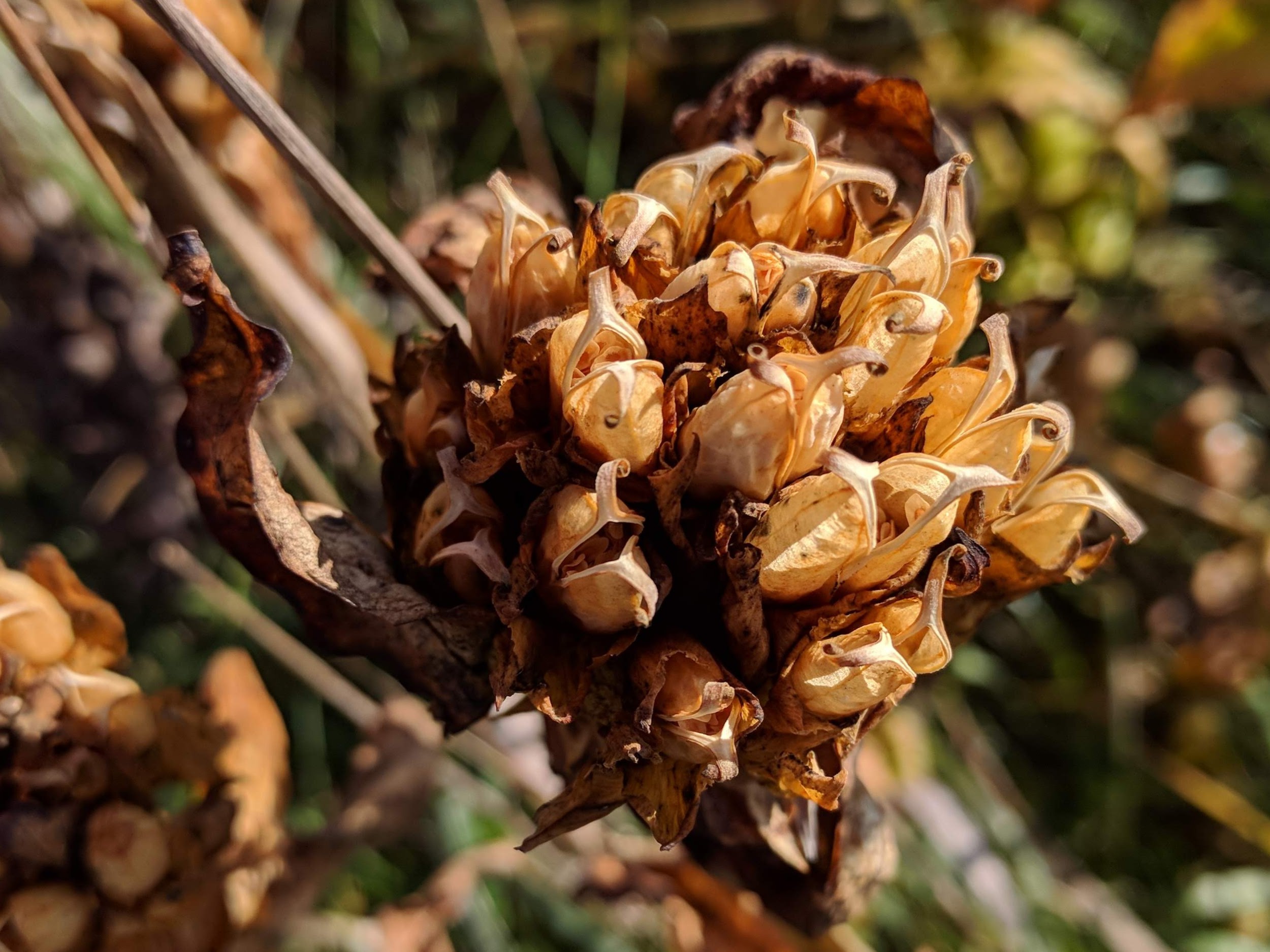
Fruit/seed head: Petals wither but are retained as a sheath around the developing capsule, 1 in long, straw-colored at maturity, with two persistent, curved styles at the tip that protrude from the dried corolla when ripe and a seam that splits along each side when seed matures, releasing numerous tiny, light, winged seeds that are dispersed by wind or water.
Pollination: This species is effectively pollinated only by bumble bees that are strong enough to push their way into the closed, bottle-shaped flowers.
- Seed
Seed characteristics
Seed weight:
Seeds per ounce: 280,000 (IA NRCS)
1000 seed weight: 0.06g (Seed Information Database)
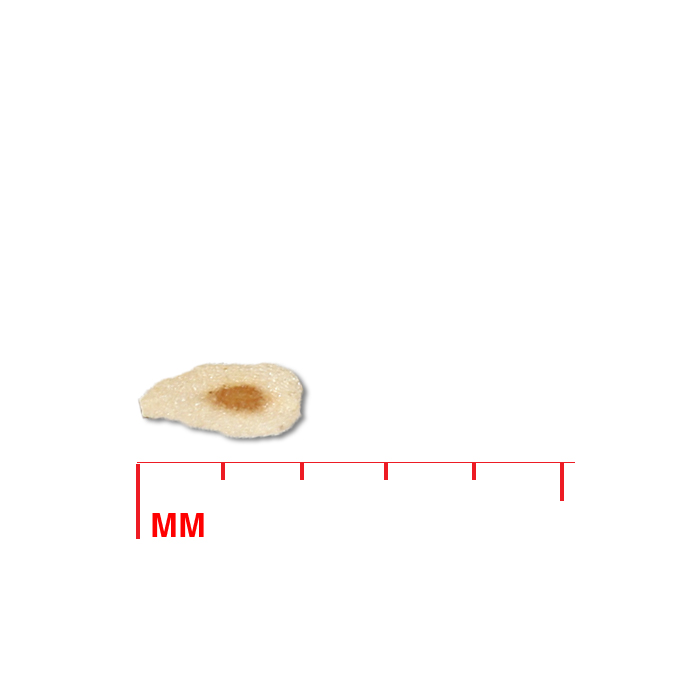
Description: Very tiny, teardrop-shaped golden seeds are surrounded by a flattened pale wing, making them look like miniature fried eggs; inclusive of the wing, they are about 1 mm wide and 2 mm long.
Typical seed test
PLS: 85% (n = 11)
Purity: 85% (n = 10)
Germination: 4% (n = 9)
Dormancy: 82% (n = 9)
(averages obtained from n tests of purchased seed lots)
- Habitat and range
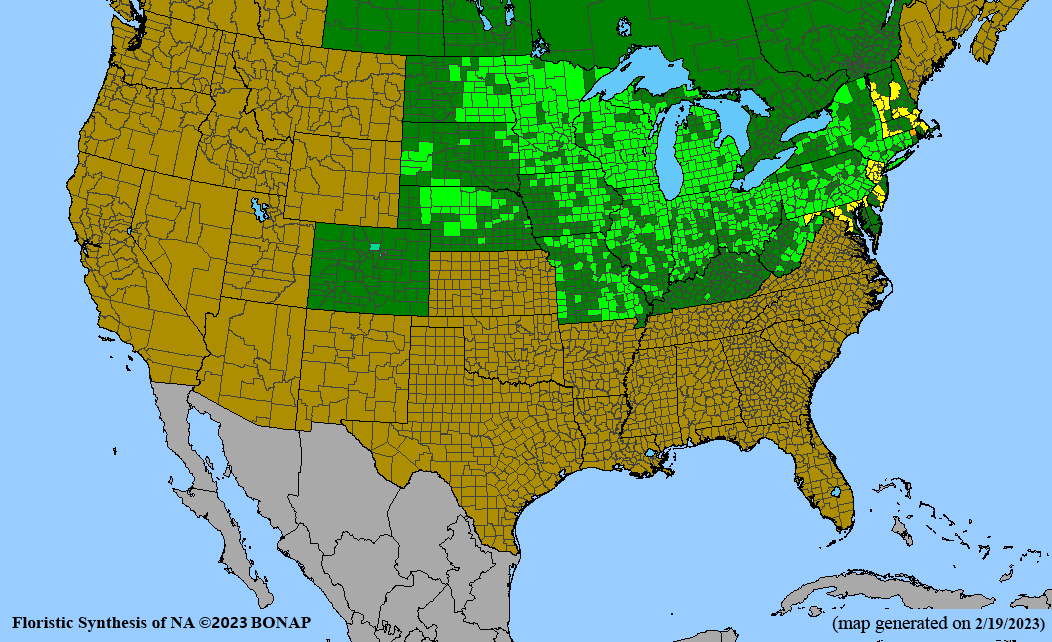
Habitat: Moist soil; partial to full sun; prairies, openings in floodplain forests, thickets, fens; Wetland Indicator Status is Facultative Wetland (FACW) for the Midwest; irrigation is needed for seed production.
Conservation status: Global- G5, secure; Delaware and Massachusetts- S1, critically imperiled; Maryland and Vermont- S2, imperiled; in all other states within its natural range, status is S4 (apparently secure) to S5 (secure) or unranked (NatureServe)
General Comments
One of the most charming plant-insect relationships to observe in the prairie is that between closed bottle gentian and its sole pollinators: bumble bees. Even large, strong bumble bees have to work hard to force their way past the tightly pleated tips of the closed flowers. Smaller bumble bees disappear completely inside the “bottle” while the rear ends of larger bumbles protrude as they feed actively on the nectar inside. This species and other late flowering gentians are important resources for the bumble bee gynes (new females) that emerge in fall and must be well fed to survive the winter and start new colonies in the spring. Closed bottle gentian grows among sedges and grasses in wet prairies and at the edges of fens in our region. Irrigation is needed for seed production.
Recommendations for Seed Production
- Establishment for seed production
Direct seeding
Not recommended for this species.
Greenhouse
Seed pre-treatment: 90 day cold/moist stratification or treat with 125 ppm to 250 ppm GA-3 solution for 24 hours just prior to sowing.
Sowing: Surface sow on saturated potting mix at least 4 months before last frost or expected planting date. Sow directly into plugs (aim for 3-5 seeds per cell) as seedlings are delicate and easily damaged by dibbling. Use caution when watering to avoid splashing seed from soil. Alternatively, seed may be started in phytoagar with 50-60 ppm GA-3 and transplanted to plugs with a small piece of agar left around the root. This method produces high rates of germination. Seeds may otherwise be slow and spotty in germination, and seedlings are always very small and slow growing. If seed in soil germinates poorly, spraying the soil surface with 500 ppm solution of GA-3 can help produce a new flush of seedlings. Be careful when spraying this solution to avoid contaminating surfaces or potting media, as many species are very sensitive to it.
Transplanting: Keep seedlings in plug flats until well-rooted, usually several months. Seedlings started in the greenhouse in spring will remain as rosettes until late summer to early fall, when some seedlings may begin to form leafy stems. At this point, they will still be fairly delicate plugs but should have sufficient root growth to be hand transplanted into irrigated, plasticulture production rows. If planted in fall, some plugs may frost-heave, but if re-seated in their holes in time, they may survive. Walk the rows frequently as the ground thaws, and seat plugs in their holes using a carefully placed boot.
- Stand management
Weeds: Prepare clean, weed-free beds. Plastic mulch suppresses weeds in the first season or two. We have tried planting closed bottle gentian with a wetland grass, bluejoint, to suppress weeds and provide some support and protection from deer. A better companion might be a tufted (cespitose) wetland sedge such as Carex scoparia, as bluejoint spreads by rhizomes to form dense stands that begin to suppress the gentians, except those on the edges of the row, in the third growing season.
Pests: Deer like to eat the flower clusters. Weeds or a companion grass within the plots discourage this. The larvae of a moth (Endothenia hebesana) feed on developing seeds within capsules.
Diseases: None noted.
Hybridization risk: This species is known to hybridize with other species in the genus Gentiana and a related genus (Gentianella quinquefolia). Maintain separation distances between plots of these species.
- Seed production
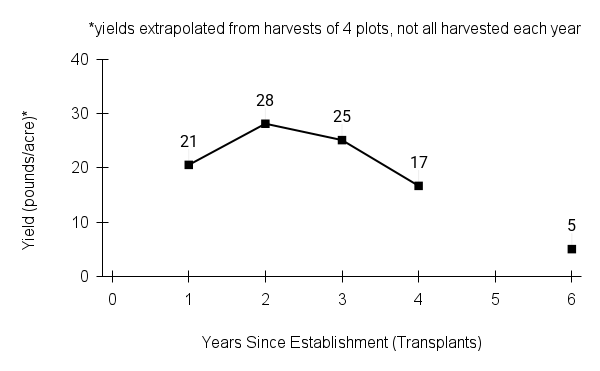 First harvest: Expect the first flowers and seed set in the year after planting. Peak yields are in the second through fourth growing seasons.
Yield/acre: 20-30 pounds per acre of very small, light seed (extrapolated from harvests of four plots at TPC)
Stand life: Stands may persist for six years or more, but yields decline in the fifth year and later.
Flowering date: late August through mid October in northeast Iowa
Seed maturity/Harvest date: late October through early November in northeast Iowa
Seed retention: Fairly high risk of shattering once capsules extend past the dried corolla tube and split open, especially during high wind events. The seeds are very light and easily dispersed.
Harvest date range at TPC (2003-2006): September 9 - November 20
Recommended harvest method: Hand pick as the capsules ripen.
- Seed cleaning and storage
Cleaning process: Shake and/or crush hand collected material to release seeds from capsules, pass through 1/4 in and 1/8 in mesh to remove larger particles, then airscreen. Static buildup can be a problem in handling this seed.
Seed storage: Cool/dry (33-50° F, 30-50% RH); seed apparently lasts only a few years in storage.
Released Germplasm
Source Identified material: Natural Selections/Iowa Ecotype Zone NI (northern Iowa, aligned with the Generalized Provisional Seed Zones of the US Forest Service)
- References
Barnd, B., Hardy, R. Hatfield, M.J., O’Connor, M., Tony, Zimlich, R.L. (2025, February 8) Species Endothenia hebesana - Verbena Bud Moth - Hodges#2738. BugGuide. https://bugguide.net/node/view/132143
Bower, Andrew D.; St.Clair, J. Bradley; Erickson, Vicky. 2014. Generalized provisional seed zones for native plants. Ecological Applications. 24(5): 913-919.
Chayka, K. (n.d.). Gentiana andrewsii (bottle gentian). Minnesota Wildflowers. https://www.minnesotawildflowers.info/flower/bottle-gentian
Cochrane, T. S., Elliot, K., & Lipke, C. S. (2014). Bottle gentian. In Prairie plants of the University of Wisconsin-Madison Arboretum (3rd ed., p. 203). University of Wisconsin-Madison Arboretum.
Hilty, J. (2019). Bottle gentian - Gentiana andrewsii. Illinois Wildflowers. https://www.illinoiswildflowers.info/prairie/plantx/bt_gentianx.htm
Kartesz, J.T., The Biota of North America Program (BONAP). 2023. North American Plant Atlas. (http://bonap.net/napa). Chapel Hill, N.C. [maps generated from Kartesz, J.T. 2023. Floristic Synthesis of North America, Version 1.0. Biota of North America Program (BONAP). (in press)]
NatureServe. 2024. NatureServe Network Biodiversity Location Data accessed through NatureServe Explorer [web application]. NatureServe, Arlington, Virginia. Available https://explorer.natureserve.org/. (Accessed: February 29, 2024).
Runkel, S. T., & Roosa, D. M. (2009). Closed gentian. In Wildflowers of the tallgrass prairie: The upper Midwest (2nd ed., pp. 258–259). University of Iowa Press.
USDA Forest Service and Southern Regional Extension Forestry. (n.d.). Propagation protocol database. RNGR - Reforestation, Nurseries, and Genetic Resources. https://npn.rngr.net/propagation
USDA NRCS National Plant Data Team. (n.d.). Gentiana andrewsii Griseb. USDA plants database. https://plants.usda.gov/home/plantProfile?symbol=GEAN
Species Guide Updated 12/23/2025