

longbract spiderwort
Table of Contents
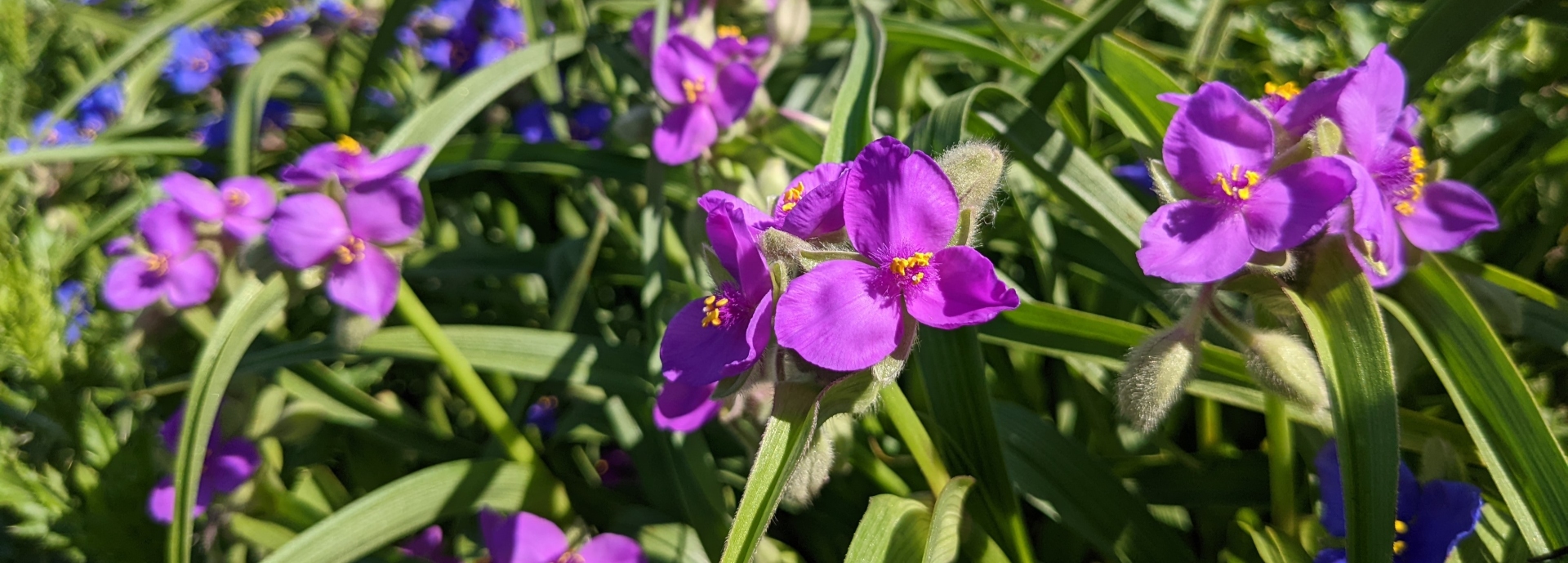
Tradescantia bracteata, Small
Alternate Common Names: spiderwort, prairie spiderwort, bracted spiderwort, long-bracted spiderwort, sticky spiderwort
Family: dayflower and spiderwort family (Commelinaceae)
Functional Group: forbs (wildflowers)
Description
- Life cycle and growth form
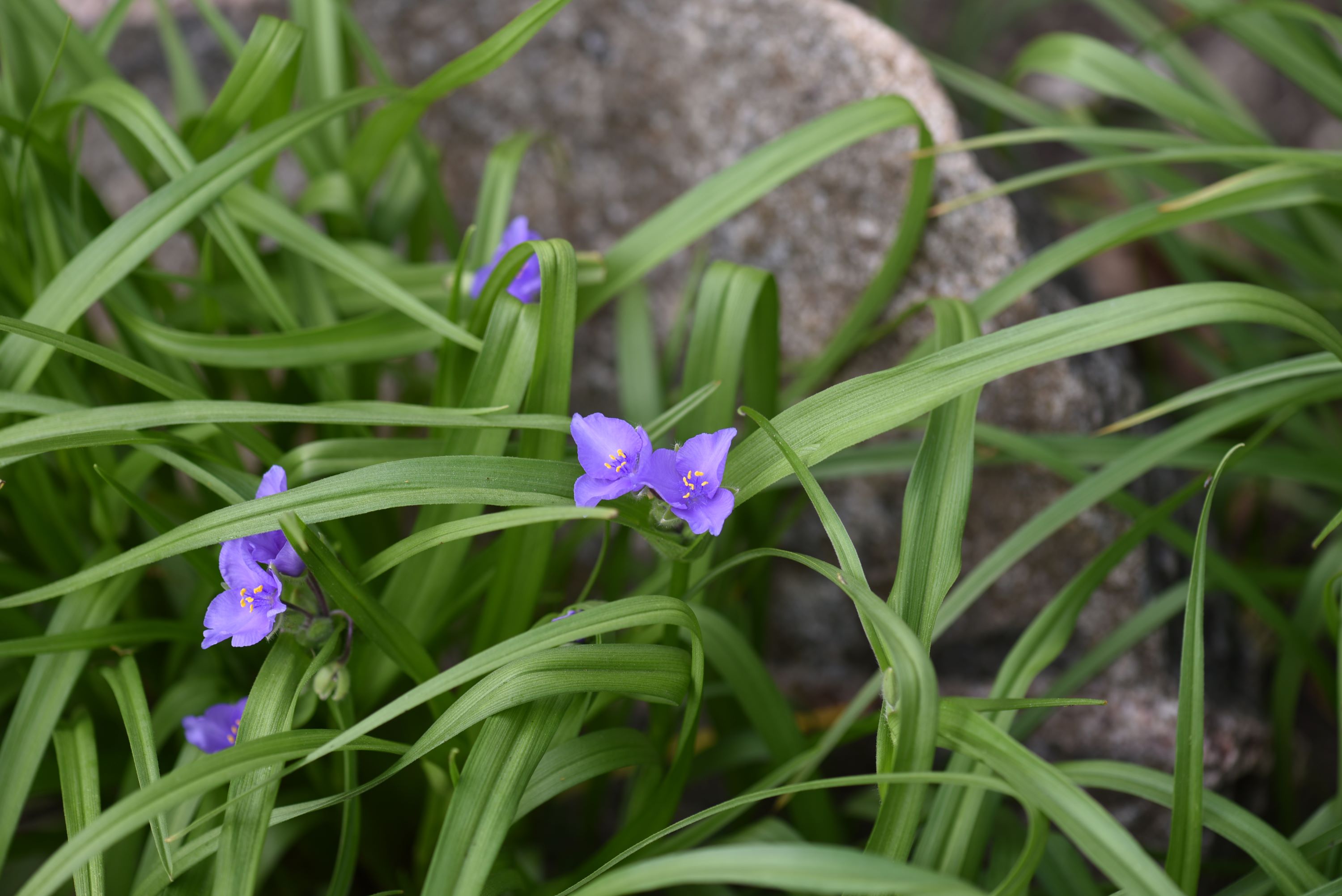
Perennial with fibrous roots, spreading by rhizomes to form colonies.
Height: 1/2-1 1/2 ft
- Leaves and stem
Leaves 4 to 10 in long, floppy, creased at the midvein, with smooth surface (though often with hairs on margins) and parallel veins; base of leaves sheath the stem; stem is smooth, rarely branched; plants form clumps of multiple stems from the base.
- Flower, fruit and seedhead
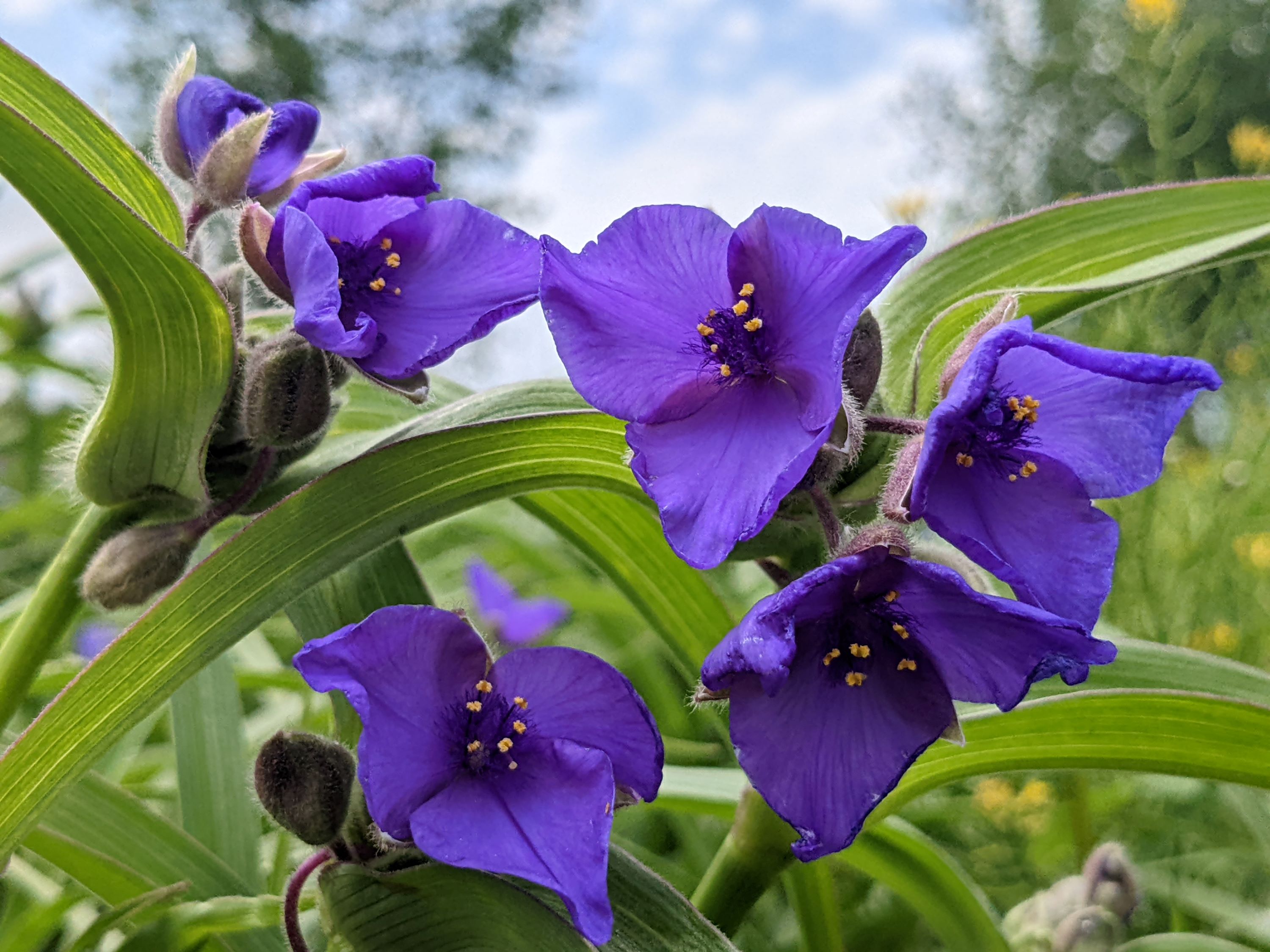
Flower: Flowers in a terminal cluster of few to many flowers (occasionally also in leaf axils) with a prominent pair of bracts at their base as long as the stem leaves; flowers 1 in wide, 3-parted, violet to pink (occasionally white), bearing 6 stamens with hairy filaments and a single blue style; sepals are hairy, distinguishing T. bracteata from T. ohiensis (bluejacket or Ohio spiderwort); each flower blooms for one day (generally fading after morning), but flowering is staggered within a cluster; the hairy stalk supporting each flower stands up when flowering but droops once blooming is done.
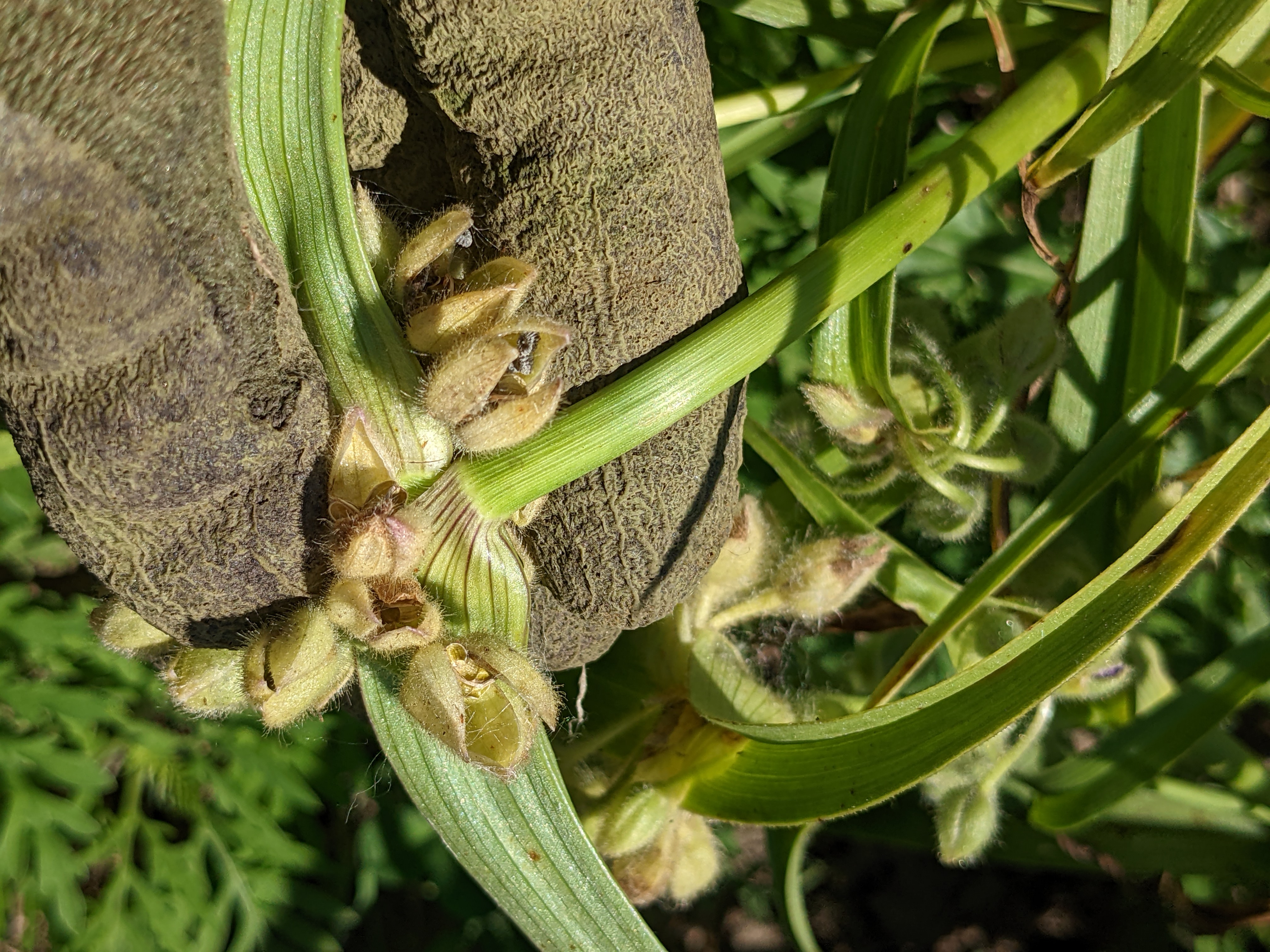
Fruit/seed head: Seed capsules are 3-celled and 1/4 in long, obovoid shape, developing within the persistent hairy sepals; splitting open at maturity to release 2-6 seeds.
Pollination: Insects, primarily bees and flower flies (syrphids).
- Seed
Seed characteristics
Seed weight:
Seeds per ounce: 10,000 seeds/oz (IA NRCS)
1000 seed weight: 3.12g (Seed Information Database)
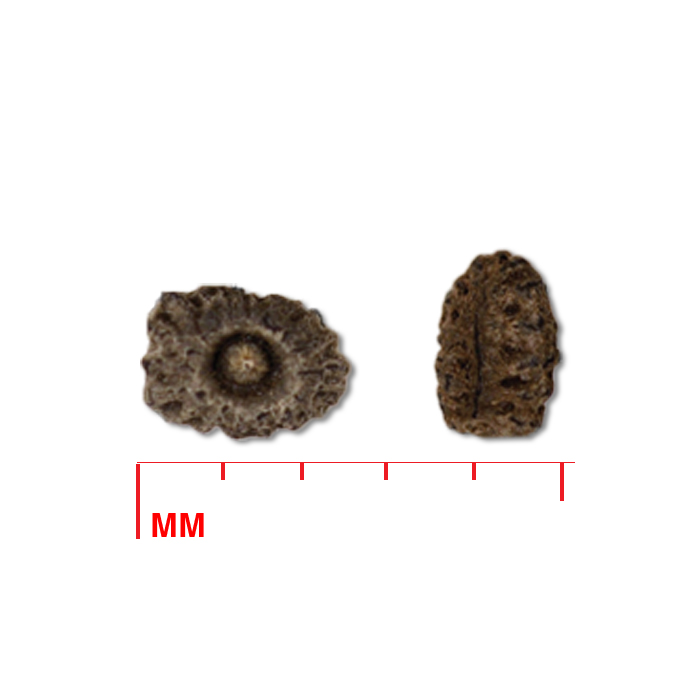
Description: Seeds dark gray (sometimes tan), oblong in outline with a dimple on one side and complex, grooved surface texture; 2-3 mm long and 1.5 mm wide.
Typical seed test
PLS: 88% (n = 11)
Purity: 95% (n = 11)
Germination: 7% (n = 10)
Dormancy: 85% (n = 10)
(averages obtained from n tests of purchased seed lots)
- Habitat and range
Habitat: Dry to mesic soil; full sun; sand prairies, black soil prairies, woodland edges, along railroads, roadsides; Wetland Indicator Status is Facultative Upland (FACU) for the Midwest; well-drained loamy soils are recommended for seed production.
Conservation status: Global- G5, secure; Michigan- SX, presumed extirpated; Wyoming- S1, critically imperiled; Arkansas and Illinois- S2, imperiled; in all other states within its natural range, status is S4 (apparently secure) to S5 (secure) or unranked. (NatureServe)

General Comments
This is an attractive, early flowering species that persists through vegetative spread and reseeding in both high quality prairies and in somewhat disturbed areas. The flowers produce pollen but no nectar, hence they are visited primarily by bees that use pollen to provision their larvae or by syrphid flies that feed directly on pollen. Once the seed matures, the above ground parts of the plants wither and plants remain dormant until the next growing season, although small shoots may emerge in fall. This species is distinguished from similar species in our region by having glandular hairs on both sepals and flower stalks and prominent bracts under the inflorescences that are as long and wide as the stem leaves. Bracted spiderwort is generally a smaller plant than T. ohiensis (bluejacket or Ohio spiderwort) and can spread vegetatively to form large colonies, while bluejacket is more clumped.
Recommendations for Seed Production
- Establishment for seed production
Direct seeding
We do not have experience with direct seeding this species for seed production.
Greenhouse
Seed pre-treatment: At least 90 days cold stratification.
Sowing: Sow about 1/4 inch deep in the greenhouse about 2 months before the last frost date.
Transplanting: When plugs are well rooted, take them outside to harden off for a week or two, then transplant in rows suitable for cultivation or at 8-12 inch intervals in plastic mulch.
- Stand management
Weeds: Prepare a clean, weed-free bed. Plastic mulch suppresses weeds in the establishment year but should be removed in subsequent years to allow vegetative spread. Mow or cultivate between rows. This species appears to be fairly intolerant of competition from weeds. Planting in rows between sheets of landscape fabric might facilitate harvest by allowing capture of seed that drops as it matures, but we have not tried this.
Pests: None noted.
Diseases: None noted.
Hybridization risk: This species is known to hybridize with other members of the genus Tradescantia such as T. ohiensis (bluejacket or Ohio spiderwort). Maintain separation distances between plots of these species.
- Seed production
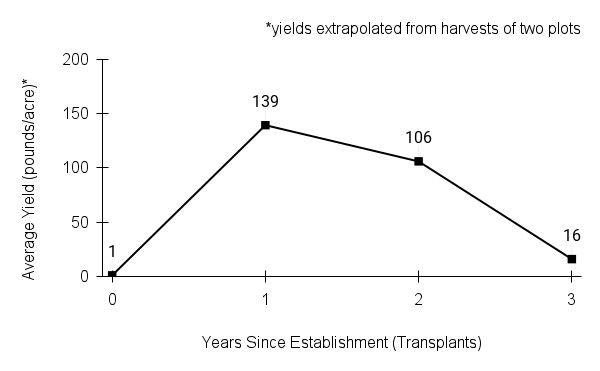 First harvest: Expect very little flowering and seed set in the first year. Peak yields occur in year 2 and/or 3.
Yield/acre: 100-140 pounds per acre in year 2 to year 3 (extrapolated from harvests of two plots at TPC)
Stand life: Productive stand life is 3-4 years. Yields begin to decline in year 3 or 4 and after.
Flowering date: mid May to mid June in northeast Iowa
Seed maturity/Harvest date: late June to early July in northeast Iowa
Seed retention: High risk of shattering. Seed drops from the plant as each capsule matures. There is no perfect way to time the harvest. Observe plants frequently as typical harvest dates approach. Turn over seedheads and look for dry, brown, open capsules among the hairy sepals. Plan to harvest when there are some mature capsules on most plants. If whole stalks are collected, capsules will continue to mature and release seed as they dry. If planted in rows between sheets of landscape fabric, it’s possible that dropped seed could be swept or vacuumed from the fabric.
Harvest date range at TPC (2003-2022): June 24 - July 22
Recommended harvest method: When most plants have some mature capsules in their seed heads, cut entire stalks and lay on tarp to dry. Provide ventilation and turn thick piles regularly to avoid mold growth. Seed will be released onto tarp as capsules mature and can then be easily screened from the dry stalks.
- Seed cleaning and storage
Cleaning process: Pass material through 1/2 inch mesh to remove dried stalks, then airscreen.
Seed storage: cool/dry (33-50° F, 30-50% RH)
Released Germplasm
Source Identified material: Natural Selections/Iowa Ecotype Zone 2 (central Iowa)
- References
Chayka, K. (n.d.). Tradescantia bracteata (long-bracted spiderwort). Minnesota Wildflowers. https://www.minnesotawildflowers.info/flower/long-bracted-spiderwort
Hilty, J. (2019). Prairie spiderwort - Tradescantia bracteata. Illinois Wildflowers. https://www.illinoiswildflowers.info/prairie/plantx/pr_spiderwort.htm
Kartesz, J.T., The Biota of North America Program (BONAP). 2023. North American Plant Atlas. (http://bonap.net/napa). Chapel Hill, N.C. [maps generated from Kartesz, J.T. 2023. Floristic Synthesis of North America, Version 1.0. Biota of North America Program (BONAP). (in press)]
NatureServe. 2024. NatureServe Network Biodiversity Location Data accessed through NatureServe Explorer [web application]. NatureServe, Arlington, Virginia. Available https://explorer.natureserve.org/. (Accessed: February 29, 2024).
USDA NRCS National Plant Data Team. (n.d.). Tradescantia bracteata Small. USDA plants database. https://plants.usda.gov/home/plantProfile?symbol=TRBR
Species Guide Updated 12/22/2025