

fourflower yellow loosestrife
Table of Contents
Lysimachia quadriflora Sims
Alternate Common Names: four-flower yellow loosestrife, linear-leaf loosestrife, prairie loosestrife
Scientific Synonyms: Lysimachia longifolia Pursh; L. revoluta Nuttall; Nummularia longifolia (Pursh) Kuntze; Steironema longifolium (Pursh) Rafinesque; S. quadriflorum (Sims) Hitchcock
Family: myrsine family (Myrsinaceae), formerly classified in the primrose family (Primulaceae)
Functional Group: forbs (wildflowers)
Description
- Life cycle and growth form
Perennial with sprawling stems that are often supported by surrounding vegetation, spreading slowly from short rhizomes to form clumps of several stems.
Height: 1-2.5 ft

- Leaves and stem
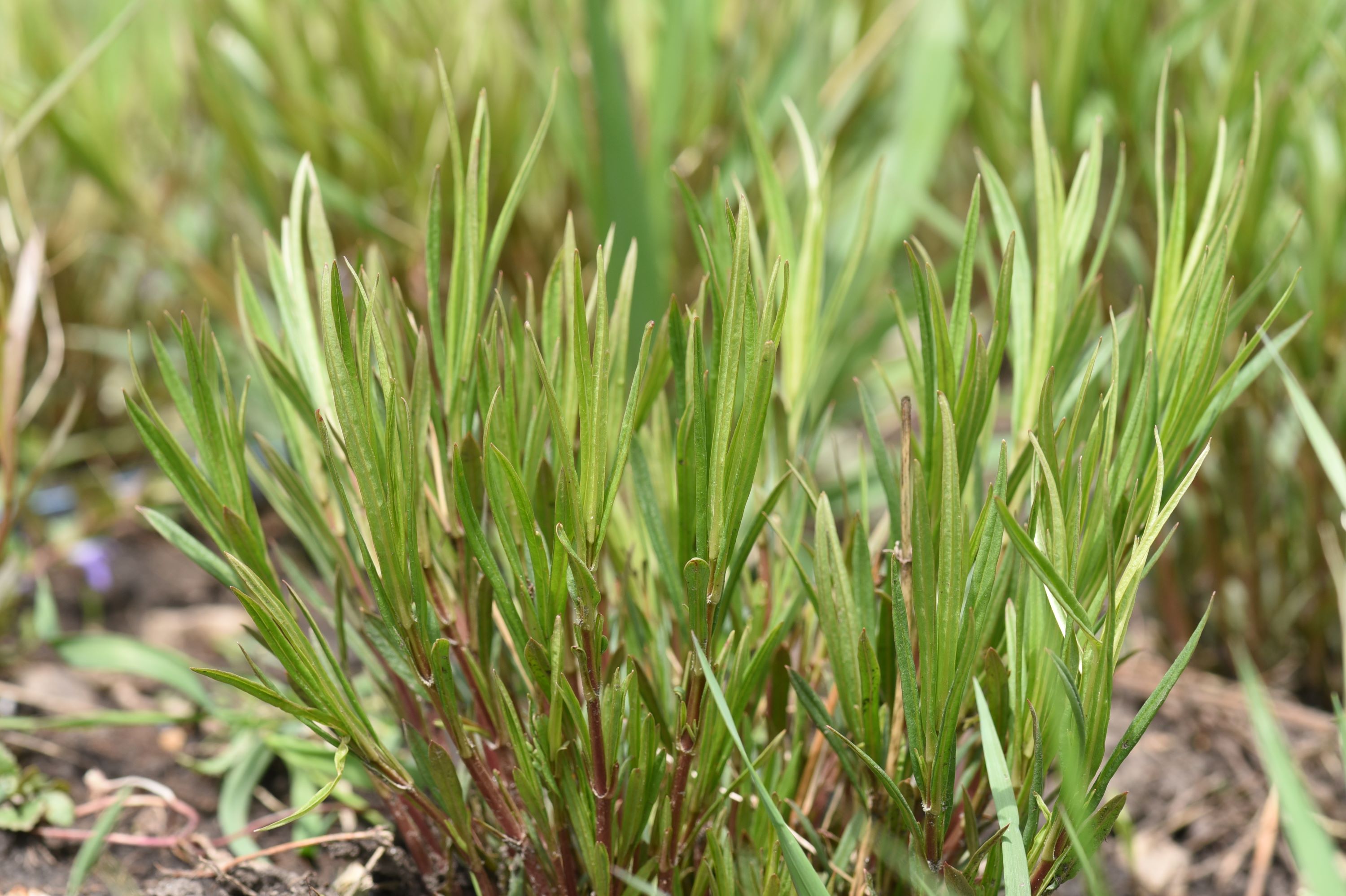
Leaves very narrow (linear), 1 1/4 to 3 1/2 in long and only up to 1/4 in wide, opposite and often with smaller secondary leaves at nodes making them appear whorled, leaves glossy and mostly hairless, often turning red in fall; stems smooth and unbranched or branching in the top half of the plant.
- Flower, fruit and seedhead
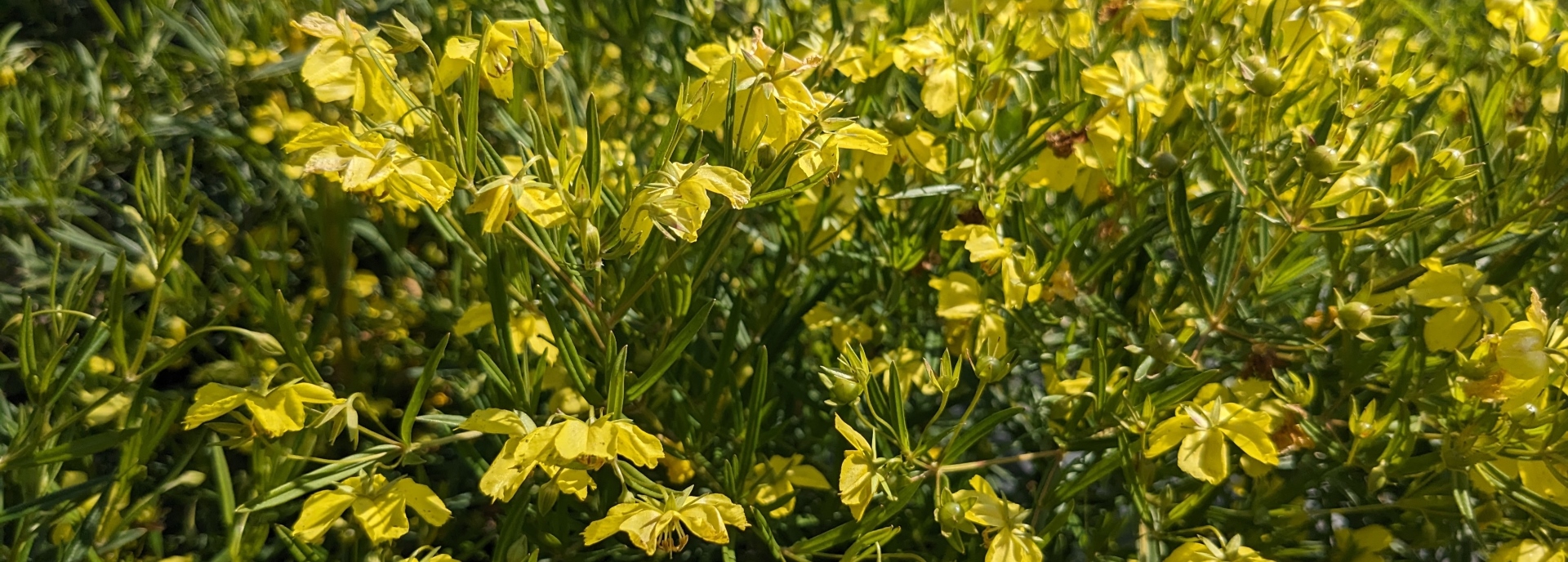
Flower: Flowers regular, 1-in wide, 5-parted, nodding on slender petioles, emerging singly or in loose clusters of up to 4 flowers from upper leaf axils; petals bright yellow, often with ragged edges and faint reddish streaks or spots.
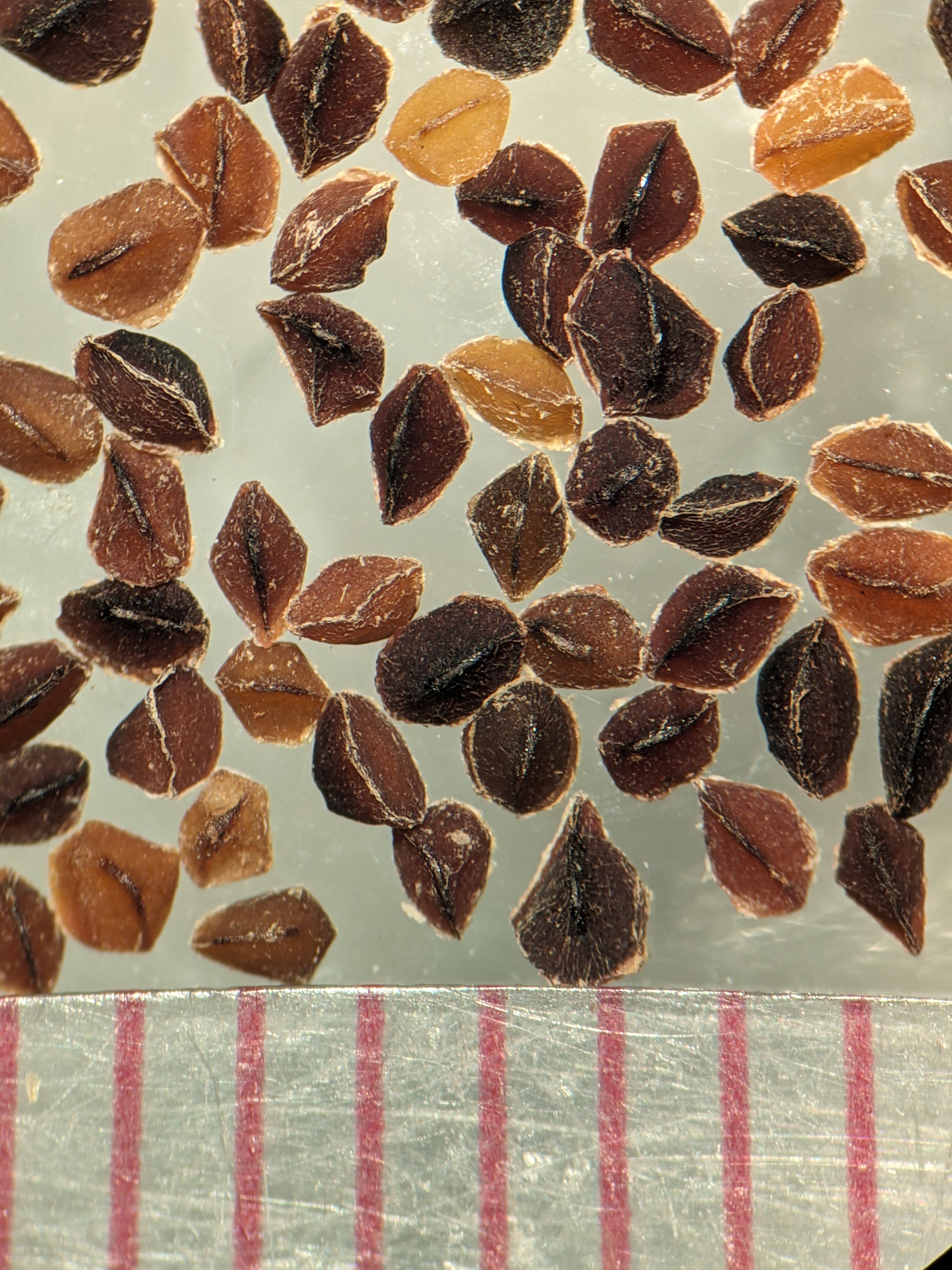
Fruit/seed head: Fruit is a nearly spherical, glossy capsule with a persistent point (the style), opens from the top at maturity and seed scatters out as the plant is shaken by the wind or passing animals.
Pollination: Insects, including generalist and specialist bees.
- Seed
Seed characteristics
Seed weight:
Seeds per ounce: 90,000 (IA NRCS)
1000 seed weight: 0.28 g (Seed Information Database)
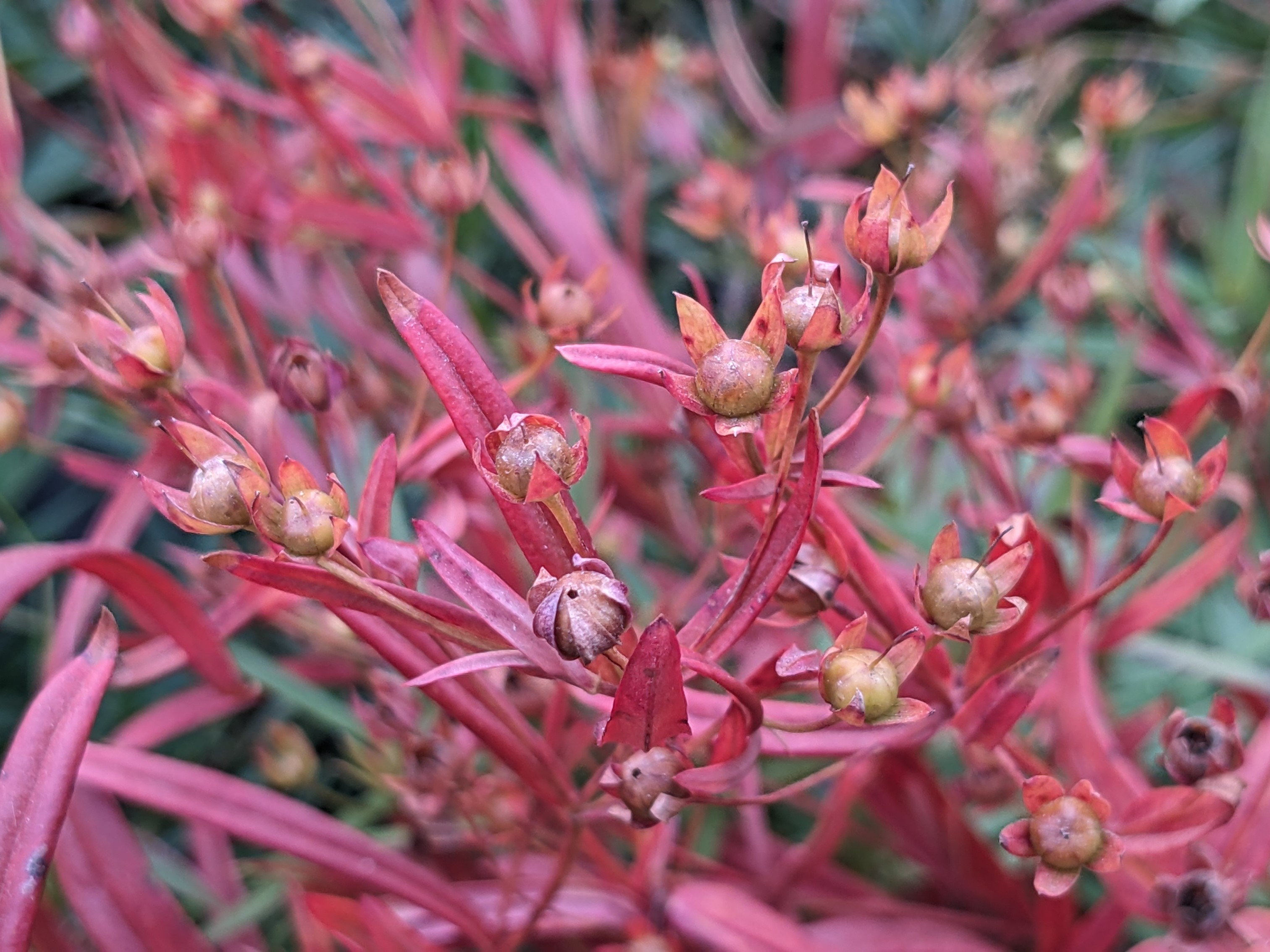
Description: Seeds 1-1.5 mm long, 3-sided, irregular in outline, concave on one side, dark or reddish brown, with a rough surface texture. Seed image includes ruler with mm markings.
Typical seed test
PLS: 90% (n=3)
Purity: 93% (n=3)
Germination: 0.33% (n=3)
Dormant: 97% (n=3)
(averages obtained from 3 tests of purchased seed lots)
- Habitat and range
Habitat: Moist to wet soils in full sun; wet prairies, fens, seeps, ditches; Wetland Indicator Status is OBL (obligate, almost always occurring in wetlands) in the Midwest; irrigation is needed for seed production.
Conservation status: Global- G5 (secure); Kentucky, West Virginia- SH (possibly extirpated); Alabama, Georgia- S3 (vulnerable); South Dakota, Oklahoma, Tennessee, New York, Virginia- S1 (critically imperiled); in all other states in its native range, status is S4 (apparently secure) to S5 (secure) or unranked (NatureServe)
[BONAP Map]
General Comments
If we want planted prairies to better resemble remnant prairies in their diversity and species composition, fourflower yellow loosestrife is a species that should be considered for wet soils. It can be found in most wet prairies, sedge meadows, seeps, and fens in our area and even in some wet ditches where native vegetation has persisted. This species is inconspicuous due to its size except when in flower or when the foliage turns red in the fall. It can be easily distinguished from other members of its genus in our region by its very thin (linear) leaves that are only up to about 1/4 in wide. The relatively weak, slender stems of fourflower yellow loosestrife seem to lean on taller grasses, sedges, and forbs for support, and some of the plants may sprawl a bit in production settings. The nodding, intensely yellow flowers produce oils rather than nectar and are visited by specialist bees that use the oils, mixed with pollen, to provision their larvae, as well as by generalist bees that use pollen.
Recommendations for Seed Production
- Establishment for seed production
Direct seeding
We do not have experience with direct seeding this species for seed production.
Greenhouse
Seed pre-treatment: 90 days cold/moist stratification
Sowing: Surface sow in greenhouse 3 months before last frost free date. Use caution in watering to avoid splashing small seeds from soil. Seeds may be slow and irregular in germination, but keeping germination flats saturated (in a tray of standing water) may improve germination.
Transplanting: When plugs are well rooted, place them outside to harden off, then transplant at 8-12 in spacing in irrigated rows with plastic mulch.
- Stand management
Weeds: Prepare clean, weed free beds. Use plastic mulch to suppress weeds in the first year or two. Mow or cultivate between rows. Hand weed or rogue out small seeded weeds or large, competitive weeds.
Pests: None noted.
Diseases: None noted.
- Seed production
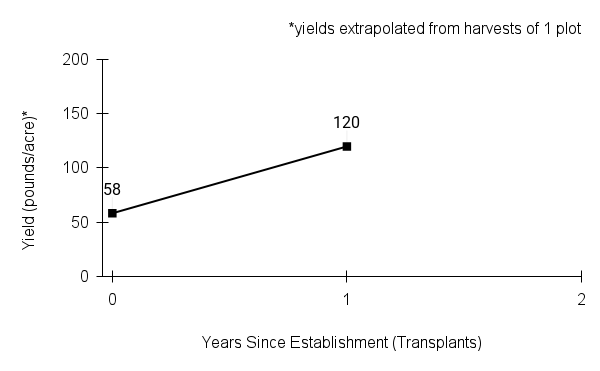 First Harvest: Some flowering and seed set in the first growing season from transplants. Yield doubled the following year.
Yield/Acre: 60-120 pounds per acre (extrapolated from harvests of one plot)
Stand Life: Unknown at this time, but productive stand life is probably 3-5 years. Invasion of the plots by weed species that benefit from irrigation may be a primary cause of decline.
Flowering Date: mid June through August in northeast Iowa
Seed Maturity/Harvest Date: late September to mid October
Seed retention: Moderate risk of shattering though some seed is retained in capsules into late October.
Harvest date range at TPC (2024-2025): Sept 26 - Oct 14
Recommended Harvest Method: Combine and hand. Uneven ripening in the field presents a challenge. Observe plot frequently when the plants begin turning red in the fall and watch for open capsules. Consider harvesting when about 10-20% of the capsules are open. Crush some of the closed capsules and observe for dark colored (maturing) seed. Hand harvesting early individuals is recommended, and stems with capsules that are immature and pass through the combine can be collected and allowed to dry, and this later maturing seed can be threshed with a stationary combine. These methods can help retain diversity in the timing of flowering and fruiting in the restoration seed supply.
- Seed cleaning and storage
Cleaning process: Pass combined material through 1/2 in and 1/4 in screens, then airscreen repeatedly.
Seed storage: Cool/dry (33-50° F, 30-50% RH); long term viability in storage unknown at this time.
Released Germplasm
Source Identified material: Natural Selections/Iowa Ecotype Zone NI (aligned with the Generalized Provisional Seed Zones of the US Forest Service)
- References
Bower, Andrew D.; St.Clair, J. Bradley; Erickson, Vicky. 2014. Generalized provisional seed zones for native plants. Ecological Applications. 24(5): 913-919.
Cholewa, A.F., Pipoly J.J. III, Ricketson, J.M. (n.d.). Myrsinaceae R. Brown. Flora of North America. http://www.efloras.org/florataxon.aspx?flora_id=1&taxon_id=10598
Chayka, K. (n.d.). Lysimachia quadriflora (Prairie Loosestrife). Minnesota Wildflowers. https://www.minnesotawildflowers.info/flower/prairie-loosestrife
Hilty, J. (2019). Prairie Loosestrife, Lysimachia quadriflora. Illinois Wildflowers. https://www.illinoiswildflowers.info/wetland/plants/pr_loosestrife.html
Kartesz, J.T., The Biota of North America Program (BONAP). 2023. North American Plant Atlas. (http://bonap.net/napa). Chapel Hill, N.C. [maps generated from Kartesz, J.T. 2023. Floristic Synthesis of North America, Version 1.0. Biota of North America Program (BONAP). (in press)]
NatureServe. 2024. NatureServe Network Biodiversity Location Data accessed through NatureServe Explorer [web application]. NatureServe, Arlington, Virginia. Available https://explorer.natureserve.org/. (Accessed: December 18, 2025).
Society for Ecological Restoration, International Network for Seed Based Restoration and Royal Botanic Gardens Kew. (2023) Seed Information Database (SID). Available from: https://ser-sid.org/ (February 2023)
USDA-NRCS. (2024). Native seeding calculator 2024 [Excel File]. Retrieved from https://efotg.sc.egov.usda.gov/#/state/IA/documents/section=4&folder=-6
USDA NRCS National Plant Data Team. (n.d.). Lysimachia quadriflora Sims, fourflower yellow loosestrife. USDA plants database. https://plants.usda.gov/plant-profile/LYQU
Species Guide Updated 12/19/2025