

button eryngo
Table of Contents
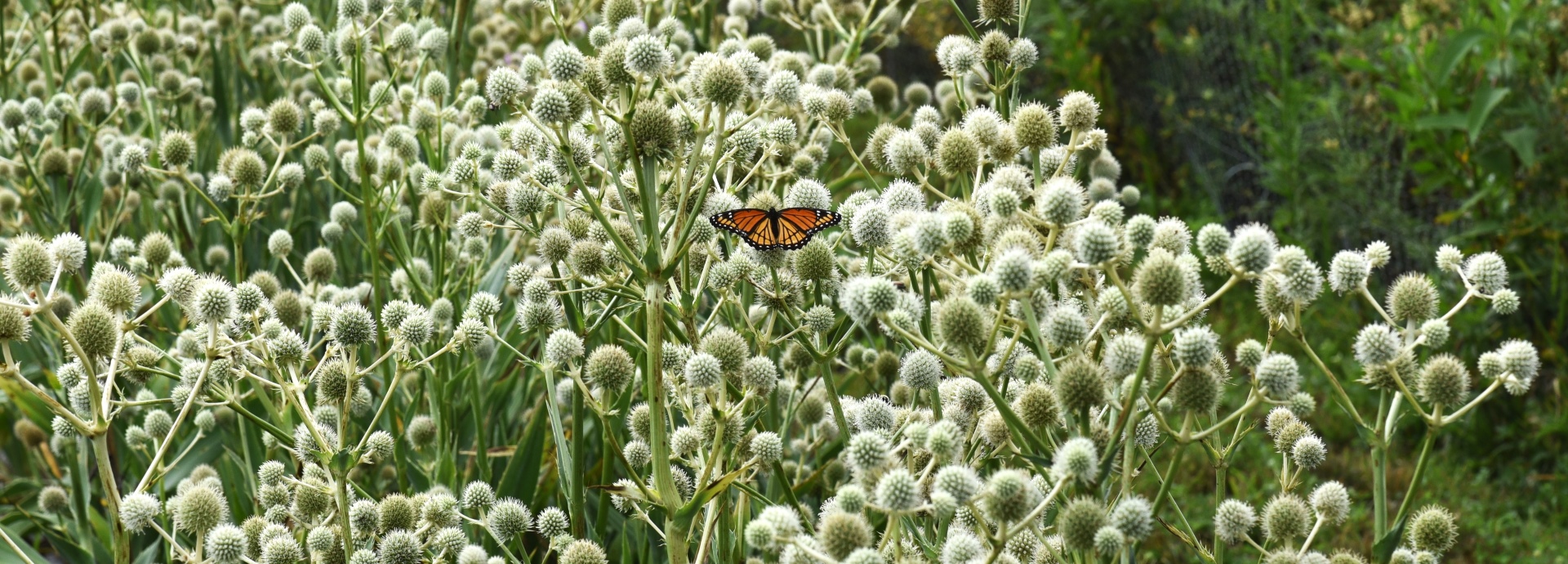
Eryngium yuccifolium Michx.
Alternate Common Names: button snakeroot, rattlesnake master, rattlesnake-master, yucca-leaf eryngo, corn snakeroot, water-eryngo, rattlesnake flag, rattlesnake weed
Family: carrot family (Apiaceae)
Functional Group: forbs (wildflowers)
Description
- Life cycle and growth form
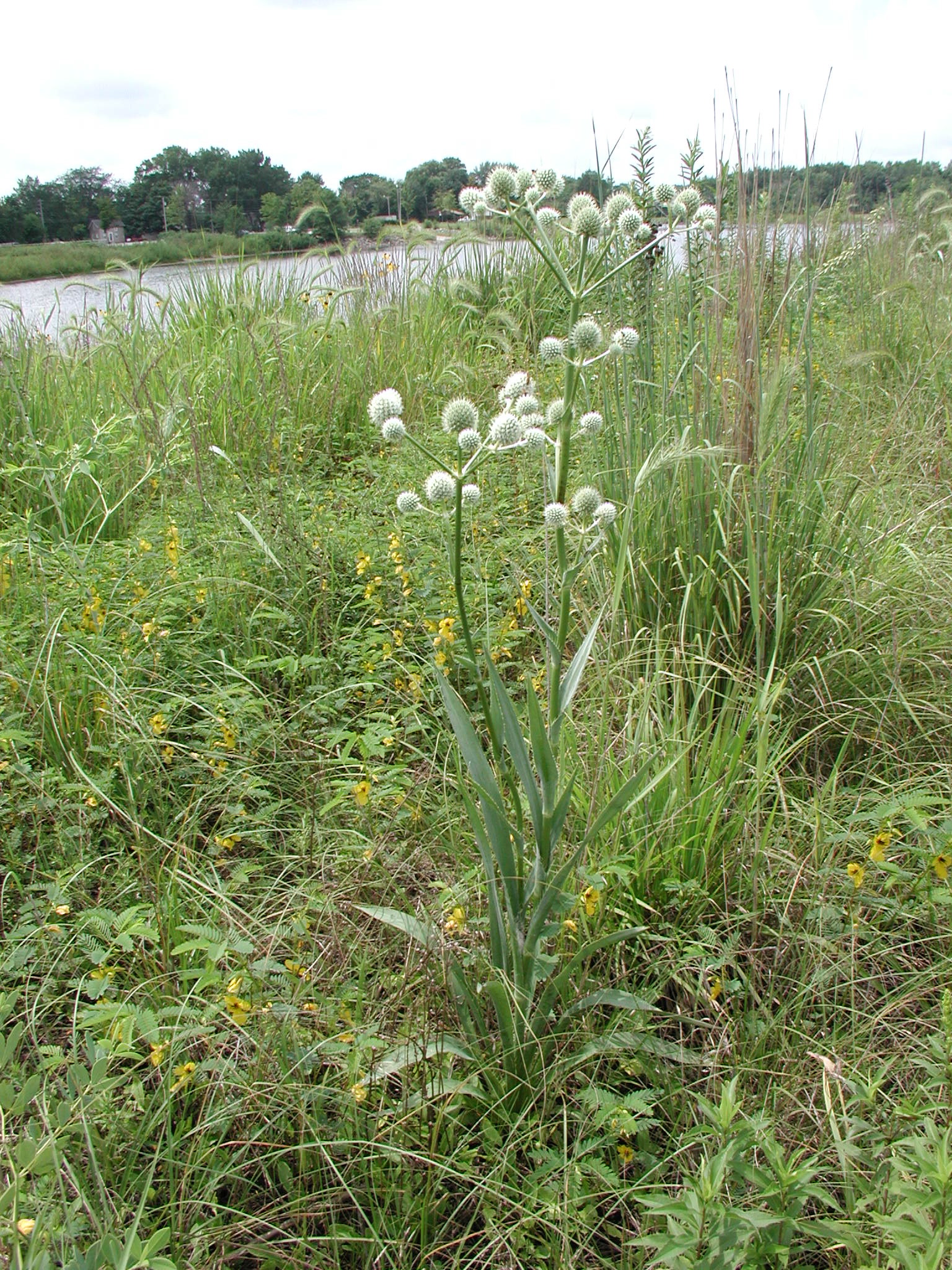
Perennial from a central taproot; forms small clumps through offsets after blooming.
Height: 2-5 ft
- Leaves and stem
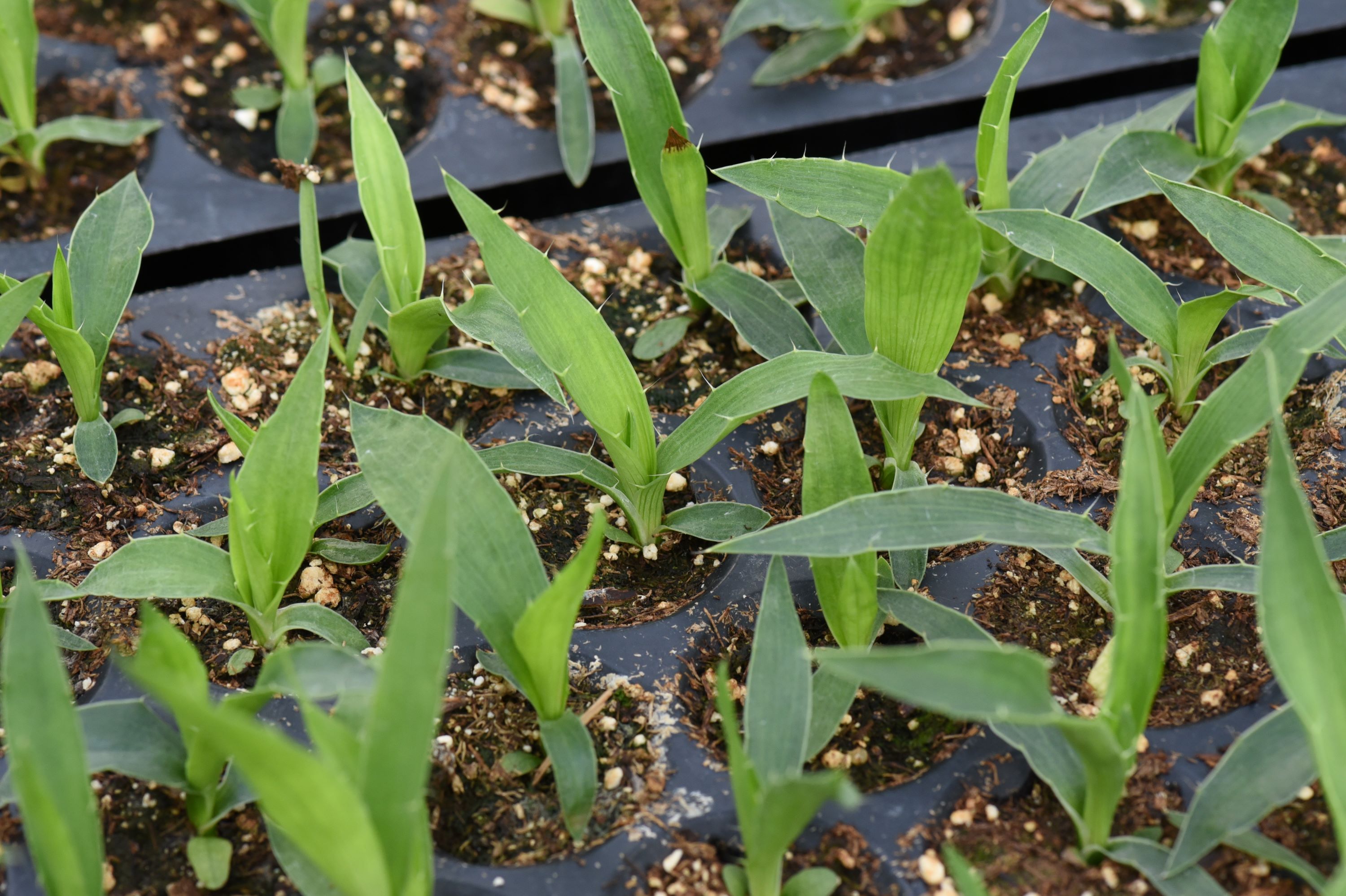
Tough, fibrous, yucca-like leaves are mostly basal, with a waxy surface and widely spaced spiny teeth along margins; stem is hairless, waxy and rigid, pale bluish green in color.
- Flower, fruit and seedhead
Flower: Spherical flowerheads composed of numerous small white flowers are arranged on short branches on the upper portion of the plant.
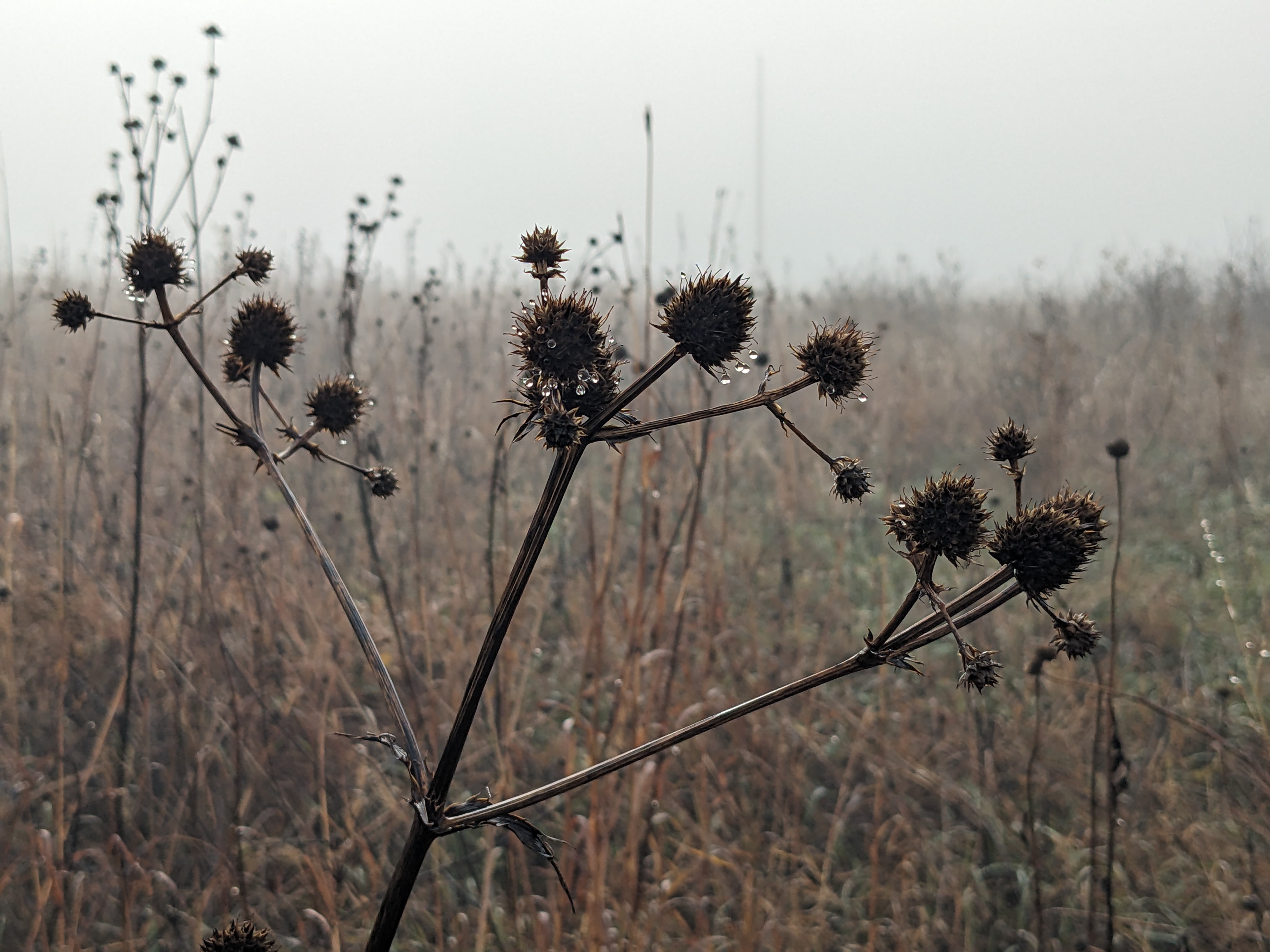
Fruit/seedhead: Seed head with prickly bracts turns golden-tan by winter; mature seed heads are dark brown when wet.
Pollination: Insects, predominantly bees and wasps, but also butterflies, flies, moths, and beetles.
- Seed
Seed characteristics
Seed weight:
Seeds per ounce: 7,500 (IA NRCS)
Seeds per pound: 120,000 (IA NRCS)
1000 seed weight: 3.82 g (Seed Information Database)
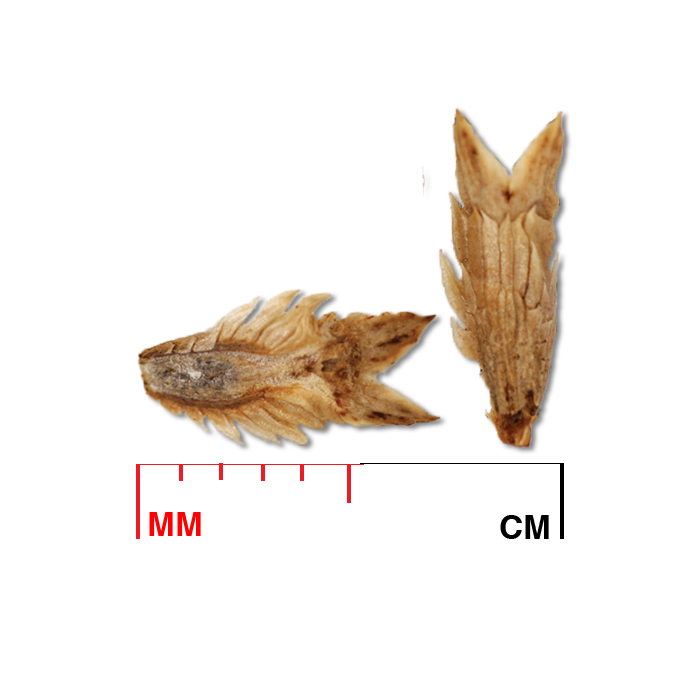
Description: Typical “seed units” are one-seeded scaly fruits, 3/16 in long.
Typical seed test
PLS: 93% (n = 10)
Purity: 98% (n = 9)
Germination: 19% (n = 8)
Dormant: 43% (n = 8)
(averages obtained from n tests of purchased seed lots)
- Habitat and range
Habitat: Dry-mesic to wet-mesic soil; full sun; occurs in medium to high quality remnant prairies, savannas, and limestone glades; Wetland Indicator Status is Facultative (FAC) for the Midwest. Well-drained loamy soils preferred for seed production.
Conservation status: Global- G5, secure; Maryland- SH, possibly extirpated; Nebraska- S1, critically imperiled; Michigan and Virginia- S2, imperiled; Minnesota and Ohio- S3, vulnerable (NatureServe)

General Comments
Greenhouse propagation is recommended for this species. It grows readily, and produces some seed the first year from transplants. Potentially high seed yield. Fairly straightforward to combine harvest and air-screen clean.
Recommendations for Seed Production
- Establishment for seed production
Direct seeding
Row spacing: 30-36 in rows
PLS pounds/acre: 3.25
Seeds per linear foot: 40
Seeding depth: 1/4 in
Seeding method: native seed drill
Seeding time: dormant season
Weed control: Prepare a clean, firm, weed free seed bed prior to seeding.
Greenhouse
Seed pre-treatment: Wet stratify 8-12 weeks at around 40° F.
Sowing: Sow seed (1/4 in deep) in greenhouse two months before last frost free date.
Transplanting: When roots are developed enough to produce a sturdy plug, harden off, then transplant into bare soil in rows or weed barrier at 8-12 in intervals after all danger of frost.
- Stand management
Weeds: Weed barrier or plastic mulch suppresses weeds during the first year. Mow/cultivate between rows. Post emergence grass herbicide, tillage, and/or hand roguing prevent weed seed contamination of crop. Anecdotal reports from commercial seed growers suggest that this species may persist and produce well within a matrix of grasses, including non-native cool season species, which may help suppress other weeds.
Pests: None noted.
Diseases: Cucumber mosaic virus detected in populations in Ohio (Whitten and Nameth, 2004).
- Seed production
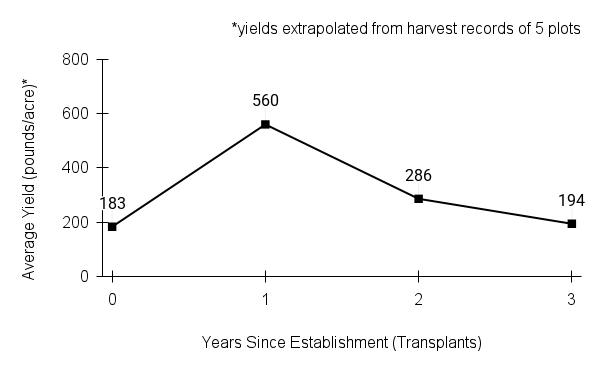 First harvest: Small harvest first growing season if greenhouse propagated in March and planted into a weed-barrier in spring. Flowering and harvest may be delayed in the planting year. First harvest in second year if direct seeded.
Yield: 180-560 bulk pounds/acre (yields extrapolated from harvest records from 5 plots)
Stand life: Peak harvests in the second to third years. Stand declines fourth year.
Flowering date: mid July-mid August in northern Iowa
Seed maturity/Harvest date: early October in northern Iowa
Seed retention: Shattering occurs mid to late October
Harvest date range at TPC (2003-2023): Sept 7 - Oct 25
Recommended harvest method: combine
- Seed cleaning and storage
Cleaning process: Pre-clean combined material by scalping thru 1/2 ft and 1/4 in mesh to remove large particles and make flowable, then air-screen. (Brushing is not needed; no awns or appendages to remove.)
Seed storage: cool/dry (33-50° F, 30-50% RH).
Released Germplasm
Source Identified material: Natural Selections/Iowa Ecotype Project Northern Iowa Germplasm (IA Zone 1), Central Iowa Germplasm (IA Zone 2), Southern Iowa Germplasm (IA Zone 3)
- References
Chayka, K. (n.d.). Eryngium yuccifolium (rattlesnake master). Minnesota Wildflowers. https://www.minnesotawildflowers.info/flower/rattlesnake-master
Cochrane, T. S., Elliot, K., & Lipke, C. S. (2014). Rattlesnake-master. In Prairie plants of the University of Wisconsin-Madison Arboretum (3rd ed., p. 45). University of Wisconsin-Madison Arboretum.
Hilty, J. (2019). Rattlesnake master - Eryngium yuccifolium. Illinois Wildflowers. https://www.illinoiswildflowers.info/prairie/plantx/rattlesnakex.htm
Houseal, G. A. (2007). Forbs wildflowers. In G. A. Houseal (Eds.), Tallgrass Prairie Center’s native seed production manual (pp. 34–35). Tallgrass Prairie Center - University of Northern Iowa.
Kartesz, J.T., The Biota of North America Program (BONAP). 2023. North American Plant Atlas. (http://bonap.net/napa). Chapel Hill, N.C. [maps generated from Kartesz, J.T. 2023. Floristic Synthesis of North America, Version 1.0. Biota of North America Program (BONAP). (in press)]
NatureServe. 2024. NatureServe Network Biodiversity Location Data accessed through NatureServe Explorer [web application]. NatureServe, Arlington, Virginia. Available https://explorer.natureserve.org/. (Accessed: February 29, 2024).
Runkel, S. T., & Roosa, D. M. (2009). Rattlesnake master. In Wildflowers of the tallgrass prairie: The upper Midwest (2nd ed., pp. 130–131). University of Iowa Press.
USDA NRCS National Plant Data Team. (n.d.). Eryngium yuccifolium Michx. USDA plants database. https://plants.usda.gov/home/plantProfile?symbol=ERYU
Species Guide Updated 12/4/2025