

longbract wild indigo
Table of Contents
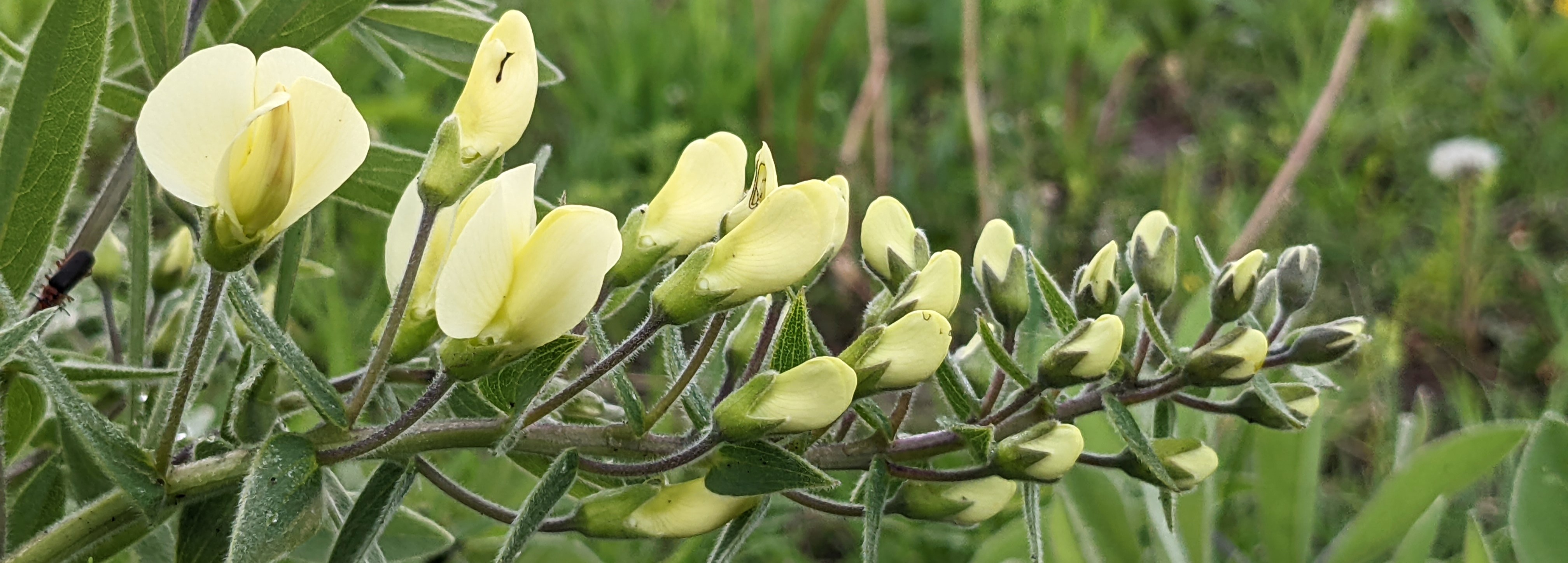
Baptisia bracteata, Muhl. ex Elliott var. leucophaea (Nutt.) Kartesz & Gandhi
Alternate Common Names: Cream-colored false indigo, plains wild indigo, large-bracted wild indigo, long-bracted wild indigo, yellowish false indigo, cream wild indigo
Scientific Synonyms: Baptisia bracteata Muhl. ex Elliott var. glabrescens (Larisey) Isely, Baptisia leucophaea Nutt., Baptisia leucophaea Nutt. var. glabrescens Larisey
Family: legume and pea family (Fabaceae (Leguminosae))
Functional Group: legumes
Description
- Life cycle and growth form
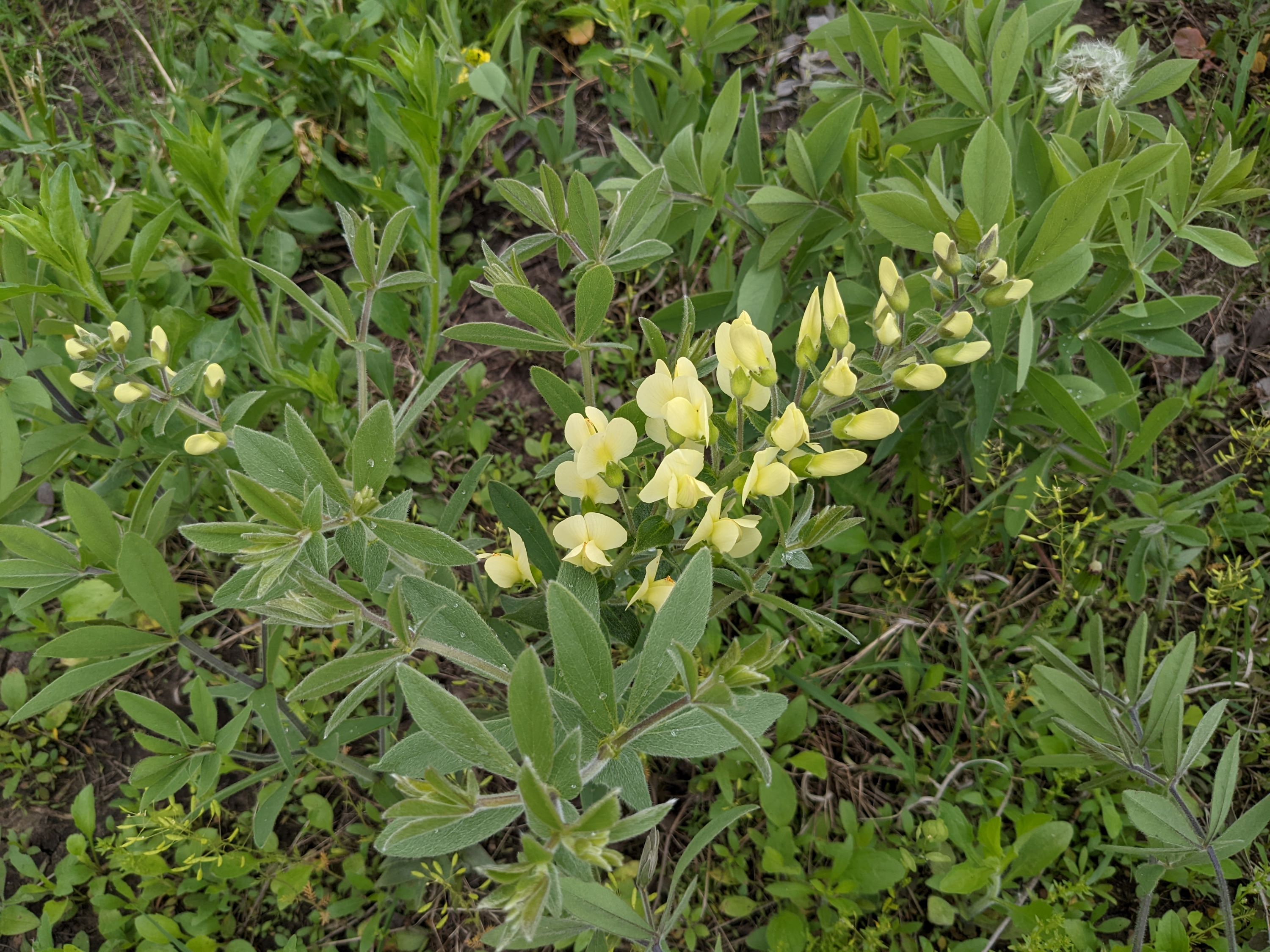
Perennial growing from a taproot; spring shoots resemble asparagus but are fuzzy; in late fall, the plant breaks off near the ground and tumbles to disperse the seeds.
Height: 1-3 ft
- Leaves and stem
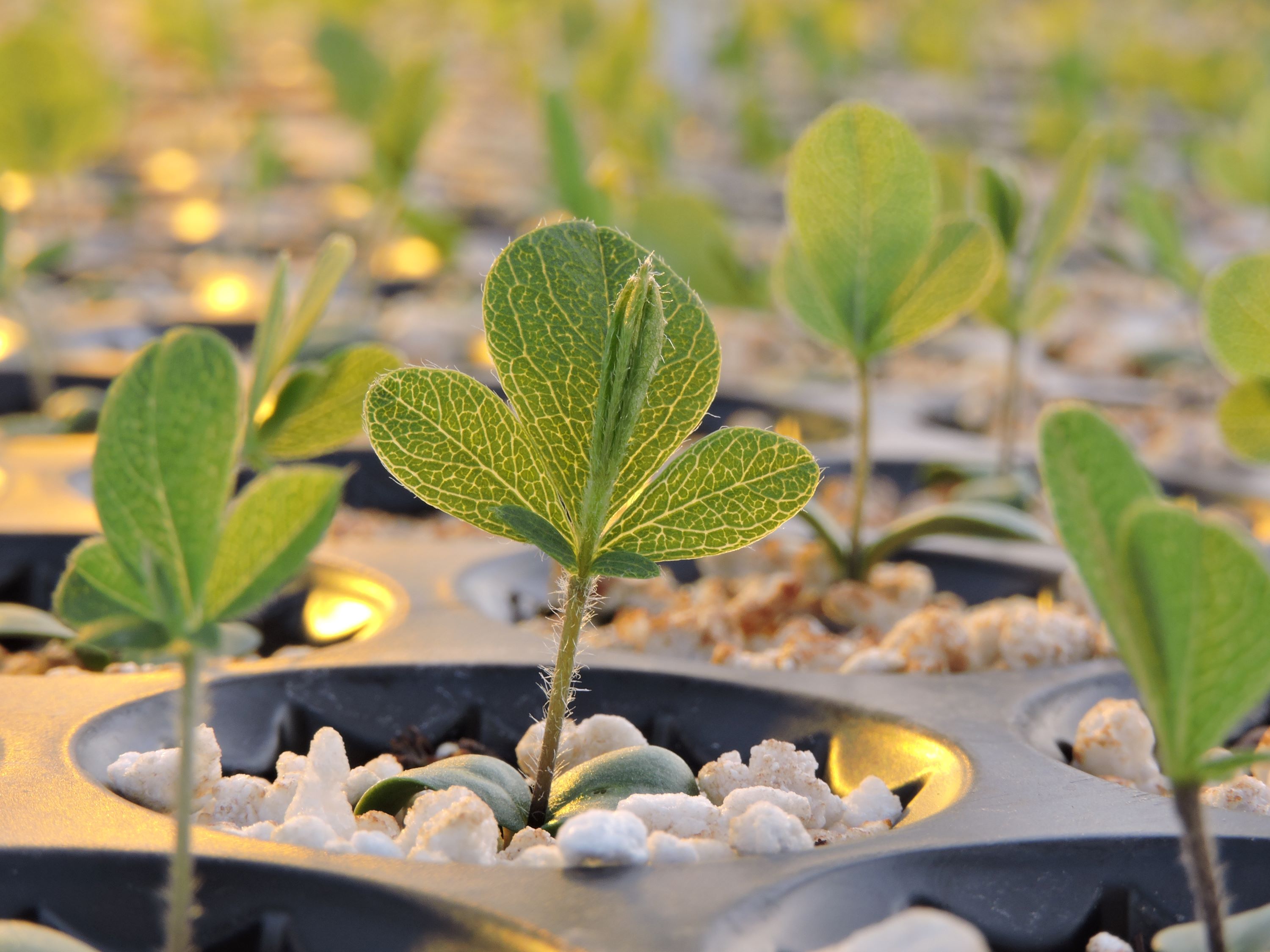
Leaves alternate, hairy, short-stalked or sessile on the stem, compound with 3 leaflets and two large, prominent stipules at the base of each leaf; stems hairy with wide-spreading branches.
- Flower, fruit and seedhead
Flower: Large, pale, creamy-yellow pea-shaped flowers in dense racemes that extend parallel to the ground or droop downward.
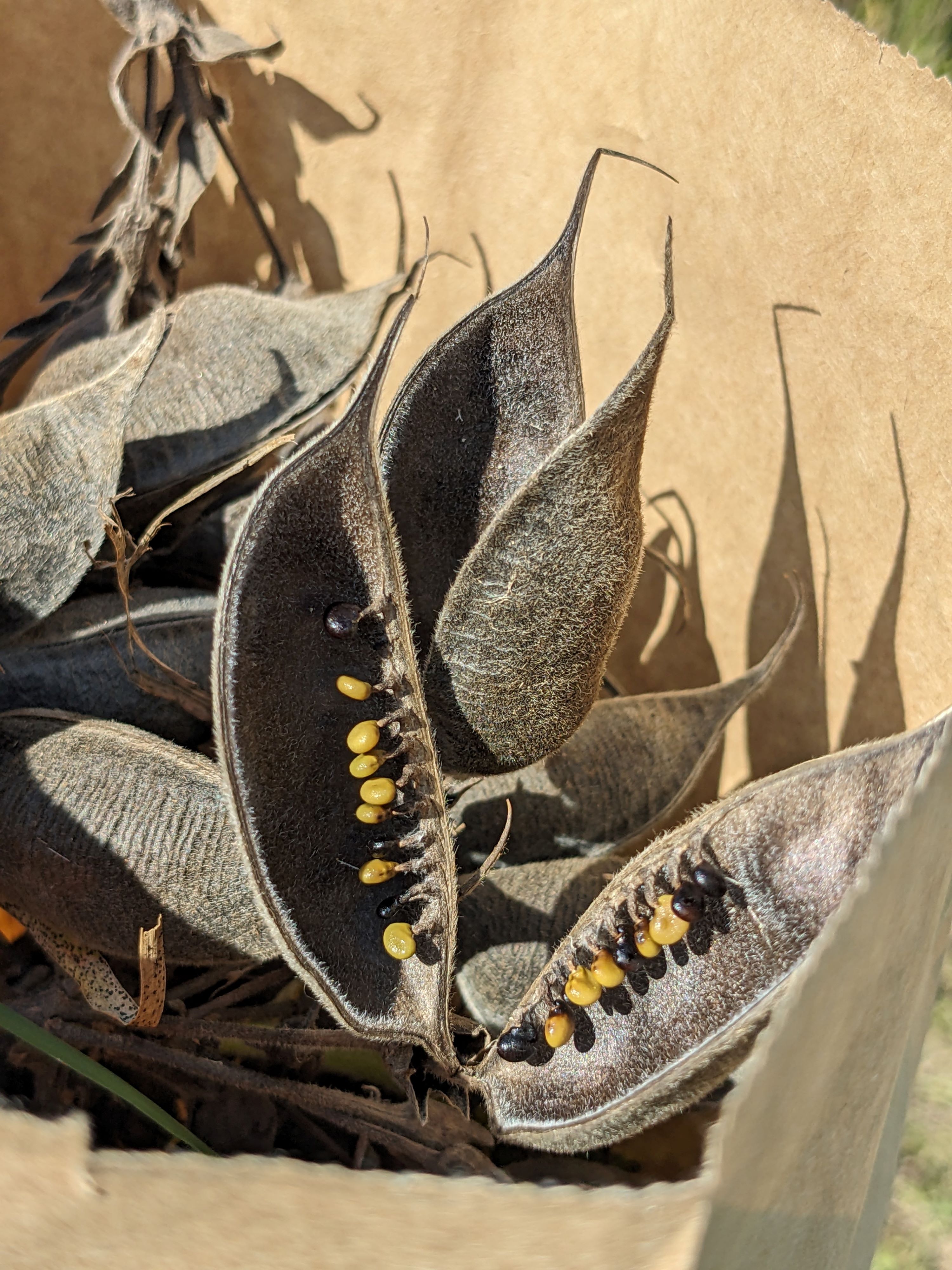
Fruit/seed head: Pods are inflated and green, turning black at maturity, 1-2 in long with pointed tips; seeds are small beans, golden-brown to olive in color
Pollination: Bumble bees and other large bodied bees.
- Seed
Seed characteristics
Seed weight:
Seeds per ounce: 1,400 seeds/oz (IA NRCS)
1000 seed weight: 11.51g (Seed Information Database)
Description: Seed is a small, plump bean about 5 mm in length, golden-brown and coated with a powdery, sticky resin.
Typical seed test
PLS: 93% (n = 6)
Purity: 100% (n = 6)
Germination: 7% (n = 4)
Dormancy: 68% (n = 4)
(averages obtained from n tests of purchased seed lots)
- Habitat and range
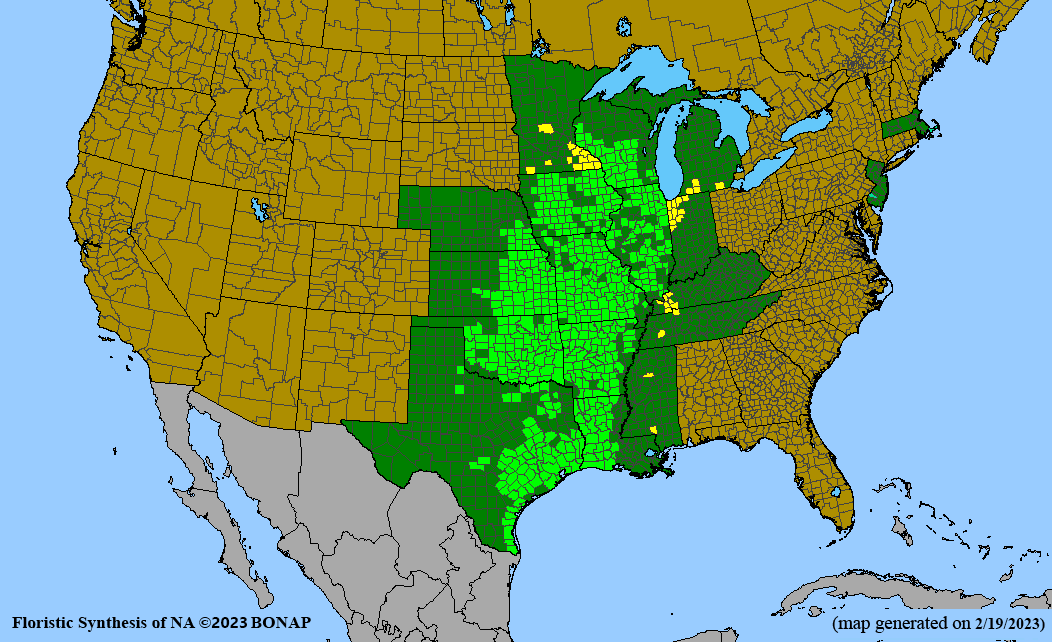
Habitat: Dry to mesic soil; full sun; prairies, savannas, woodland openings; well drained soils preferable for seed production.
Conservation status: Global- G4, apparently secure; Minnesota- S3, vulnerable; (NatureServe)

General Comments
The spring shoots of mature cream wild indigo plants come up quickly, resembling hairy asparagus, in late April in northeast Iowa. Blooms appear in May, making this large-flowered species an important source of food for new bumble bee queens. The pods blacken at maturity, and the entire plant turns charcoal-gray in fall. Pods eventually split open, revealing orderly rows of attached seeds, if they have not been devoured by the larvae of a host specific insect: the baptisia seed pod weevil. Seed yields are highly variable due to fluctuations in weevil populations. In natural populations, the stem breaks off at ground level in late fall and plants tumble with the wind, shaking out any seed remaining in the pods, aiding seed dispersal.
Recommendations for Seed Production
- Establishment for seed production
Direct seeding
We do not have experience with direct seeding this species for seed production.
Greenhouse
Seed pre-treatment: Scarify and stratify for 10-14 days in the refrigerator. Inoculate with Baptisia rhizobia if desired.
Sowing: Sow seed 1/4 in deep in plugs two months before average final frost. Damping off (fungal pathogen) can be a problem on seedlings if soil is kept too moist, or seedlings are planted too thickly. Add additional perlite to sterile potting mix to improve drainage. Avoid excess moisture on the soil surface by applying a thin layer of chick grit over the top of the soil, improving air circulation with fans, thinning seedlings, and/or watering from the bottom of the containers only. Seedlings form a fleshy taproot with few lateral roots, unless allowed to grow until taproot is air-pruned as it reaches the bottom drainage holes of the container. Plugs with vertical grooves and large bottom openings encourage air-pruning and branching of roots.
Transplanting: When seedlings are well-rooted plugs, transplant at 12 in spacing in rows mulched with plastic or other weed barrier.
- Stand management
Weeds: Adding a short, warm-season grass to production rows helps suppress weeds and provides fuel for prescribed fires.
Pests: A native, host-specific insect, the baptisia seed pod weevil, consumes nearly all seed in some years, making harvests of this species highly variable. Insecticide (permethrin) treatment may increase seed production slightly (15 more seeds per plant) (Horn and Hanula, 2004), but this must be weighed against potential damage to pollinators.
Diseases: None noted.
- Seed production
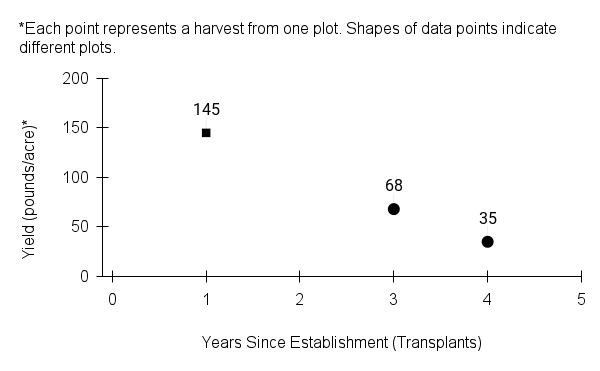 First harvest: Seed may be produced in the year following transplanting, however, yields are extremely variable depending on weevil populations. First measurable harvest in one field at TPC was in year 3.
Yield/acre: 35-145 pounds per acre (extrapolated based on harvest records of 2 plots. Note that each point on the yield graph represents a harvest from one plot. Plots were harvested only in years when weevil damage was light).
Stand life: Plants are very long-lived, persisting within a grassy matrix for 20 years or more, though they do not produce seed every year due to seed predation by weevils.
Flowering date: May in northeast Iowa
Seed maturity/harvest date: Aug - Sept
Seed retention: Not prone to shattering until late fall (October)
Harvest date range at TPC (2005-2024): Aug 4 - Oct 7
Recommended harvest method: Hand pick or combine
- Seed cleaning and storage
Cleaning process: Hand collected material may be stomped to break up pods. This step is not needed for combined material. Pre-clean air-dried material by scalping through 1/2 in mesh to remove large particles. Air-screen to clean (see Appendix C). Most black-colored seeds are non-viable and usually less dense than light-colored seeds, and most should be removed by increasing aspiration.
Seed storage: Cool/dry (33-50° F, 30-50% RH); seed may remain viable for 10 or more years
Released Germplasm
Source Identified material: Natural Selections/Iowa Ecotype Zones 1, 2, 3
- References
Chayka, K. (n.d.). Baptisia bracteata (plains wild indigo). Minnesota Wildflowers. https://www.minnesotawildflowers.info/flower/plains-wild-indigo
Cochrane, T. S., Elliot, K., & Lipke, C. S. (2014). Cream wild indigo. In Prairie plants of the University of Wisconsin-Madison Arboretum (3rd ed., p. 181). University of Wisconsin-Madison Arboretum.
Hilty, J. (n.d.). Cream wild indigo - Baptisia bracteata. Illinois Wildflowers. https://www.illinoiswildflowers.info/prairie/plantx/cr_indigox.htm
Kartesz, J.T., The Biota of North America Program (BONAP). 2023. North American Plant Atlas. (http://bonap.net/napa). Chapel Hill, N.C. [maps generated from Kartesz, J.T. 2023. Floristic Synthesis of North America, Version 1.0. Biota of North America Program (BONAP). (in press)]
NatureServe. 2024. NatureServe Network Biodiversity Location Data accessed through NatureServe Explorer [web application]. NatureServe, Arlington, Virginia. Available https://explorer.natureserve.org/. (Accessed: February 28, 2024).
Runkel, S. T., & Roosa, D. M. (2009). Cream-colored false indigo. In Wildflowers of the tallgrass prairie: The upper Midwest (2nd ed., pp. 46–47). University of Iowa Press.
USDA NRCS National Plant Data Team. (n.d.). Baptisia bracteata Muhl. ex Elliott. USDA plants database. https://plants.usda.gov/home/plantProfile?symbol=BABR2
Species Guide Updated 12/5/2025