

prairie blazing star
Table of Contents
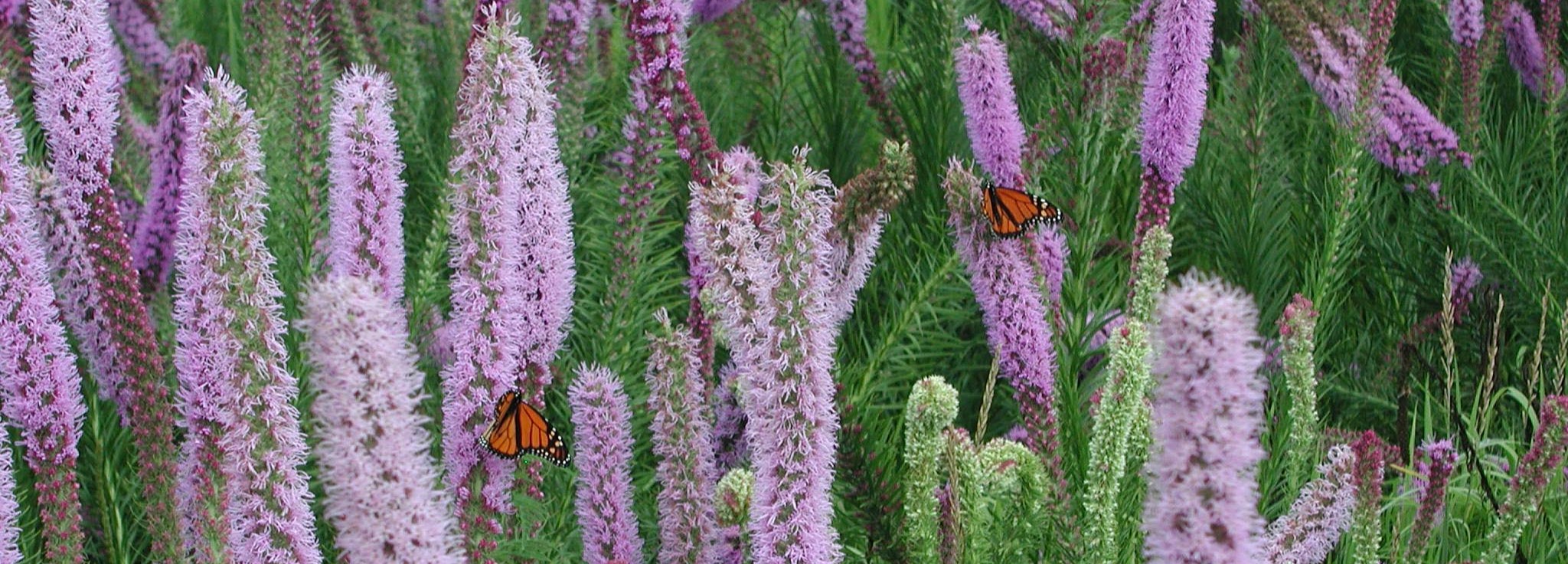
Liatris pycnostachya Michx.
Alternate Common Names: cat-tail gayfeather, thick-spike gayfeather, prairie blazingstar, prairie blazing-star, button snakeroot, gayfeather, blazing star, thick-spike gay-feather, thick-spike blazing-star
Scientific Synonyms: Lacinaria pycnostachya (Mich.) Kuntze
Family: aster family (Asteraceae)
Functional Group: forbs (wildflowers)
Description
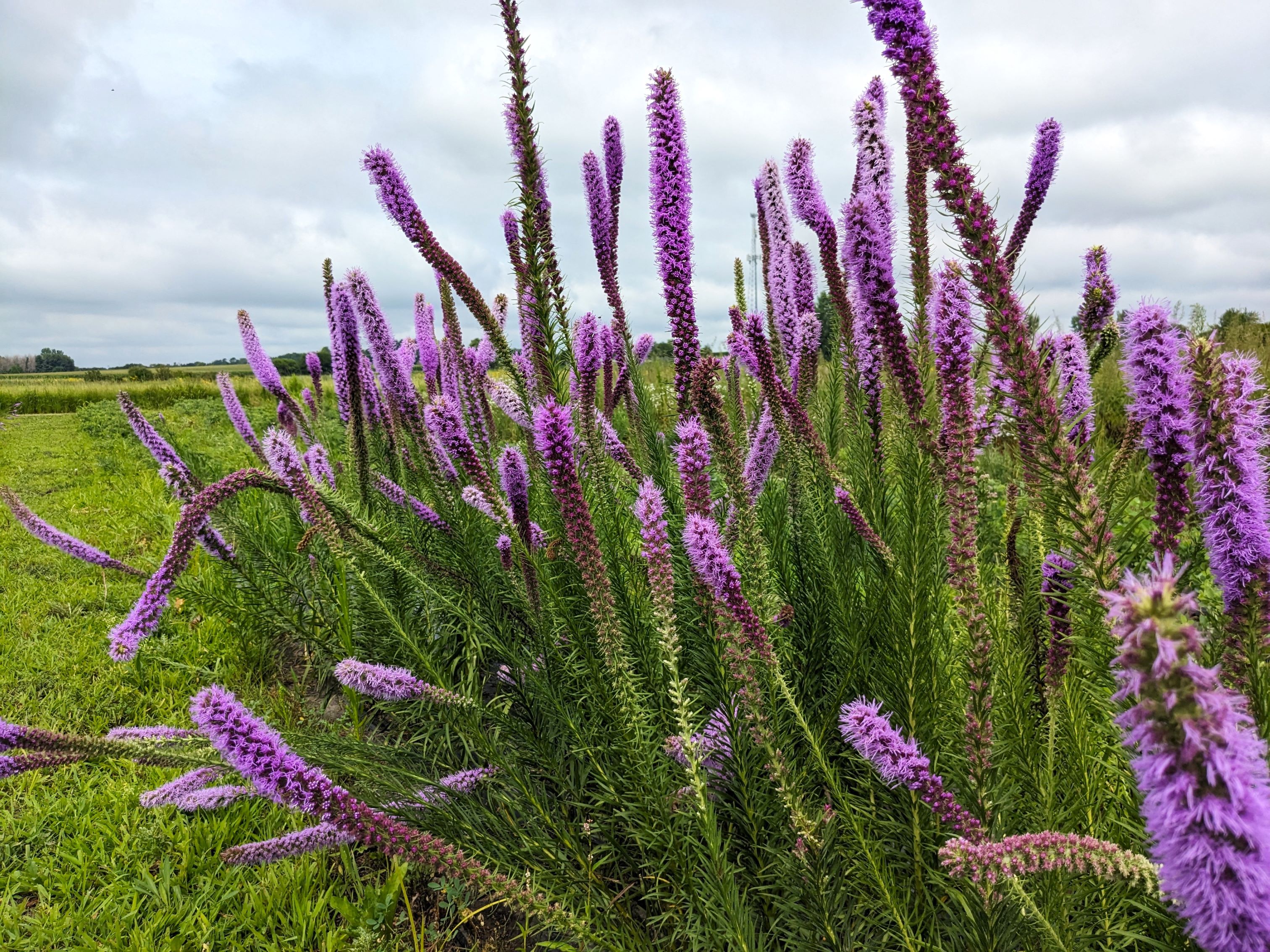
- Life cycle and growth form
Perennial from corms that can be divided.
Height: 2-5 ft
- Leaves and stem
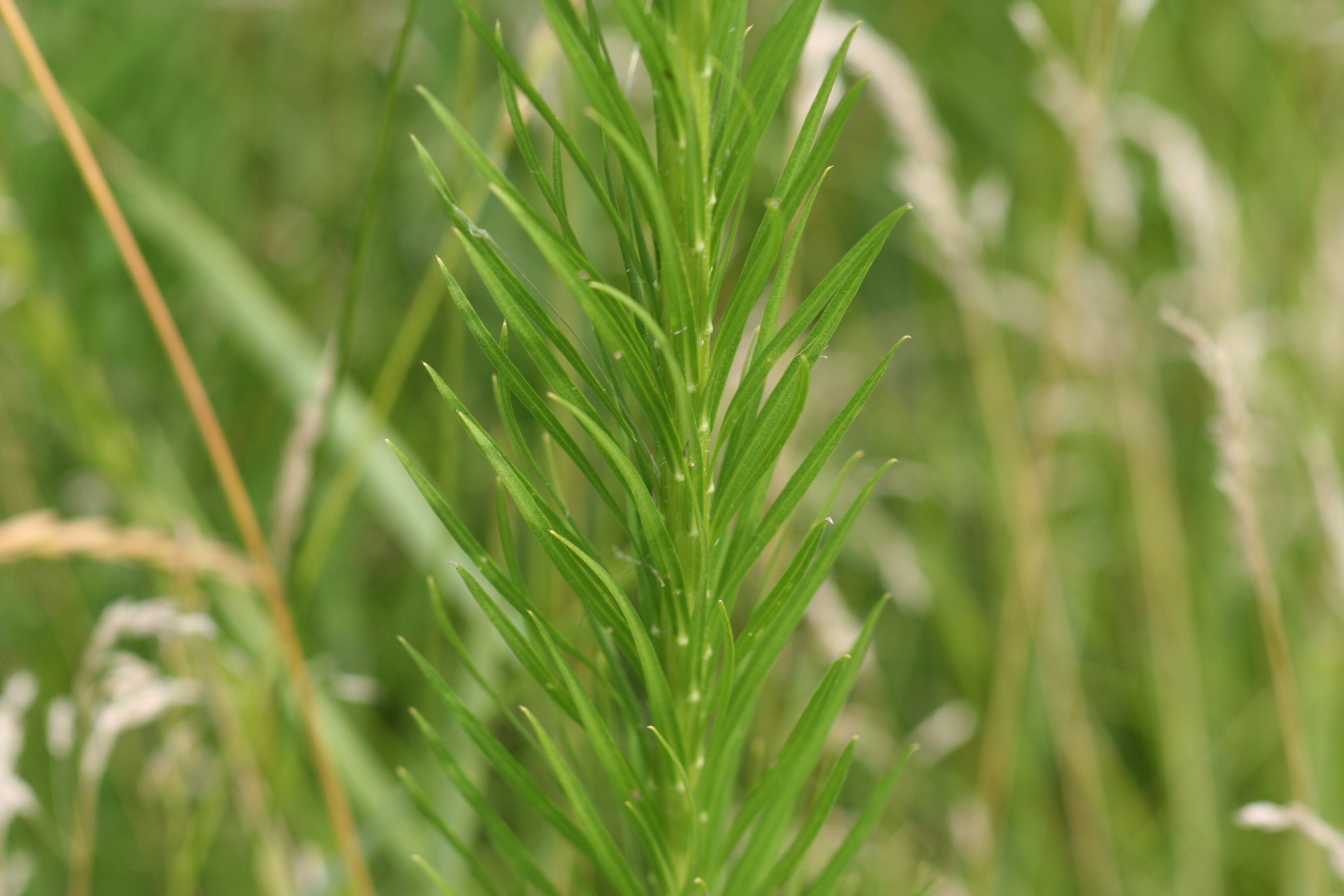
Leaves grasslike, alternate but so crowded as to appear almost whorled, becoming progressively shorter toward the top of the stem; stem is hairy and stiff, unbranched.
- Flower, fruit and seedhead
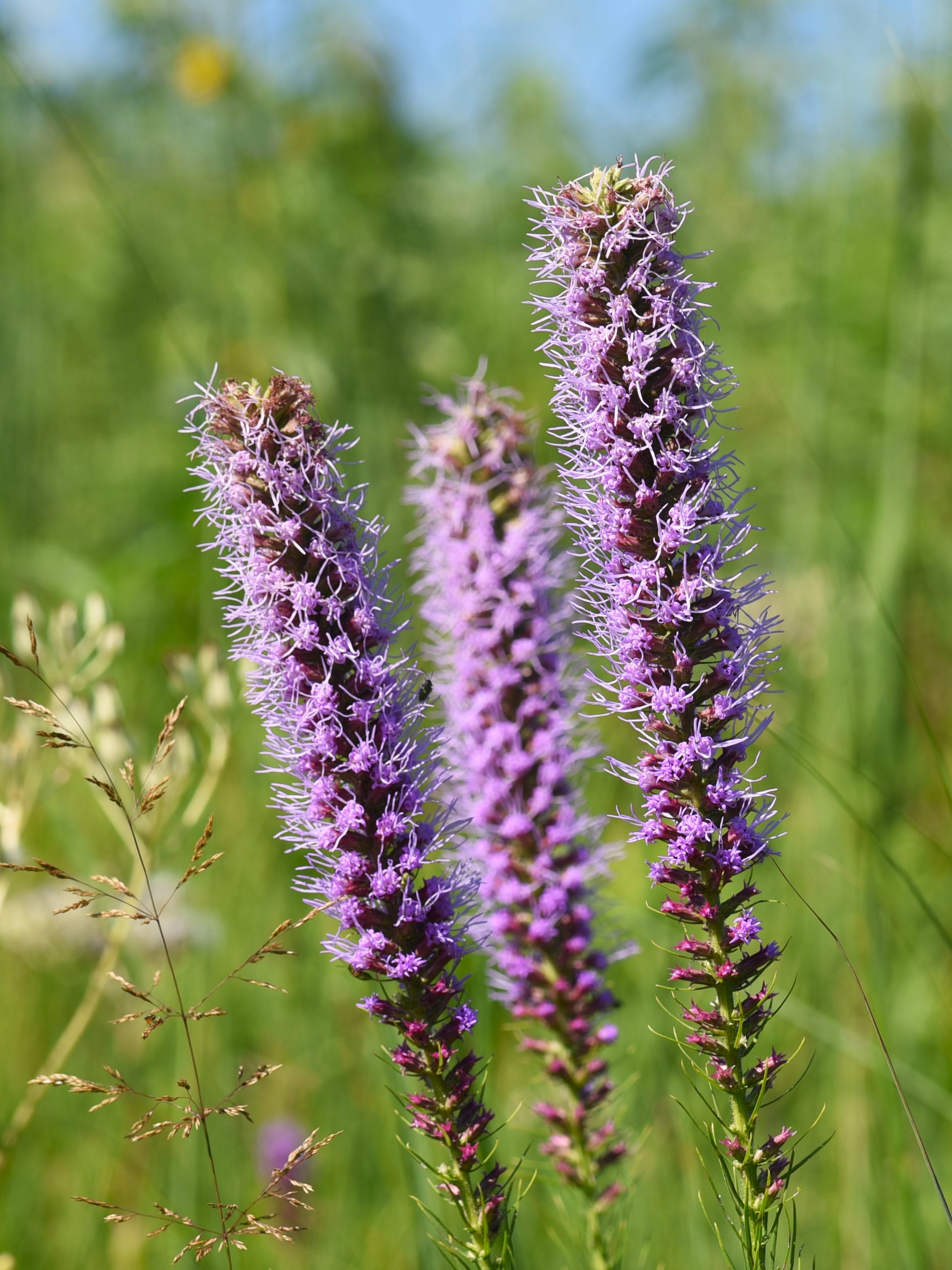
Flower: Heads of 5-10 purplish-pink disk flowers with long styles that stick out; slender heads are densely packed in spikes that bloom from the top down.
Fruit/seedhead: “Seed” is an achene bearing a tan pappus (tuft of hair), distributed by the wind.
Pollination: Insects such as butterflies, bees, and moths.
- Seed
Seed characteristics
Seed weight:
Seeds per ounce: 11,000 (IA NRCS)
1000 seed weight: 1.86 g (Seed Information Database)
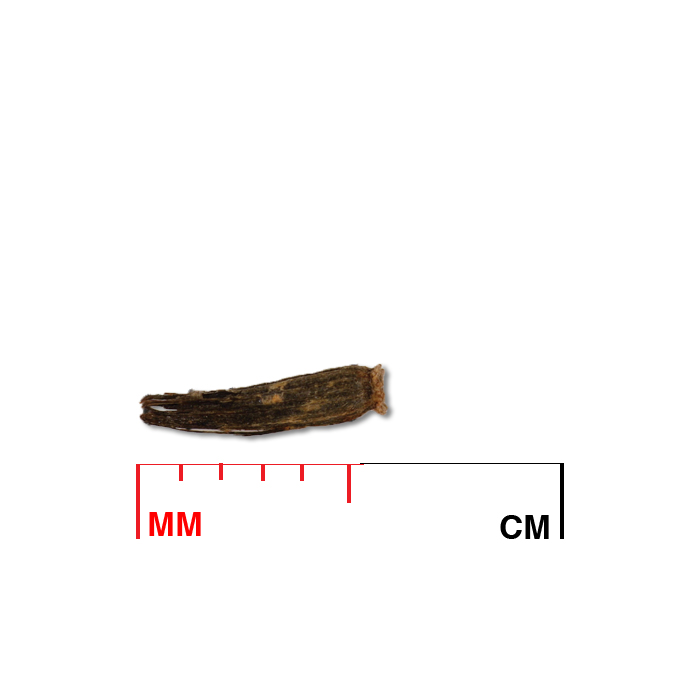
Description: “Seeds” are achenes, about 1/8 to 1/4 in long, with tufts of tan hairs (pappus).
Typical seed test
PLS: 93% (n = 10)
Purity: 98% (n = 10)
Germination: 22% (n = 7)
Dormancy: 73% (n = 6)
(averages obtained from n tests of purchased seed lots)
- Habitat and range
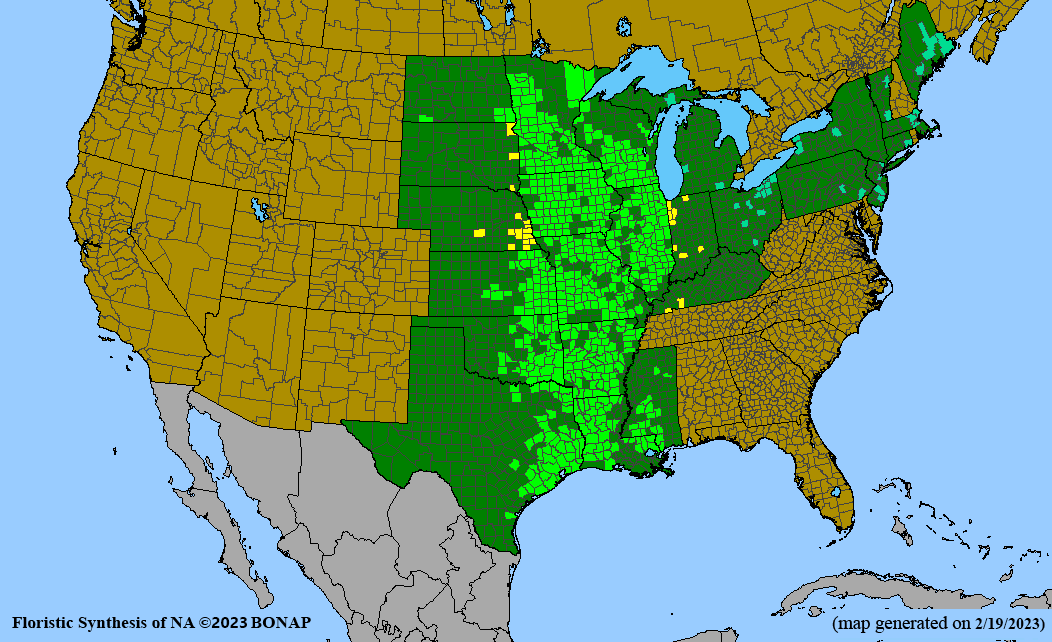
Habitat: Mesic to wet-mesic soils; full sun; may be abundant in medium to high quality prairies; moist meadows, rocky bluffs, along railroads, limestone glades. Wetland Indicator Status is Facultative (FAC) for the Midwest. Moist, but well-drained soils are preferred for seed production.
Conservation status: Global- G5, secure; Indiana and South Dakota- S1, critically imperiled; (NatureServe)
General Comments
Prairie blazing star is best propagated in the greenhouse, where seedlings form small pea-sized corms after about 2 months. First true leaves of seedlings are grass-like. Expect prolific seed production in the second growing season, after which the stand declines. Corms can be dug and divided for fall transplant, if disease free, for abundant flowering and seed set the following growing season. Species in the genus Liatris are known to hybridize, therefore proper isolation should be maintained between related species to avoid hybrid seed production (Levin 1968, Menhusen 1972). Liatris species and cultivars are also produced commercially for the landscaping and cut-flower industries.
Recommendations for Seed Production
- Establishment for seed production
Direct seeding
Not recommended for this species
Greenhouse
Seed pre-treatment: Wet stratify 8-12 weeks at 40˚ F. Seed may be prone to mold in stratification. Some growers add fungicide to the stratification media.
Sowing: Sow seed in greenhouse two months before last frost free date.
Transplanting: Harden-off, transplant into bare soil in rows or weed barrier at 8 in intervals after all danger of frost.
- Stand management
Weeds: Mow/cultivate between rows, mulch within rows. Post emergence grass herbicide, tillage, hoeing, hand roguing. Very sensitive to soil disturbance during bolting/flowering, so clip weeds rather than pulling or hoeing after flowering shoots emerge.
Pests: Voles will eat and/or cache corms, rabbits and deer eat young shoots, goldfinches eat seed as it matures.
Diseases: powdery mildew, root-knot nematodes, stem rot, verticillium wilt.
Hybridization risk: This species is known to hybridize with related species Liatris acidota, L. ligulistylis, L. punctata, and L. squarrosa
- Seed production
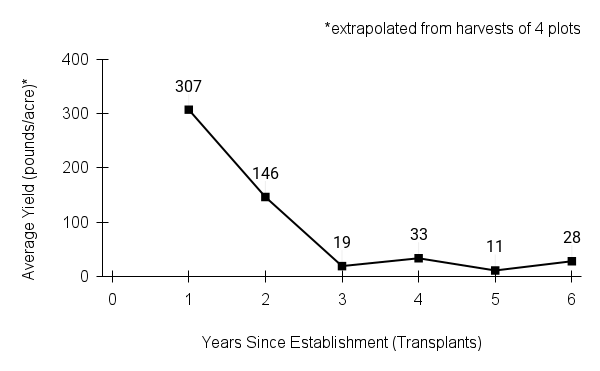 First Harvest: Plants remain vegetative for the first year (seedlings); abundant flowering/seed production second year. Fall corm division/transplanting results in abundant flowering the following growing season.
Yield: 11-307 pounds/acre (per acre yields extrapolated from harvest records of 4 plots)
Stand life: Peak harvests occur in the second year. Good harvest third year if proper soils. Stand declines significantly fourth year and after. Plants tend to lodge second year when flowering. On more well-drained soils, irrigation may improve yields.
Flowering date: late July - late August in northern Iowa
Seed maturity/Harvest date: early September - mid-October in northern Iowa
Seed retention: Seed is wind dispersed shortly after ripening when pappus “parachutes” dry and fluff out
Harvest date range at TPC (2003-2023): Sept 2 - Oct 23
Recommended Harvest Method: Combine at maturity, but before pappus is dry and fluffy. Seedheads mature from the top down along a stalk. When the topmost heads are fluffy, break open a few of the lower heads and observe for signs of maturity: dark-colored seeds that separate easily from the base of the head. Small plots may be hand harvested by clipping stalks as the seed matures, then drying the cut material in a building. Dry seed threshes easily from stalks.
- Seed cleaning and storage
Cleaning process: Pre-clean by scalping thru 1/2 in mesh to remove large particles and make the material flowable, brush gently with soft bristles to remove fluffy pappus, using care not to damage seed coat, then air screen.
Seed storage: cool/dry (33-50° F, 30-50% RH); seed stores well for a few years if seed is not damaged during cleaning.
Released Germplasm
Source Identified material: Northern Iowa Germplasm (IA Zone 1), Central Iowa Germplasm (IA Zone 2), Southern Iowa Germplasm (IA Zone 3), Northern Missouri Germplasm, Western Missouri Germplasm
Selected Germplasm: Pineywoods Germplasm (TX)
Cultivated variety (cultivars): Eureka (KS; developed for cut flower industry)
- References
Chayka, K. (n.d.). Liatris pycnostachya (prairie blazing star). Minnesota Wildflowers. https://www.minnesotawildflowers.info/flower/prairie-blazing-star
Cochrane, T. S., Elliot, K., & Lipke, C. S. (2014). Thick-spike gay-feather. In Prairie plants of the University of Wisconsin-Madison Arboretum (3rd ed., p. 98). University of Wisconsin-Madison Arboretum.
Hilty, J. (2019). Prairie blazingstar - Liatris pycnostachya. Illinois Wildflowers. https://www.illinoiswildflowers.info/prairie/plantx/pr_blazingstarx.htm
Houseal, G. A. (2007). GForbs wildflowers. In G. A. Houseal (Eds.), Tallgrass Prairie Center’s native seed production manual (pp. 40–41). Tallgrass Prairie Center - University of Northern Iowa.
Kartesz, J.T., The Biota of North America Program (BONAP). 2023. North American Plant Atlas. (http://bonap.net/napa). Chapel Hill, N.C. [maps generated from Kartesz, J.T. 2023. Floristic Synthesis of North America, Version 1.0. Biota of North America Program (BONAP). (in press)]
Levin, D.A. (1968). The Structure of a Polyspecies Hybrid Swarm in Liatris. Evolution, 22(2), 352-372. https://doi.org/10.1111/j.1558-5646.1968.tb05903.x
Menhusen, B.R. (1972). Ecology of the Prairie Species of the Genus Liatris. Third Midwest Prairie Conference Proceedings. Manhattan, Kan.: Division of Biology, Kansas State University. https://search.library.wisc.edu/digital/AL7JMUVRYYXDZO8S/pages/A56MVY3FXXELEL8L
NatureServe. 2024. NatureServe Network Biodiversity Location Data accessed through NatureServe Explorer [web application]. NatureServe, Arlington, Virginia. Available https://explorer.natureserve.org/. (Accessed: February 29, 2024).
Nesom, G. L. (2020, November 6). Liatris pycnostachya Michaux. Flora of North America. http://floranorthamerica.org/Liatris_pycnostachya
Runkel, S. T., & Roosa, D. M. (2009). Blazing star. In Wildflowers of the tallgrass prairie: The upper Midwest (2nd ed., pp. 198–199). University of Iowa Press.
USDA NRCS National Plant Data Team. (n.d.). Liatris pycnostachya Michx. USDA plants database. https://plants.usda.gov/home/plantProfile?symbol=LIPY
Species Guide Updated 2/21/2025