

bluejoint
Table of Contents
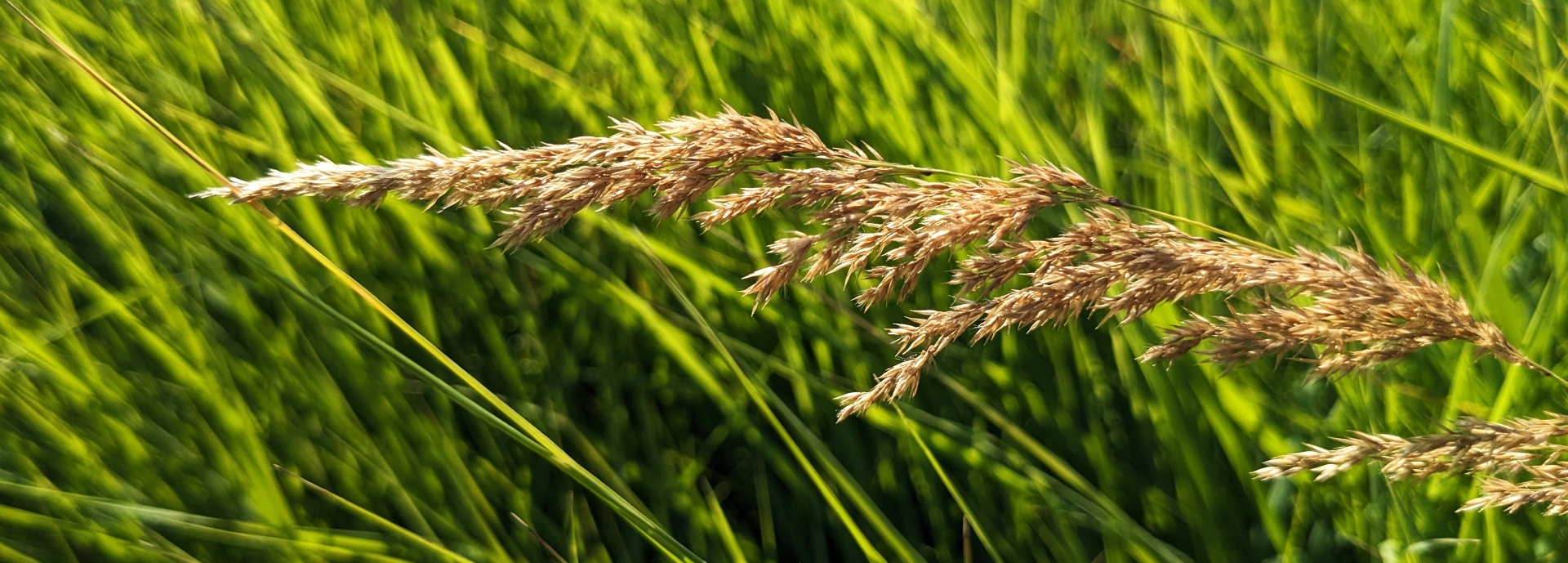
Calamagrostis canadensis (Michx) P. Beauv.
Alternate Common Names: bluejoint reedgrass, Canada bluejoint, Canada reedgrass, marsh reedgrass, meadow pinegrass
Scientific Synonym: Calamagrostis anomala
Family: grass family (Poaceae)
Functional Group: cool season grasses
Description
- Life cycle and growth form
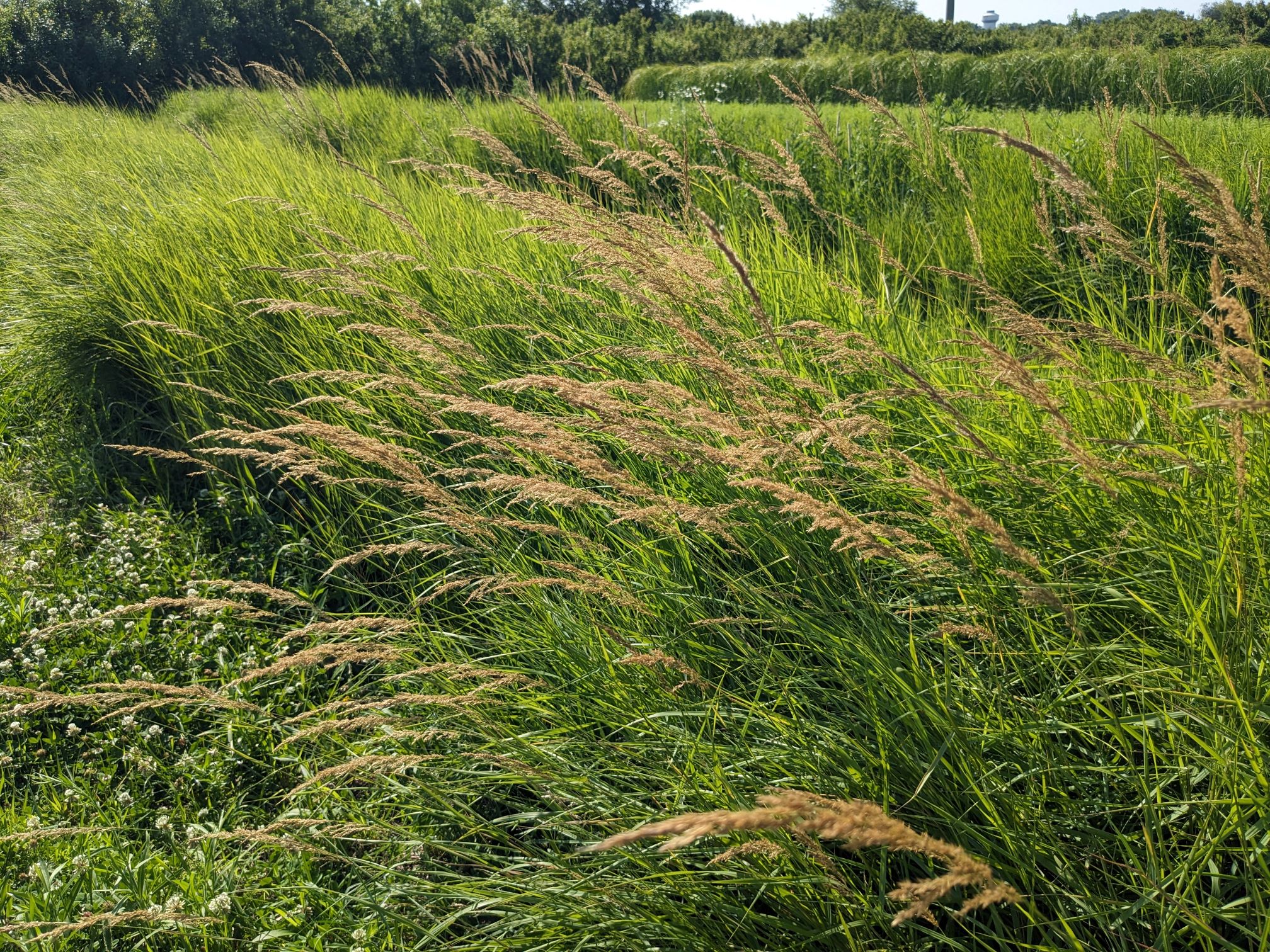
Perennial, rhizomatous grass that forms spreading, hummocky colonies.
Height: Flowering culms 3-5 ft tall
- Leaves and stem
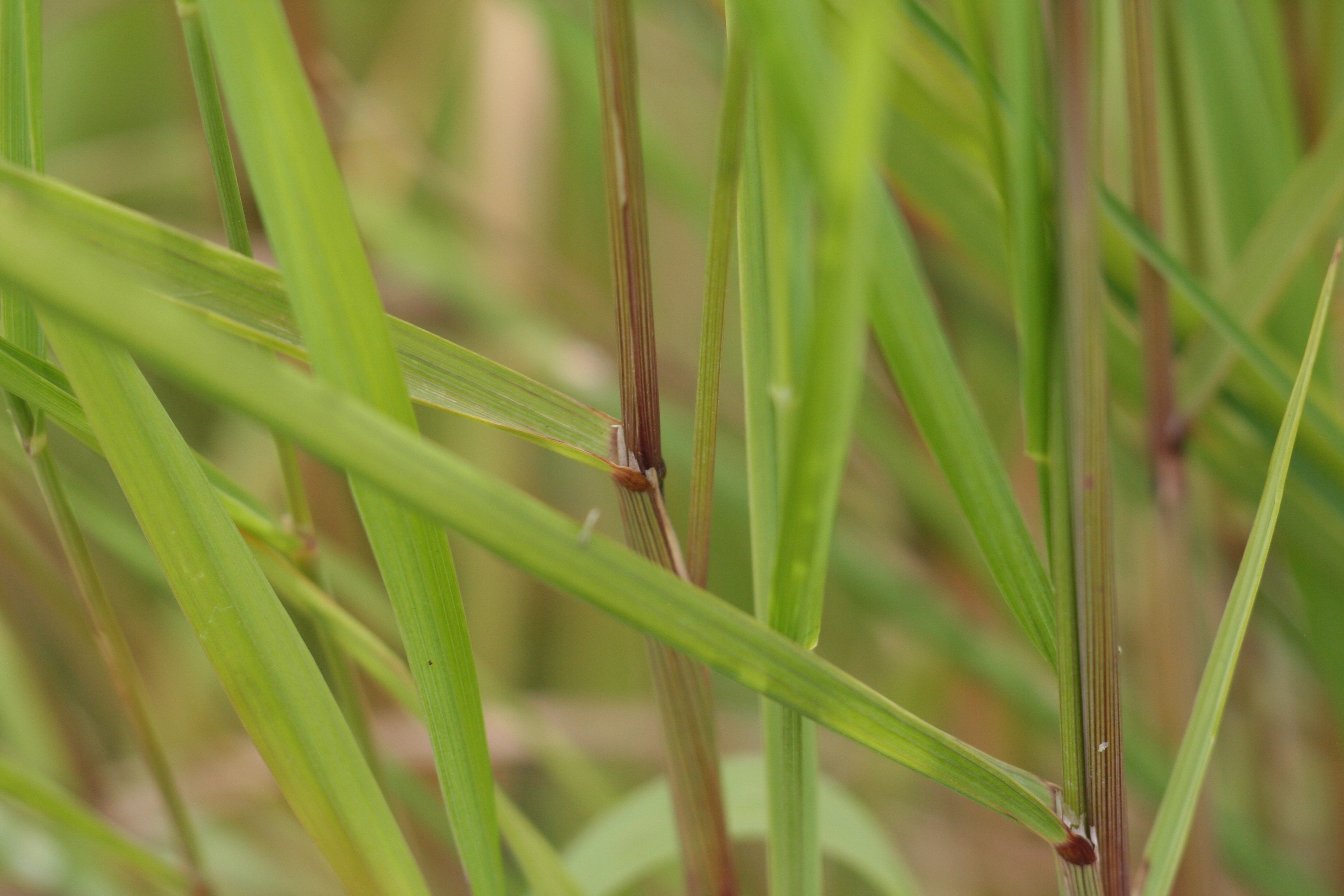
Leaf blades up to 12 in (30 cm) long and 3/16-3/8 in (3-8 mm) wide, leaf sheaths smooth with prominent veins; ligule is membranous, about 1/8 in (3 mm) tall; stems and nodes are hairless; dead leaves and stems accumulate from year to year in absence of fire, forming tussocks.
- Flower, fruit and seedhead
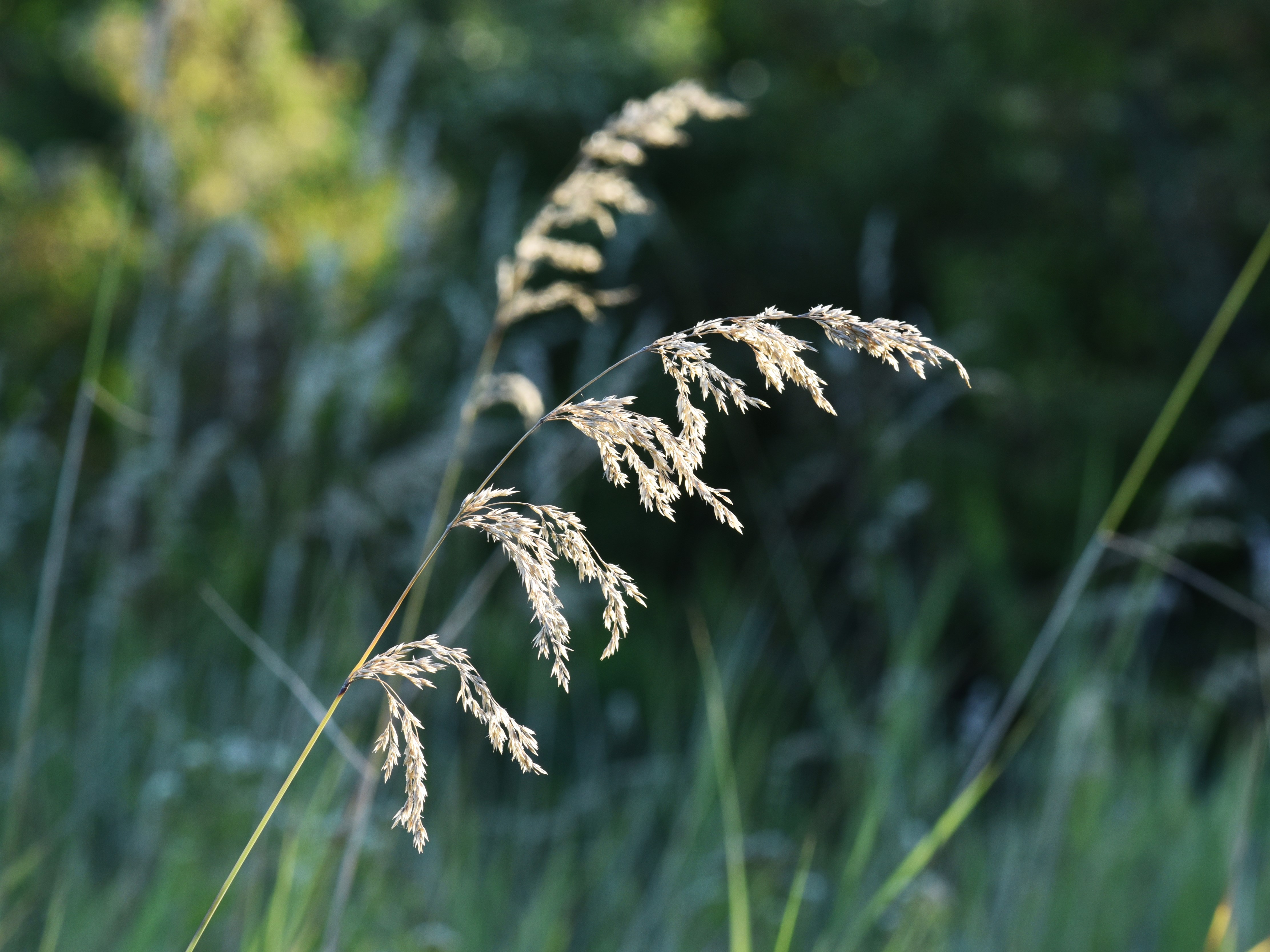
Fruit/seedhead: Mature seed head is a pale gold, loosely branched, plume-like panicle 4-8 in long (10-20 cm), tending to nod to one side; short “flag leaf” just below panicle tends to stick out at a 90 degree angle from the stem; florets fall off when mature, leaving glumes on the stalks.
Pollination: Wind
- Seed
Seed characteristics
Seed weight:
Seeds per ounce: 280,000 (IA NRCS)
Seeds per pound: 4,480,000 (IA NRCS)
1000 seed weight: 0.32 g (Seed Information Database)
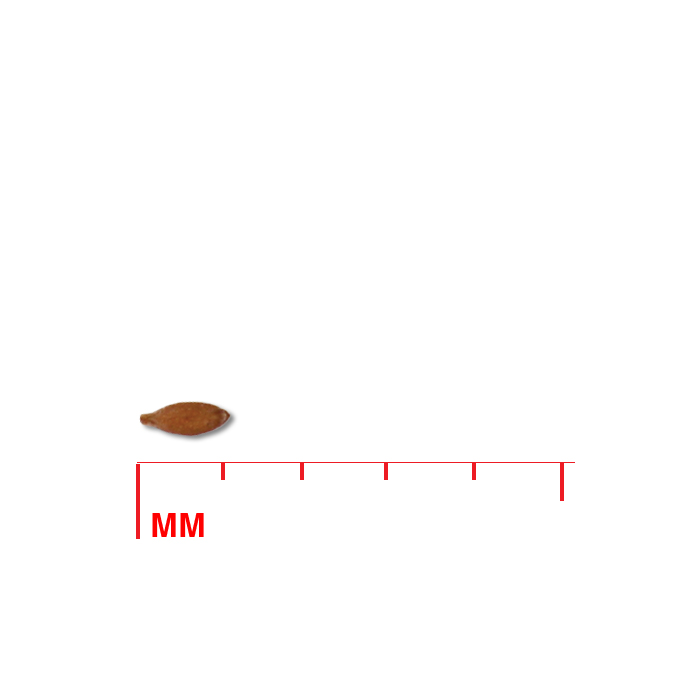
Description: Spikelets about 2 mm (3/32 in) long. Grain (caryopsis) about 1/32-1/16 in (1 mm) long, with tuft of hairs at the base slightly shorter than the grain.
Typical seed test
PLS: 90%
Purity: 95%
Germination: 73%
Dormant: 22%
(averages obtained from 4 tests of purchased seed lots)
- Habitat and range
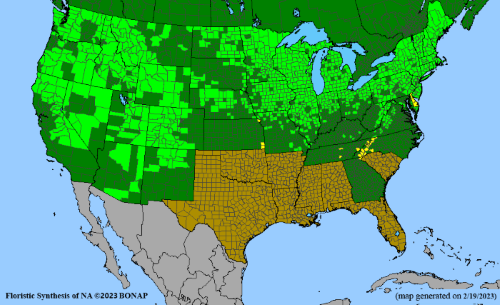
Habitat: Wet-mesic to wet soil; full sun; bogs, marshes, wet swales, along rivers and streams. Tolerates acidic soils up to pH 8 conditions; can tolerate anaerobic (low oxygen) conditions; prefers nutrient-rich, seasonally-inundated soils; irrigation is essential for optimal seed production on upland sites. Wetland Indicator Status is Obligate Wetland (OBL) for the Midwest.
Conservation status: Global- G5, secure; North Carolina, Delaware, and Kansas- S1, critically imperiled; Illinois- S3, vulnerable (NatureServe)
General Comments
Bluejoint is a highly rhizomatous species forming large colonies in preferred habitats, occupying sites even more wet than prairie cordgrass (Spartina pectinata) seems to prefer. Like prairie cordgrass, seed production occurs mostly on the outer edges of colonies, and is generally low. Bluejoint is best propagated in controlled conditions of the greenhouse, and transplanted into wide row spacings.
Recommendations for Seed Production
- Establishment for seed production
Direct seeding
Not recommended for this species
Greenhouse
Seed pre-treatment: No stratification necessary. Germination of grass seed usually improves with proper storage (cool, dry conditions) throughout the first year after harvest.
Sowing: Sow seed on surface of growing mix in greenhouse two months before last frost free date. Water carefully with a mist wand to avoid dislodging seed.
Transplanting: Transplant after all danger of frost. Greenhouse grown plugs can be transplanted into wide row spacing, 6-8 ft between rows, and plants should be 1-2 ft apart within the rows. This gives the newly established plants adequate root-space for rhizome spread, and promotes more flowering and seed set after establishment. Irrigate during establishment and as needed for flowering and seed production.
- Stand management
Weeds: Pre-emergent herbicides can be used after transplanting seedling plugs or pieces of rhizome. It’s critical to water-in transplants to seal soil around roots to prevent herbicide from coming into contact with and possibly damaging roots.
Pests: Nematode (Subanguina calamagrostis) invades leaf tissue and form galls, causing leaves to twist, and allowing subsequent infection by a fungus (Norton 1987).
Diseases: None noted.
- Seed production
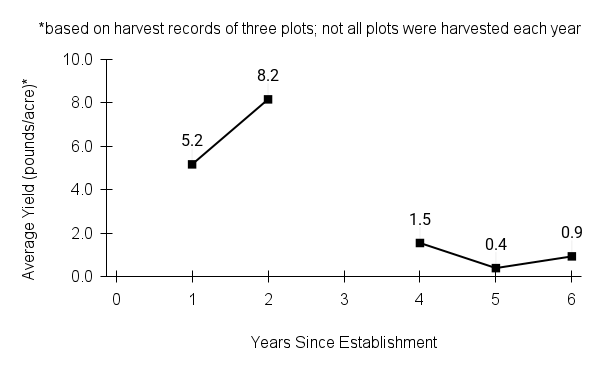 First harvest: Plants remain vegetative first growing season. Some flowering and seed set in the second growing season from greenhouse grown transplants.
Yield: 0.4-8.2 bulk pounds/acre (yields extrapolated based on production from 3 plots); commercial growers can achieve yields of 20-50 pounds per acre (USDA Plants Guide)
Stand life: Stands are long-lived in proper soils/hydrology. Seed production declines as stands become sod-bound in approximately 4-5 years. Flowering is patchy within a stand and may be higher on the edges of clones.
Flowering date: mid to late June in northern Iowa
Seed maturity: early July in northern Iowa
Seed retention: Shattering occurs soon after maturity, and seed is windblown. Monitor frequently for ripeness and be ready to harvest when inflorescences turn pale, fluffy, and open. The glumes stay on the plant when the seed drops, so seed heads can appear full even after they have shed much of their seed.
Harvest date range at TPC (2003-2008): June 29 - July 10
Recommended harvest method: Hand harvest or combine at maturity, but before dispersal. The seed is very light and wind-dispersed. Turn off air when combining.
- Seed cleaning and storage
Cleaning process: Thresh hand-collected material through 1/4 in screen. Brush seed to remove tuft of hairs at base of florets to improve flow of seed through airscreen (see settings in Appendix C).
Seed storage: Cool/dry (33-50° F, 30-50% RH).
Released Germplasm
Source Identified material: Natural Selections/Iowa Ecotype Zones 1, 2, and 3
Cultivated variety (cultivars): Sourdough (AK)
- References
Alaska DNR. (2007). ‘Sourdough’ Bluejoint Reedgrass Calamagrosis canadensis. [Infographic]. dnr.alaska.gov. https://dnr.alaska.gov/ag/akpmc/pdf/plant-flyers/SourdoughBluejoint.pdf
Chayka, K. (n.d.). Calamagrostis canadensis (Canada bluejoint). Minnesota Wildflowers. https://www.minnesotawildflowers.info/grass-sedge-rush/canada-bluejoint
Hilty, J. (2019). Bluejoint grass - Calamagrostis canadensis. Illinois Wildflowers. https://www.illinoiswildflowers.info/grasses/plants/bluejoint.html
Houseal, G. A. (2007). Grasses cool season. In G. A. Houseal (Eds.), Tallgrass Prairie Center’s native seed production manual (pp. 82–83). Tallgrass Prairie Center - University of Northern Iowa.
Kartesz, J.T., The Biota of North America Program (BONAP). 2023. North American Plant Atlas. (http://bonap.net/napa). Chapel Hill, N.C. [maps generated from Kartesz, J.T. 2023. Floristic Synthesis of North America, Version 1.0. Biota of North America Program (BONAP). (in press)]
Marr, K. L., Hebda, R. J., & Greenef, C. W. (2021). Calamagrostis canadensis (Michx.) P. Beauv. Flora of North America. http://floranorthamerica.org/Calamagrostis_canadensis
NatureServe. 2024. NatureServe Network Biodiversity Location Data accessed through NatureServe Explorer [web application]. NatureServe, Arlington, Virginia. Available https://explorer.natureserve.org/. (Accessed: February 29, 2024).
Norton, D.C., Cody, A.M., Gabel, A.W. (1987) Subanguina calamagrostis and Its Biology in Calamagrostis spp. in Iowa, Ohio, and Wisconsin. The Journal of Nematology, 19(2), 260-262. https://pmc.ncbi.nlm.nih.gov/articles/PMC2618621/
USDA NRCS National Plant Data Team. (n.d.). Calamagrostis canadensis (Michx.) P. Beauv. USDA plants database. https://plants.usda.gov/plant-profile/CACA4
Wynia, R.L. (2006, March 07) Bluejoint Reedgrass Calamagrostis canadensis (Michx.) Beaux. USDA NRCS Plant Guide. https://plants.usda.gov/DocumentLibrary/plantguide/pdf/pg_caca4.pdf
Species Guide Updated 12/1/2025