

spotted beebalm
Table of Contents

Monarda punctata, L.
Alternate Common Names: dotted horsemint, spotted horsemint, dotted monarda, dotted beebalm
Family: mint family (Lamiaceae)
Functional Group: forbs (wildflowers)
Description
- Life cycle and growth form
Short-lived perennial, spreading by rhizomes to form clumps with a bushy appearance.
Height: 1-3 ft

- Leaves and stem
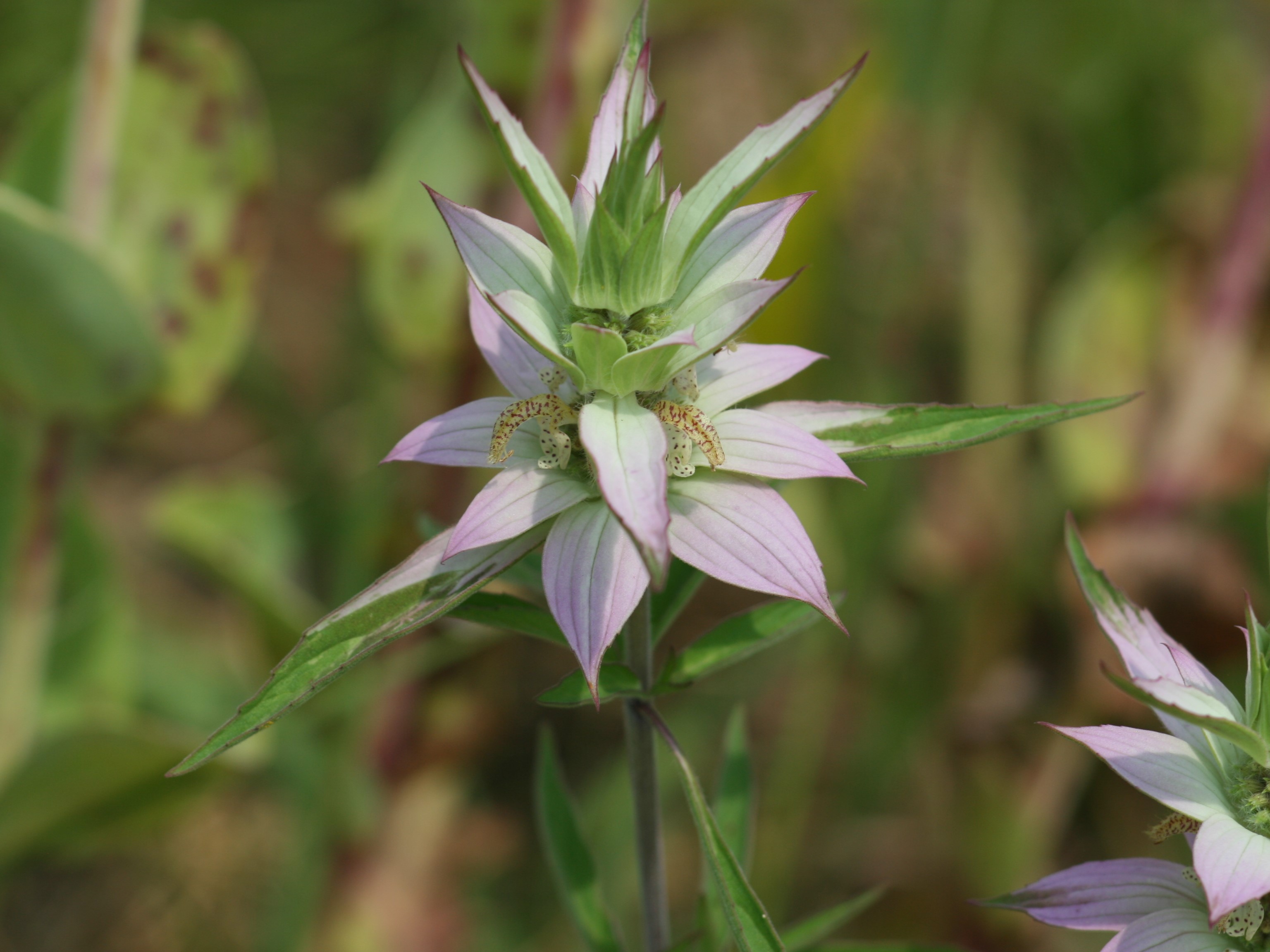
Leaves opposite, lance-shaped to narrowly lanceolate, 1-3 in long by 1/4 to 1/2 in wide, softly hairy; stems are brown to purple, 4-angled and branched sparingly, appearing frosted due to their coat of short, dense hairs.
- Flower, fruit and seedhead
Flower: Whorls of flowers form an interrupted spike at the end of branching stems, with showy, white to lavender-pink, leaf-like bracts at the base of each whorl that persist even after the flowers themselves wither; flowers are up to 1 in long, yellow with purple spots, tubular in shape with a distinct upper and lower lip.
Fruit/seed head: Calyx tubes (fused sepals of the flowers) persist as whorls around stem nodes after leaves drop; multiple whorls of seedheads per stem help distinguish this species from its congener M. fistulosa in seed; four nutlets develop within each calyx tube.
Pollination: Insects, especially solitary wasps.

- Seed
Seed characteristics
Seed weight:
Seeds per ounce: 90,000 seeds/oz (IA NRCS)
1000 seed weight: 0.27g (Seed Information Database)
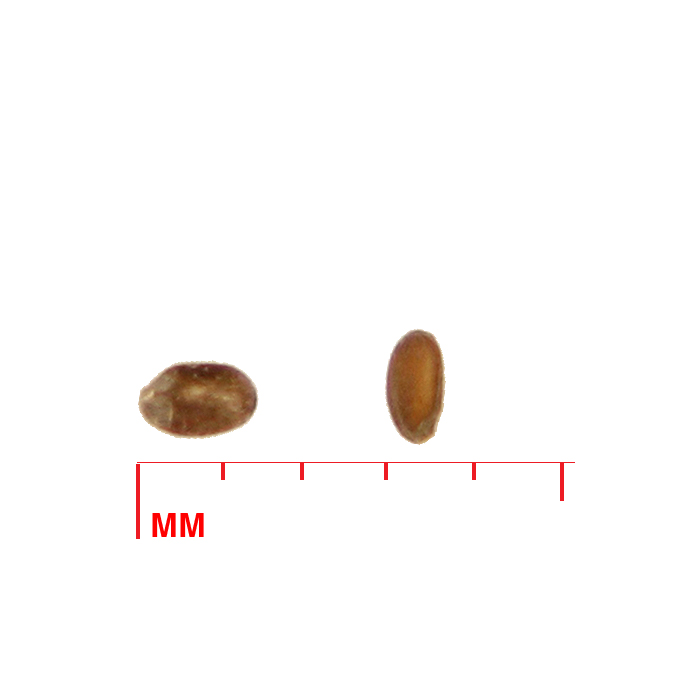
Description: “Seed unit” is a nutlet, oval in outline, smooth and brown, about 1-mm long.
Typical seed test
PLS: 90% (n = 2)
Purity: 92% (n = 2)
Germination: 20% (n = 1)
Dormancy: 83% (n = 2)
(averages obtained from n tests of purchased seed lots)
- Habitat and range
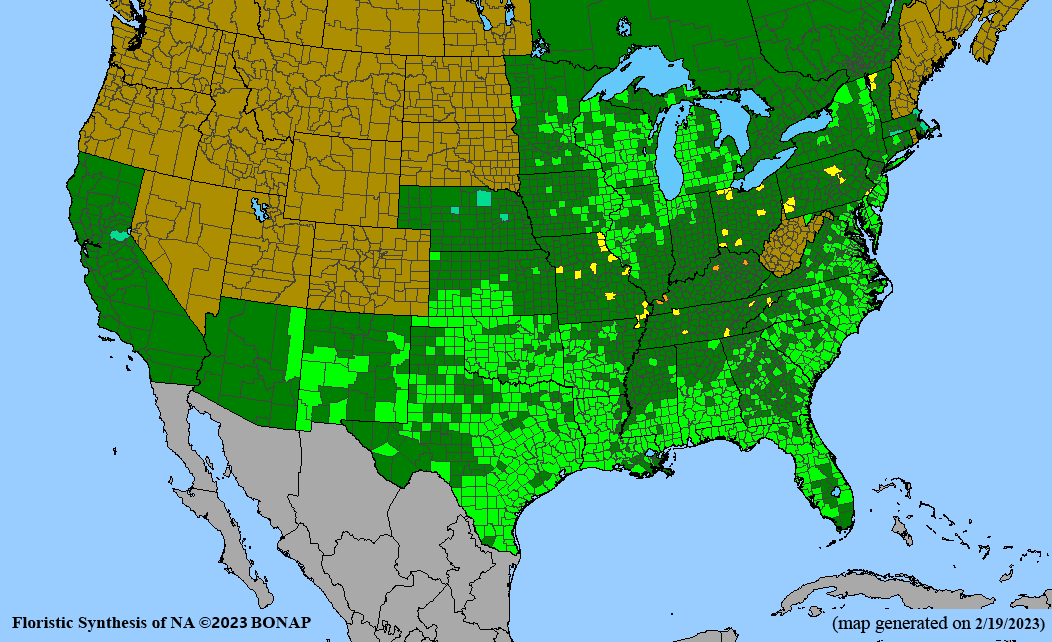
Habitat: Dry to mesic sandy soil; full sun; sand and hill prairies, sandy savannas, sand dunes, sandy fields; Wetland Indicator Status is Obligate Upland (UPL) for the Midwest; very well drained soils are recommended for seed production.
Conservation status: Global- G5, secure; Ohio, Pennsylvania, and Vermont- S1, critically imperiled; in all other states within its natural range, status is S4 (apparently secure) to S5 (secure) or unranked (NatureServe)
General Comments
Spotted beebalm is in the same genus as wild bergamot, M. fistulosa, but is found in habitats with sandy soils. Spotted beebalm differs from wild bergamot in having multiple whorls of flowers along a stem and white to lavender bracts beneath each flower cluster that are showier than the flowers themselves. Spotted beebalm has a long blooming season from mid to late summer, and remains showy after the flowers drop due to its persistent bracts. Its primary pollinators are solitary wasps such as great black wasps and golden digger wasps which drink nectar as adults but supply their young with insect prey. As wasps visit the flowers to sip nectar, the flowers’ stamens dust their thoraxes thickly with yellow pollen. When wasps are feeding at the flowers, they are not aggressive, and we have never been stung even when working among hundreds of plants (and their attendant wasps) in a plot. Spotted beebalm is short-lived in production plots but produces a lot of seed per plant and is relatively uncomplicated to manage, harvest, and clean.
Recommendations for Seed Production
- Establishment for seed production
Direct seeding
We do not have experience with direct seeding this species for seed production.
Greenhouse
Seed pre-treatment: Cold/moist stratification for 30 days may improve germination. Seed test reports suggest that a proportion of seeds may be dormant, though this is highly variable. Not using dormancy breaking procedures risks loss of dormancy-related genetic traits from production populations.
Sowing: Surface sow in the greenhouse about 2 months before the average date of last frost. Use caution when watering to avoid splashing seeds off the surface.
Transplanting: When plugs are well-rooted, move them outside to harden off, then transplant at 8-12 inch intervals into rows prepared with plastic mulch.
- Stand management
Weeds: Prepare clean, weed-free beds. Use plastic mulch to suppress weeds during the first growing season. Remove the mulch at the end of the season to allow plants to form clumps and to prevent moisture buildup. Mow or cultivate between rows and hand weed or rogue to prevent small-seeded weeds from contaminating the seed lot.
Pests: None noted.
Diseases: None noted.
- Seed production
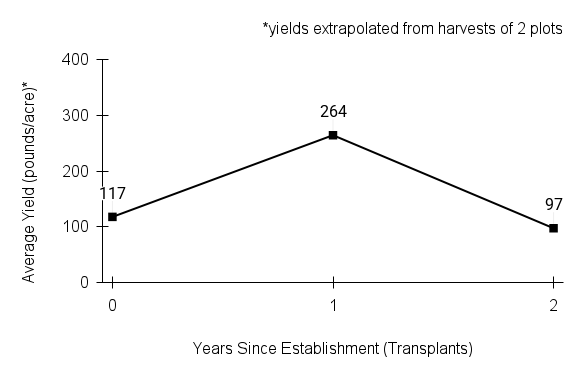 First harvest: Plants flower and set seed in the establishment year (from transplants), reaching peak harvest in the second year.
 Yield/acre: 120-260 pounds per acre (extrapolated from harvests of two plots)
Stand life: Plots are productive for two to three years. Subsequent yield declines are due to plant mortality in this short-lived species.
Flowering date: early July to late August in northeast Iowa
Seed maturity/Harvest date: mid September to mid October
Seed retention: Fairly low risk of shattering, except during high wind events.
Harvest date range at TPC (2017-2019): September 10 - October 18
Recommended harvest method: Hand clip early maturing plants, then combine when plot is at peak maturity.
- Seed cleaning and storage
Cleaning process: Brush to release seed remaining in calyx tubes, then airscreen.
Seed storage: cool/dry (33-50° F, 30-50% RH)
Released Germplasm
Source Identified material: Natural Selections/Iowa Ecotype Zone 2 (central Iowa) and Zone 3 (southern Iowa)
- References
Chayka, K. (n.d.). Monarda punctata (spotted horsemint). Minnesota Wildflowers. https://www.minnesotawildflowers.info/flower/spotted-horsemint
Christiansen, P., & Muller, M. (1999). Lamiaceae. An Illustrated Guide to Iowa Prairie Plants. (p.122). University of Iowa Press.
Cochrane, T. S., Elliot, K., & Lipke, C. S. (2014). Dotted horsemint. In Prairie plants of the University of Wisconsin-Madison Arboretum (3rd ed., p. 219). University of Wisconsin-Madison Arboretum.
Hilty, J. (2019). Spotted bee balm - Monarda punctata. Illinois Wildflowers. https://www.illinoiswildflowers.info/prairie/plantx/sp_balm.htm
Kartesz, J.T., The Biota of North America Program (BONAP). 2023. North American Plant Atlas. (http://bonap.net/napa). Chapel Hill, N.C. [maps generated from Kartesz, J.T. 2023. Floristic Synthesis of North America, Version 1.0. Biota of North America Program (BONAP). (in press)]
Missouri Botanical Garden. (n.d.). Monarda punctata. Missouri Botanical Garden - Plant Finder https://www.missouribotanicalgarden.org/PlantFinder/PlantFinderDetails.aspx?taxonid=281405
NatureServe. 2024. NatureServe Network Biodiversity Location Data accessed through NatureServe Explorer [web application]. NatureServe, Arlington, Virginia. Available https://explorer.natureserve.org/. (Accessed: February 29, 2024).
USDA NRCS National Plant Data Team. (n.d.). Monarda punctata L. USDA plants database. https://plants.usda.gov/home/plantProfile?symbol=MOPU
Species Guide Updated 12/22/2025