

New England aster
Table of Contents

Symphyotrichum novae-angliae (L.) Nelson
Alternate Common Names: New England American-aster, purple meadow aster
Scientific Synonyms: Aster novae-angliae L., Lasallea novae-angliae (L.) Semple & L. Brouillet, Virgulus novae-angliae (L.) Reveal & Keener
Family: aster family (Asteraceae)
Functional Group: forbs (wildflowers)
Description
- Life cycle and growth form
Perennial from short thick rhizomes.
Height: 3-4 ft
- Leaves and stem

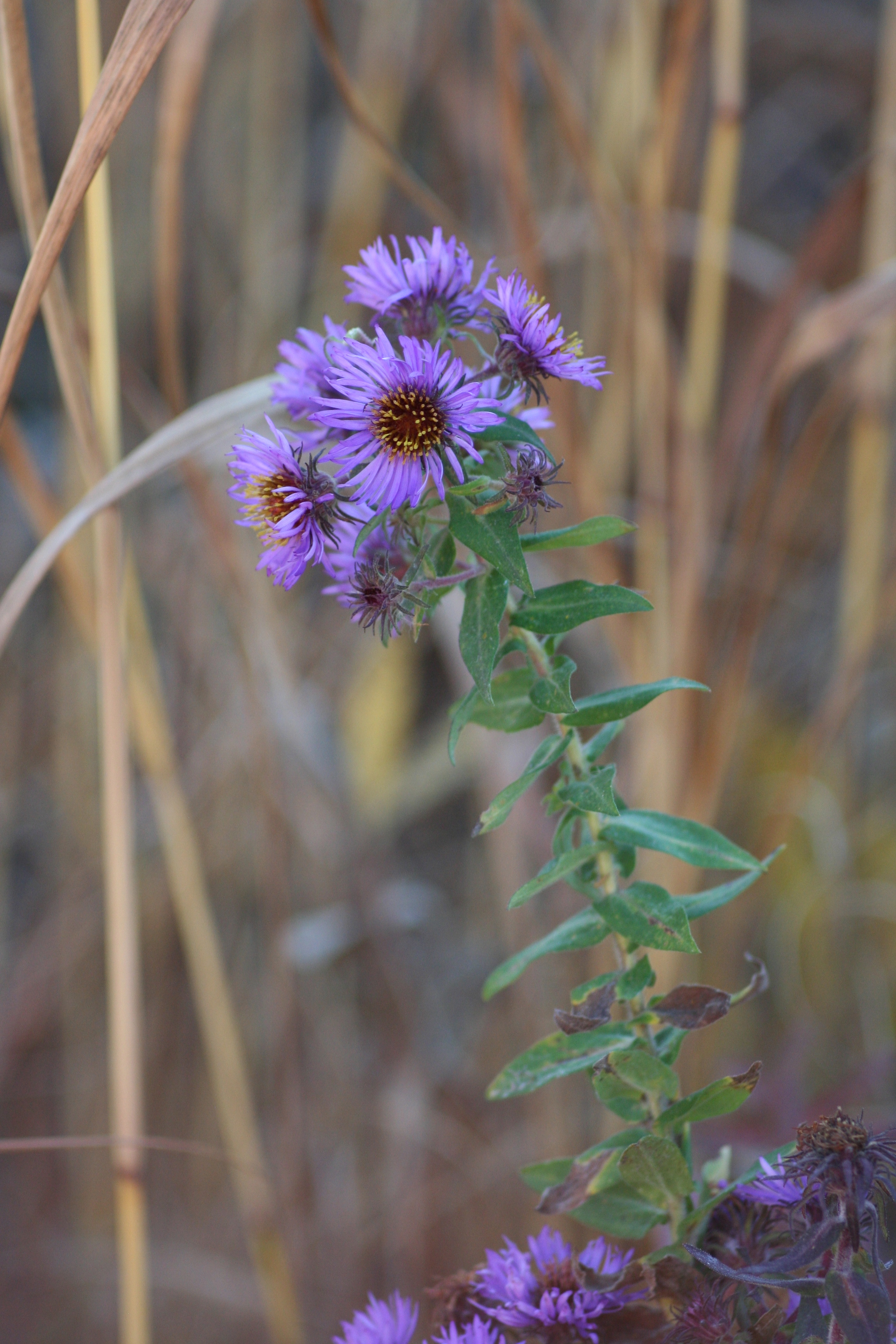
Leaves alternate with leaf bases clasping the stem, softly hairy on the underside, closely spaced and persistent near the top of the plant; stem is hairy, reddish brown in color, mostly unbranched except within the inflorescence.
- Flower, fruit and seedhead
Flower: Composite flowerheads 1 to 1 1/2 in across with purple rays (occasionally pink or white) and yellow disk flowers, with long, spreading bracts (phyllaries) on the underside of each head. A single stem may bear 30-50 flowerheads in a panicle-like cluster.
Fruit/seedhead: Small hairy “seed” (achene) with a tuft (pappus) of light brown hairs. Seeds are wind-dispersed fairly soon after the pappus expands.
Pollination: Insects, primarily bees, flower flies, and butterflies.

- Seed
Seed characteristics
Seed weight:
Seeds per ounce: 66,000 (IA NRCS)
1000 seed weight: 0.66 g (Seed Information Database)
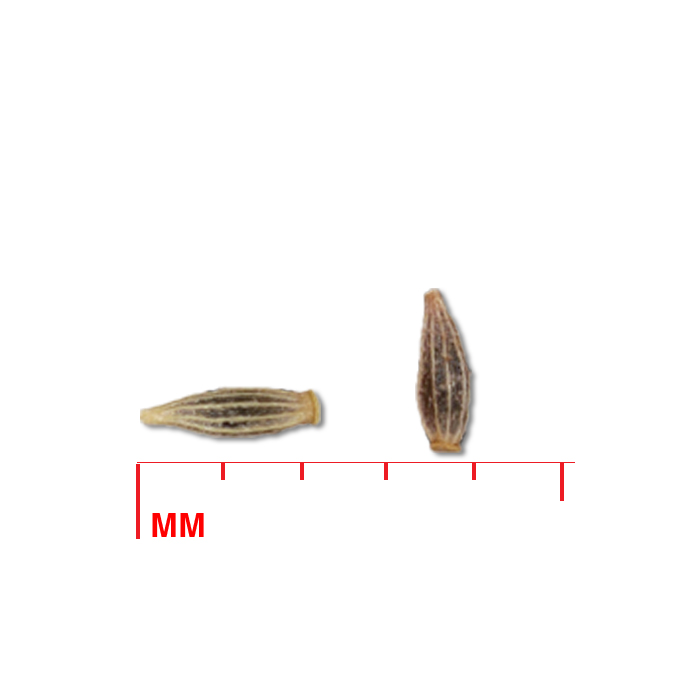
Description: ‘Seeds’ are fruits 1/16 in long (achenes), with hairs attached to all parts of the seed coat.
Typical seed test
PLS: 86% (n = 10)
Purity: 92% (n = 10)
Germination: 37% (n = 9)
Dormant: 45% (n = 9)
(averages obtained from n tests of purchased seed lots)
- Habitat and range
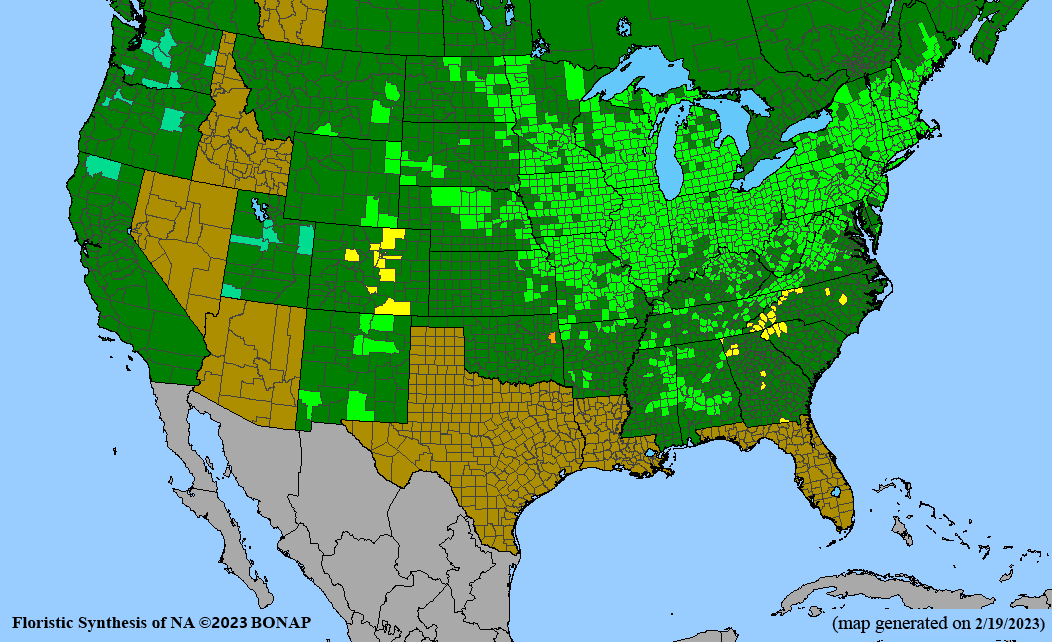
Habitat: Wet-mesic soil conditions, prairie swales, wet meadows, full sun; Wetland Indicator Status is Facultative Wetland (FACW) for the Midwest. Avoid poorly drained clay soils for seed production purposes.
Conservation status: Global- G5, secure; Oklahoma- SH, possibly extirpated; Georgia, South Carolina, and Wyoming- S1, critically imperiled; Colorado- S2, imperiled; Kansas and North Carolina- S3, vulnerable (NatureServe)
General Comments
This species is easy to propagate in the greenhouse. Though this species establishes readily in prairie reconstructions, weedy competition will severely curtail establishment and seed yield for seed production purposes. Fine hairs arise from nearly the entire surface of the seed, requiring thorough brushing/debearding to remove for good airscreen separation.
Recommendations for Seed Production
- Establishment for seed production
Direct seeding
Not recommended for this species
Greenhouse
Seed pre-treatment: Wet stratify 8 weeks at 40° F.
Sowing: Sow seed in the greenhouse 2 months before the last frost-free date.
Transplanting: Harden-off, transplant into bare soil in rows or weed barrier at 8-12 in intervals after all danger of frost.
- Stand management
Weeds: Post emergence grass herbicide, tillage, hand roguing. Weed pressure severely curtails establishment and seed production of this species.
Pests: Rabbits and other mammalian herbivores seem to favor eating foliage of this and other aster species and will keep plants pruned to 8 in throughout the growing season, particularly in the establishment year.
Diseases: Powdery mildew.
- Seed production
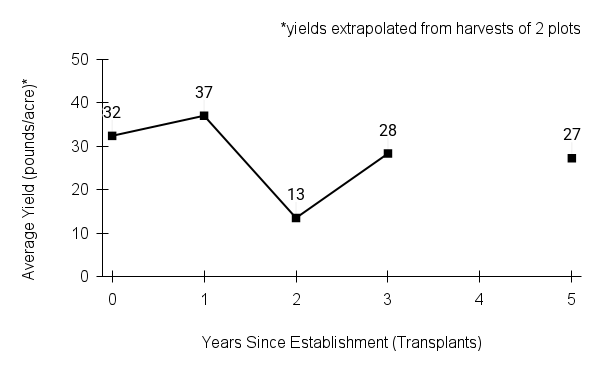 First harvest: Flowering and seed set at the end of first growing season from greenhouse grown transplants.
Yield: 20-40 bulk pounds/acre (per acre yield extrapolated based on harvests from 2 plots)
Stand life: Peak harvests 1st and 2nd year. Seed production declines significantly 3rd year and after. For ornamental purposes, plants of this species are commonly pinched back through mid-summer to increase bushiness and flowering. Whether this would also increase seed production has not been demonstrated.
Flowering date: Late August - September in northern Iowa
Seed maturity/Harvest date: Mid-September - October in northern Iowa
Seed retention: Seeds are wind dispersed very soon after maturity.
Harvest date range at TPC (2004-2009): Oct 6-25
Recommended harvest method: Combine after seed maturity but before more than 10% of the seed heads have turned brown and fluffy. Otherwise, combining will simply contribute to dispersal of the seed crop. Harvested material will have to be forced-air dried and turned carefully to prevent mold and decay.
- Seed cleaning and storage
Cleaning process: Pre-clean air-dried material by scalping through 1/2 in and 1/4 in mesh to remove large particles. Remove plumes with a debearder or brush machine, then air-screen.
Seed storage: cool/dry (32-40 F, 40-60% RH)
Released Germplasm
Source Identified material: Natural Selections/Iowa Ecotype Project Central Iowa Germplasm (IA Zone 2), Northern Iowa Germplasm (IA Zone 1), Southern Iowa Germplasm (IA Zone 3)
Cultivated variety (cultivars): Horticultural varieties also exist.
- References
Chayka, K. (n.d.). Symphyotrichum novae-angliae (New England aster). Minnesota Wildflowers. https://www.minnesotawildflowers.info/flower/new-england-aster
Hilty, J. (2019). New England aster - Symphyotrichum novae-angliae. Illinois Wildflowers. https://www.illinoiswildflowers.info/prairie/plantx/ne_asterx.htm
Houseal, G. A. (2007). Forbs wildflowers. In G. A. Houseal (Eds.), Tallgrass Prairie Center’s native seed production manual (pp. 52–53). Tallgrass Prairie Center - University of Northern Iowa.
Kartesz, J.T., The Biota of North America Program (BONAP). 2023. North American Plant Atlas. (http://bonap.net/napa). Chapel Hill, N.C. [maps generated from Kartesz, J.T. 2023. Floristic Synthesis of North America, Version 1.0. Biota of North America Program (BONAP). (in press)]
NatureServe. 2024. NatureServe Network Biodiversity Location Data accessed through NatureServe Explorer [web application]. NatureServe, Arlington, Virginia. Available https://explorer.natureserve.org/. (Accessed: February 29, 2024).
USDA NRCS National Plant Data Team. (n.d.). Symphyotrichum novae-angliae (L.) G.L. Nesom. USDA plants database. https://plants.usda.gov/home/plantProfile?symbol=SYNO2
Species Guide Updated 12/10/2025