

bluejacket
Table of Contents

Tradescantia ohiensis Raf.
Alternate Common Names: Ohio spiderwort, common spiderwort, cow-slobbers, snotweed, smooth spiderwort
Scientific Synonyms: Tradescantia canaliculata Raf., Tradescantia foliosa Small, Tradescantia incarnata Small, Tradescantia ohiensis Raf. var. foliosa (Small) MacRoberts, Tradescantia reflexa Raf., Tradescantia barbata
Family: dayflower or spiderwort family (Commelinaceae)
Functional Group: forbs (wildflowers)
Description
- Life cycle and growth form
Perennial from fibrous, fleshy roots.
Height: 1.5 -2.5 ft

- Leaves and stem
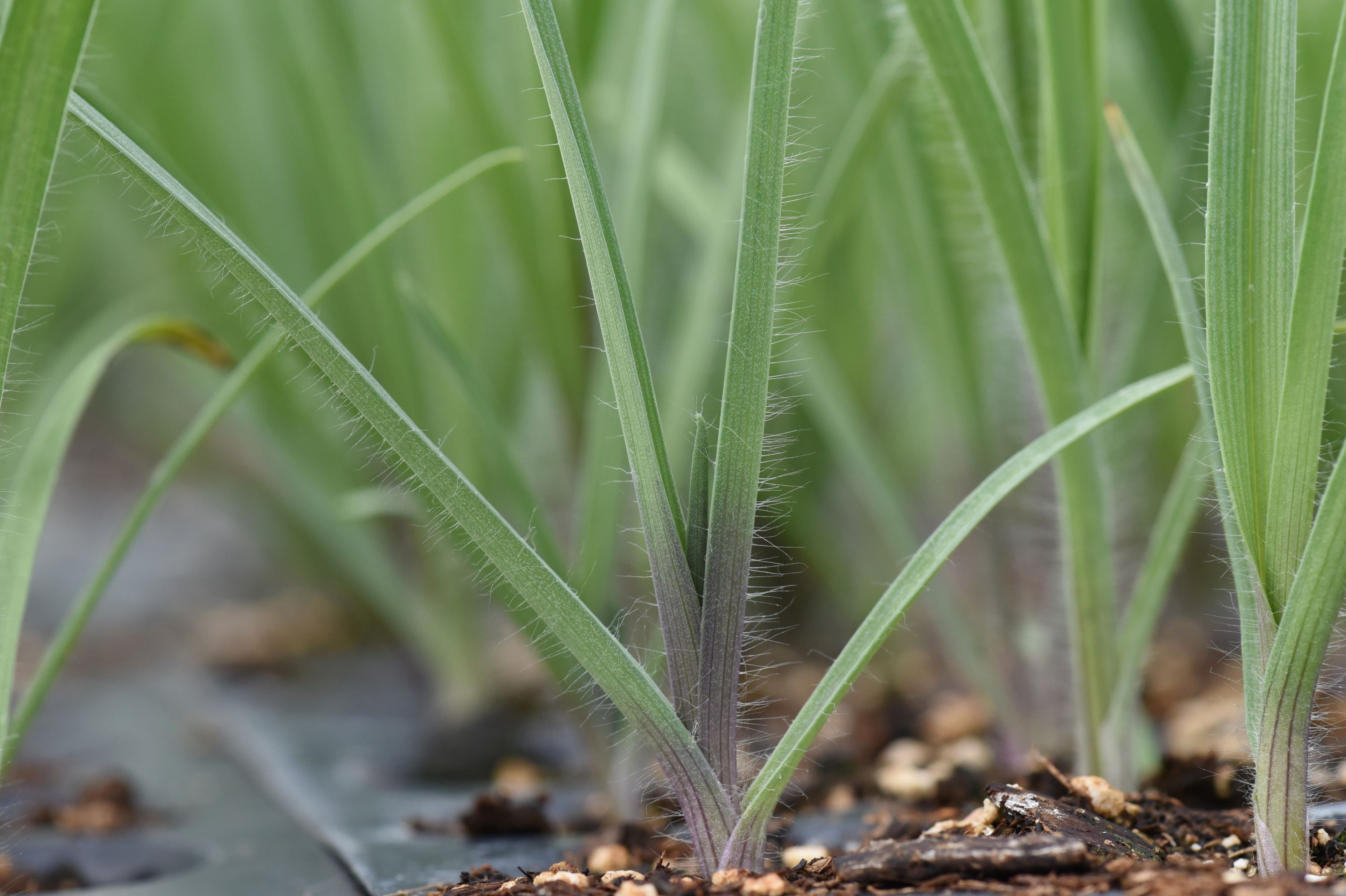
Leaves smooth, grass-like and almost succulent with a waxy bluish-green sheen, alternate, joining main stem as a sheath, generally hairless at maturity although leaves of seedlings may have hairs; stem smooth, unbranched.
- Flower, fruit and seedhead
Flower: Clusters of few to many buds at stem tip and upper leaf axils; flower buds bent downwards within a cluster, bending upwards on smooth flowering stalks as each bud flowers; flowers with three blue-violet petals (occasionally white to light purple) and 6 yellow anthers with fine violet hairs at base; sepals smooth and hairless (helping distinguish this species from T. bracteata); each flower opens for a day, primarily in the morning hours.
Fruit/seedhead: Dark gray to black seeds develop inside three-parted capsules that split open and drop seed at maturity, starting at the base of a flower cluster.
Pollination: Insects, primarily bumblebees. Spiderworts produce pollen but no nectar.

- Seed
Seed characteristics
Seed weight:
Seeds per ounce: 8,000 (IA NRCS)
Seeds per pound: 128,000 (IA NRCS)
1000 seed weight: 3.66 g (Seed Information Database)
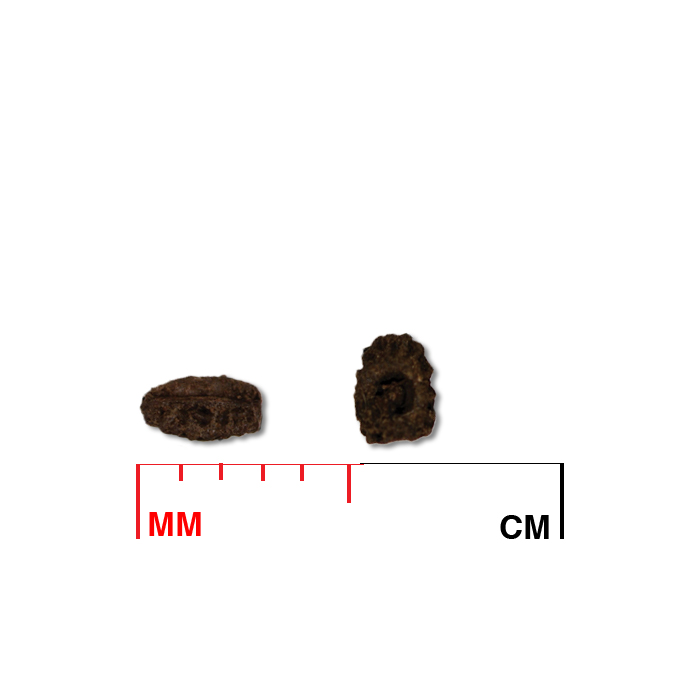
Description: Seeds develop inside three-parted capsules that split open and drop seed at maturity. Seed coats are dark gray to black with intricate, wrinkled ornamentation.
Typical seed test
PLS: 91% (n = 11)
Purity: 98% (n = 10)
Germination: 6% (n = 7)
Dormant: 89% (n = 8)
(averages obtained from n tests of purchased seed lots)
- Habitat and range
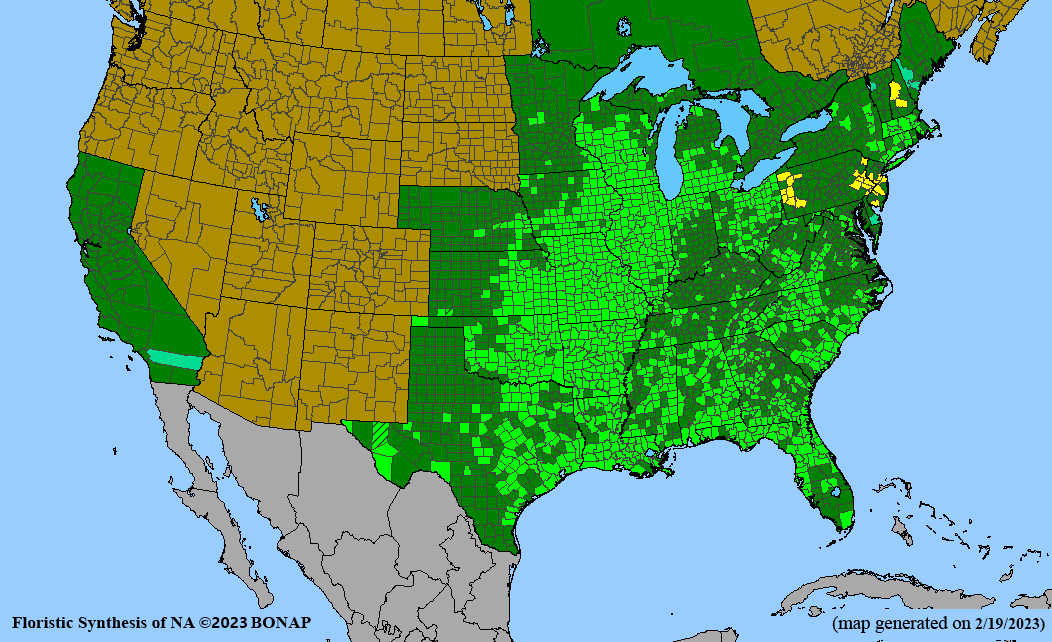
Habitat: Mesic soils, prefers sandy soils in remnant prairies and open woodlands, often in areas with some disturbance; Wetland Indicator Status is Facultative Upland (FACU) for the Midwest; full sun and well-drained loam soils preferred for seed production.
Conservation status: Global- G5, secure; New Jersey- S2, imperiled. (NatureServe)
General Comments
This species is easily propagated in the greenhouse for transplanting into production beds. Plants establish readily in prairie restorations and will spread with good management. Timing of seed harvest is challenging, since flowering and seed maturity occur gradually, and the sepals in the flower clusters may still appear green and fleshy even after much of the seed has dropped. Also, plants have a slimy, sticky sap (hence the unglamorous but obvious common name ‘snotweed’), which makes direct combining inadvisable.
Recommendations for Seed Production
- Establishment for seed production
Direct seeding
Row spacing: 30-36 in rows
PLS pounds/acre: 4.5
Seeds per linear foot: 40
Seeding depth: 1/4 in
Seeding method: native seed drill
Seeding time: dormant season
Weed control: Prepare clean, firm, weed free seedbed prior to seeding.
Greenhouse
Seed pre-treatment: High percentage of dormancy, seed must be wet stratified 12 weeks at 40°F.
Sowing: Sow seed at 1/4 in depth in greenhouse 2 months before the last frost-free date.
Transplanting: Transplant into bare soil at 30-36 in row spacing or into a weed barrier at 8-12 in spacing after all danger of frost is past.
- Stand management
Weeds: Post emergence grass herbicide, tillage, hand roguing.
Pests: None noted. Rabbits and deer will browse foliage.
Diseases: None noted.
- Seed production
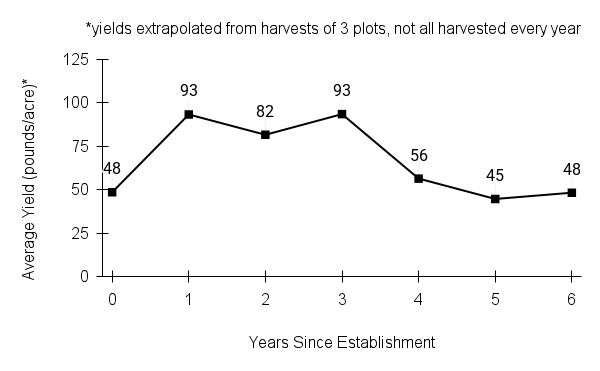 First harvest: Some flowering and seed set ( 24-48 bulk pounds/acre) at the end of the first growing season from greenhouse grown transplants.
 Yield: 40-100 bulk pounds/acre (per acre yields extrapolated based on production from 3 plots, not all of which were harvested each year)
Stand life: Peak harvests in the second and third full growing season after establishment. Seed production declined somewhat 4th year and was about half peak harvest 5th year. Chisel plowing can reinvigorate stands. Spiderwort is reportedly tolerant of low rates (1%) of glyphosate.
Flowering date: Late May - late June in northern Iowa
Seed maturity/Harvest date: June - mid-July in northern Iowa
Seed retention: Shattering occurs as soon as seed ripens in each capsule within a cluster. Monitor plots frequently during the later part of the flowering season. Turn over flower clusters and observe for opened capsules. Aim to harvest when a few capsules are open on most heads even though some flowers may still be present. The color of sepals changes as the capsules mature; this is helpful but variable and not a consistent indicator of readiness.
Harvest date range at TPC (2003-2023): June 24 - July 23 (but first year stands from transplants may mature much later than is typical)
Recommended harvest method: Hand pick seed heads and dry on tarps for several days with good air circulation. If piles are thick, turn often to avoid mold. Most seed will be released from capsules as they dry, and threshing largely entails simply scalping off the dried vegetative material. Large fields may be machine swathed, but seed will shatter out of heads as material dries down.
- Seed cleaning and storage
Cleaning process: Pre-clean air-dried material by scalping through 1/2 in and 1/4 in mesh to remove large particles, and then air-screen. Hard seed coats can visually mask seed quality. Aspiration (air screening) of seed is critical to remove unfilled but otherwise normal-looking seed.
Seed storage: cool/dry (50°F, 30% RH)
Released Germplasm
Source Identified material: Natural Selections/Iowa Ecotype Zone 1 (northern Iowa), Zone 2 (central Iowa), and Zone 3 (southern Iowa)
- References
Chayka, K. (n.d.). Tradescantia ohiensis (Ohio spiderwort). Minnesota Wildflowers. https://www.minnesotawildflowers.info/flower/ohio-spiderwort
Cochrane, T. S., Elliot, K., & Lipke, C. S. (2014). Common spiderwort. In Prairie plants of the University of Wisconsin-Madison Arboretum (3rd ed., p. 155). University of Wisconsin-Madison Arboretum.
Gleason, H. A., & Cronquist, A. (1991). Commelinaceae. In Manual of Vascular Plants of Northeastern United States and Adjacent Canada (2nd ed., p. 655). The New York Botanical Garden.
Hilty, J. (2019). Ohio spiderwort - Tradescantia ohiensis. Illinois Wildflowers. https://www.illinoiswildflowers.info/prairie/plantx/oh_spiderwortx.htm
Houseal, G. A. (2007). Forbs wildflowers. In G. A. Houseal (Eds.), Tallgrass Prairie Center’s native seed production manual (pp. 54–55). Tallgrass Prairie Center - University of Northern Iowa.
Kartesz, J.T., The Biota of North America Program (BONAP). 2023. North American Plant Atlas. (http://bonap.net/napa). Chapel Hill, N.C. [maps generated from Kartesz, J.T. 2023. Floristic Synthesis of North America, Version 1.0. Biota of North America Program (BONAP). (in press)]
NatureServe. 2024. NatureServe Network Biodiversity Location Data accessed through NatureServe Explorer [web application]. NatureServe, Arlington, Virginia. Available https://explorer.natureserve.org/. (Accessed: February 29, 2024).
USDA NRCS National Plant Data Team. (n.d.). Tradescantia ohiensis Raf. USDA plants database. https://plants.usda.gov/home/plantProfile?symbol=TROH
Species Guide Updated 12/11/2025