hairy wildrye
hairy wildrye dickeye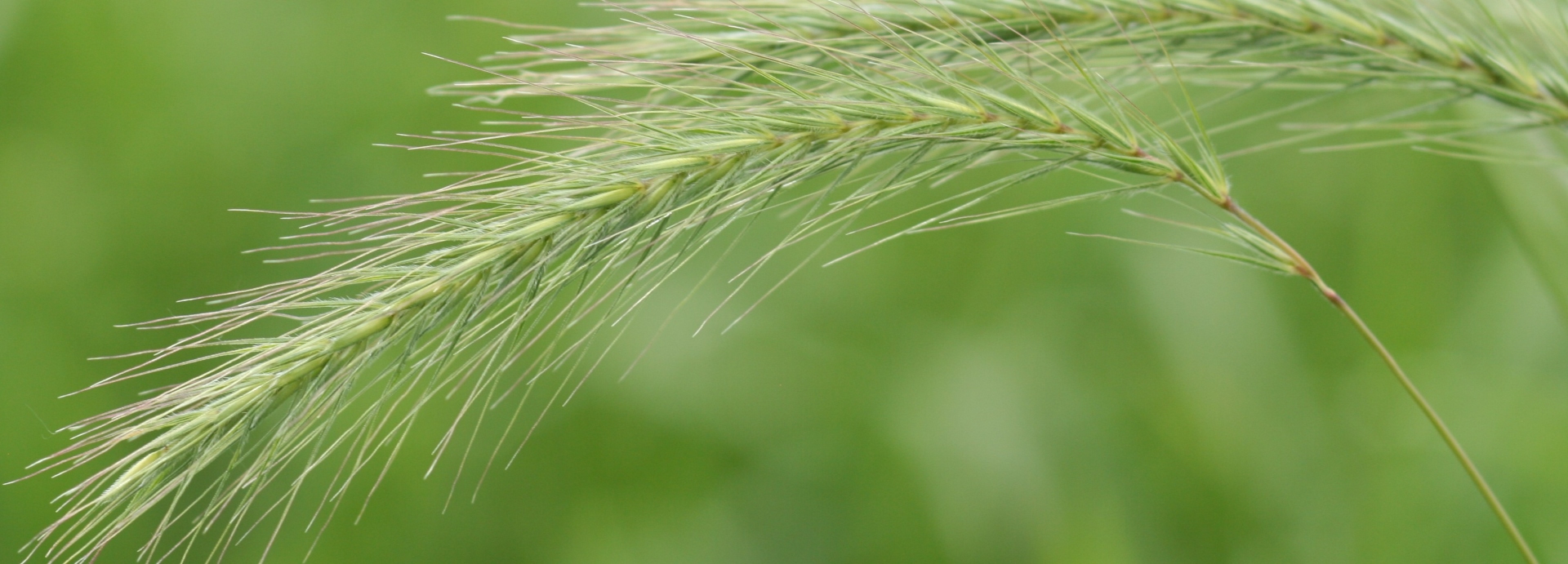
Elymus villosus, Muhl. ex Willd
Alternate Common Names: silky wildrye, downy wildrye
Scientific Synonyms: Elymus arkansanus Scribn. & C.R. Ball, Elymus canadensis L. var. Villosus (Muhl. ex Willd.) Shinners, Elymus villosus Muhl. ex Willd. var. Arkansanus (Scribn. & C.R. Ball) J.J.N. Campbell, Terrellia villosa (Muhl. ex Willd.) Baum
Family: grass family (Poaceae)
Functional Group: cool season grass
Description
- Life cycle and growth form
Perennial, cool season grass from fibrous roots (no rhizomes), forming leafy tufts.
Height: 2.5 - 3.5 ft

- Leaves and stem
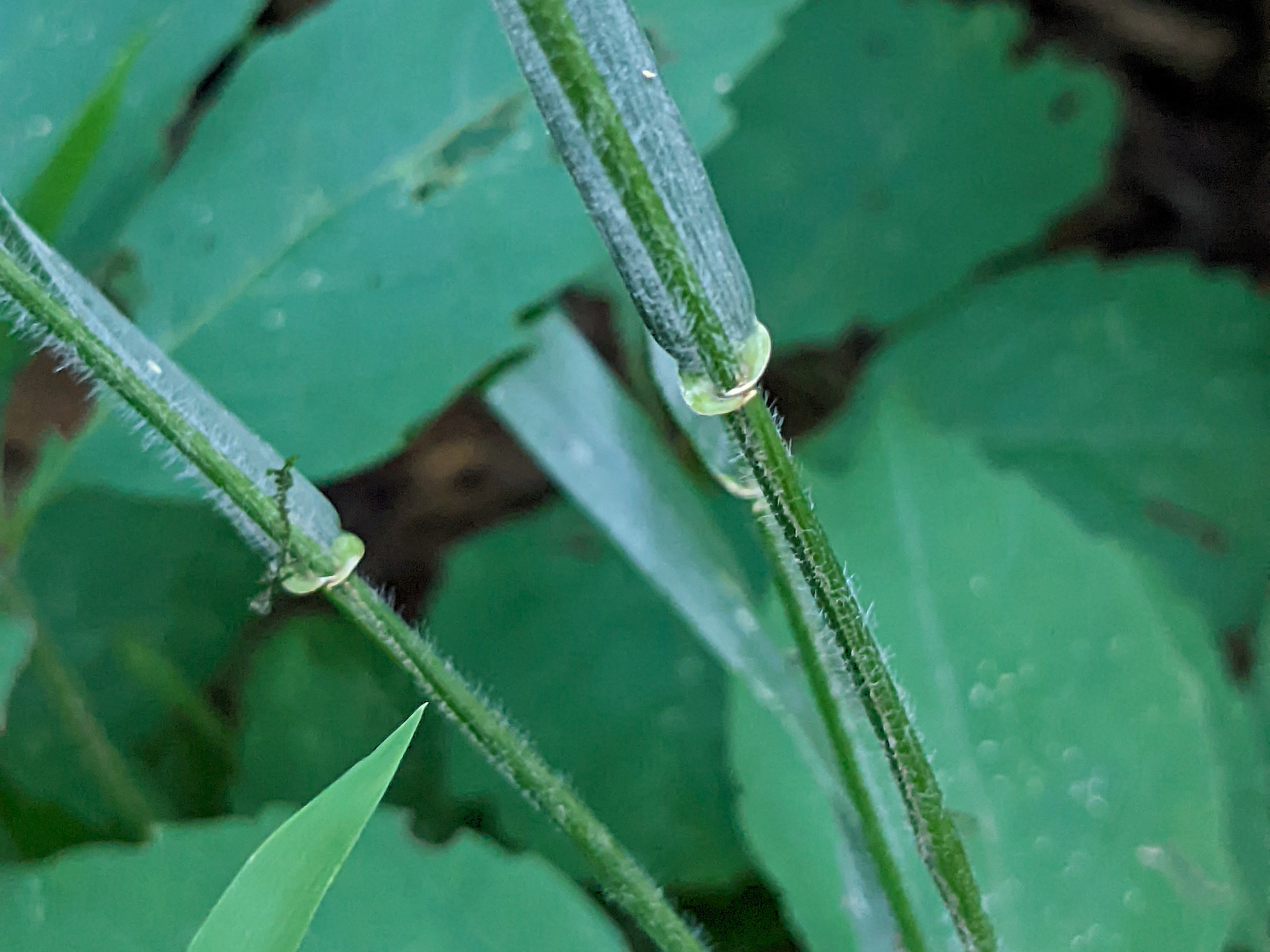
Leaves flat, dark green with a soft texture from their abundant short, silky hairs; sheath is often hairy; two small purplish projections at the collar (auricles) wrap partly to all the way around the stem.
- Flower, fruit and seedhead
Fruit/seedhead: Inflorescence a single, nodding spike per culm, 1.5 - 5 in long, with many spikelets, bristly due to long awns (1 to 1 1/2 in long) on glumes and lemmas; glumes and lemma (one of the pair of bracts around the grain) are finely hairy.
Pollination: wind

- Seed
Seed characteristics
Seed weight:
Seeds per ounce: 5,500 seeds/oz (IA NRCS)
1000 seed weight: 3.30g (Seed Information Database)
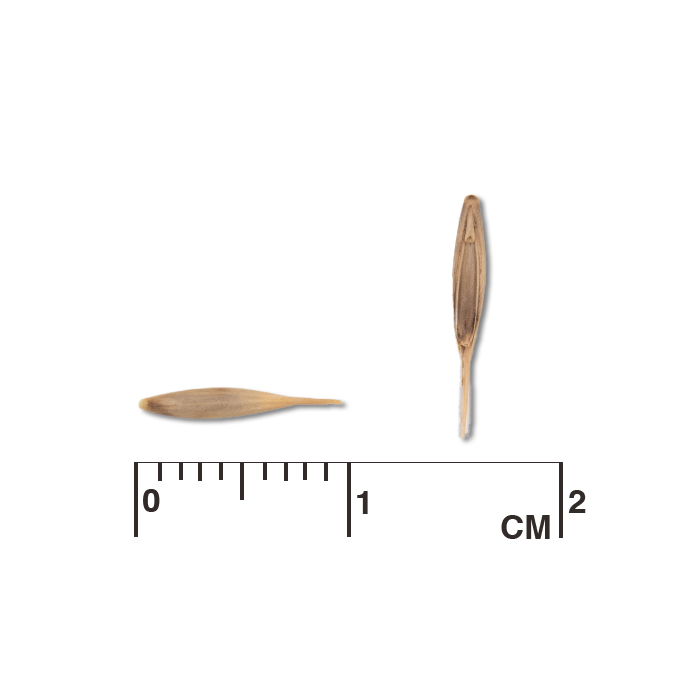
Description: Typical seed unit consists of sterile bracts (lemma and palea) enclosing the elliptical grain (1.5 mm by 5-6 mm).
Typical seed test
PLS: 91.6%
Purity: 98.5%
Germination: 89%
Dormant: 4%
(Values obtained from 1 test of a seed lot produced at TPC; note that this seed lot was 11 years old at time of test)
- Habitat and range
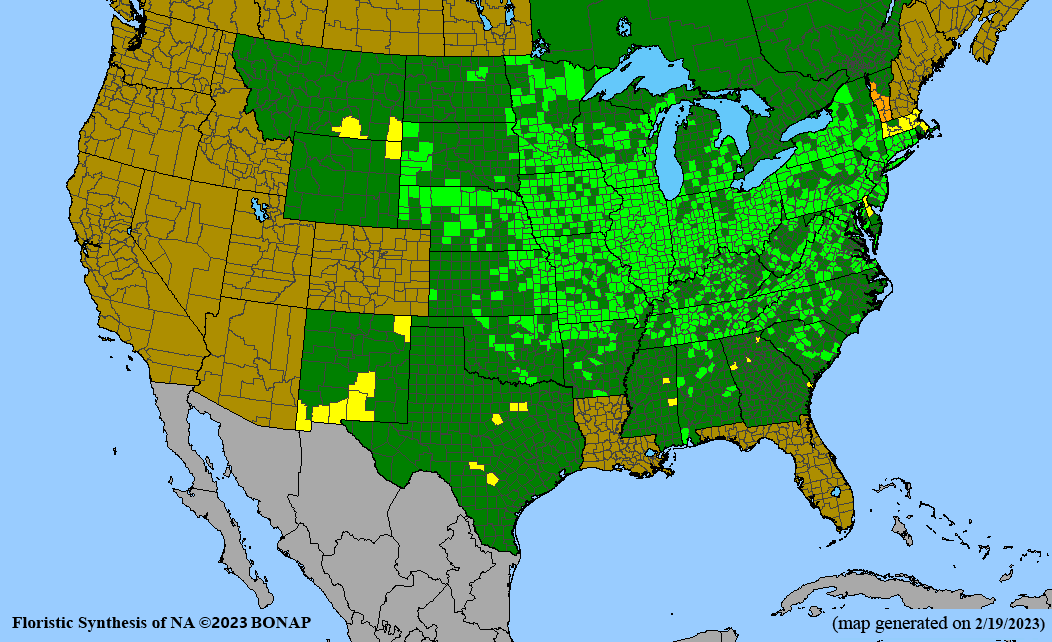
Habitat: Dry, sandy or gravelly soil; part shade to full sun; woods, floodplain forests, river banks, ravines, wooded slopes, rock outcrops; Wetland Indicator Status is Facultative Upland (FACU) for the Midwest; moist, well-drained, loamy soils are recommended for seed production.
Conservation status: Global- G5, secure; Massachusetts, Rhode Island, and Vermont- S1, critically imperiled; Mississippi and North Carolina- S2, imperiled; Wyoming- S2/S3, imperiled to vulnerable; Delaware- S3, vulnerable (NatureServe)
General Comments
Silky wildrye is typically found in wooded areas, but it tolerates full sun in production areas as long as the site is not excessively dry. This species somewhat resembles Canada wildrye (Elymus canadensis) but has straight awns in mature seedheads, slender glumes, fine hairs within the inflorescences, and generally more hairy leaves and sheaths.
Recommendations for Seed Production
- Establishment for seed production
Direct seeding
Direct seeding methods shared by a commercial native seed grower.
Row spacing: Solid stand
PLS pounds/acre: 12
Seeding depth: Surface (1/4 to 1/2 in depth with native seed drill should also be effective)
Seeding method: broadcast
Seeding time: late fall or early spring
Weed control: Prepare clean, firm, weed free seedbed prior to seeding (e.g., following a glyphosate-resistant crop, for example).
Greenhouse
Seed pre-treatment: 30 day cold/moist stratification produces rapid, even germination
Sowing: Sow seed in germination flats or plugs lightly covered (1/8 - 1/4 in) with potting mix about 2 months before the last frost free date.
Transplanting: Harden off plugs for a week or two outside, then transplant after all danger of frost into rows spaced convenient for tillage equipment or at 8-12 in spacing in a weed barrier or plastic mulch.
- Stand management
Weeds: Mow direct seeded stands high (6-12 in) first growing season to prevent weed canopy from shading seedlings. We do not currently have information on herbicides that could be used for weed control in this crop. Cultivate or mow between rows and weed or hand rogue to prevent contamination of seed lots by weed seed.
Pests: None noted.
Diseases: None noted.
Hybridization risk: This species is known to hybridize with related species Elymus canadensis, E. hystrix, E. virginicus. Maintain adequate separation between plots of these species.
- Seed production
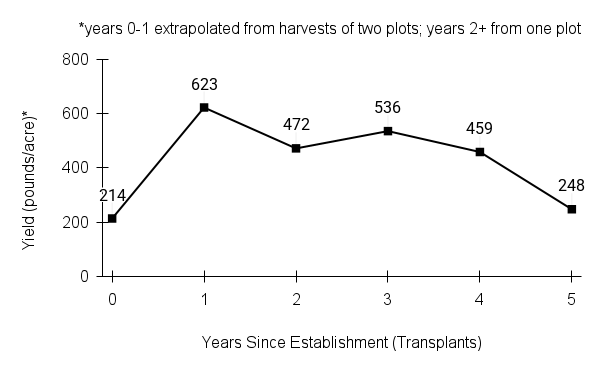 First harvest: Some flowering and seed set in the establishment year when transplanted as plugs. First harvest in second growing season from direct seeding.
Yield/acre: 200 - 620 pounds/acre (extrapolated from harvests of two plots at TPC)
Stand life: Five years or more, though production may begin to decline by years 4-5.
Flowering date: June in northeast Iowa
Seed maturity/Harvest date: Late July - Aug in northeast Iowa
Seed retention: Moderate risk of shattering; spikelets begin to drop in August.
Harvest date range at TPC (2010-2025): July 27 - August 30 (early September harvest is possible in first season from transplants)
Recommended harvest method: Combine at hard dough stage (no clogging observed despite awns)
- Seed cleaning and storage
Cleaning process: Pass combined material through 1/2 in mesh to remove large particles. Brush to remove awns and make flowable, then airscreen.
Seed storage: Seed may retain viability for 10 years or more when stored in cool/dry conditions (33-50° F, 30-50% RH).
Released Germplasm
Source Identified material: Natural Selections/Iowa Ecotype Zone “Iowa”
- References
Barworth, M. E., Campbell, J. J. N., & Salomon B. (2021, May 11). Elymus villosus Muhl. ex Willd. Flora of North America. http://floranorthamerica.org/Elymus_villosus
Chayka, K. (n.d.). Elymus villosus (silky wild rye). Minnesota Wildflowers. https://www.minnesotawildflowers.info/grass-sedge-rush/silky-wild-rye
Great Plains Flora Association. (1991). Grass family. In T. M. Barkley, R. E. Brooks, & E. K. Schofield (Eds.), Flora of the Great Plains (2nd ed., p. 1169–1170). University Press of Kansas.
Hilty, J. (2019). Silky wild rye - Elymus villosus. Illinois Wildflowers. https://www.illinoiswildflowers.info/grasses/plants/silky_rye.htm
Kartesz, J.T., The Biota of North America Program (BONAP). 2023. North American Plant Atlas. (http://bonap.net/napa). Chapel Hill, N.C. [maps generated from Kartesz, J.T. 2023. Floristic Synthesis of North America, Version 1.0. Biota of North America Program (BONAP). (in press)]
NatureServe. 2024. NatureServe Network Biodiversity Location Data accessed through NatureServe Explorer [web application]. NatureServe, Arlington, Virginia. Available https://explorer.natureserve.org/. (Accessed: February 29, 2024).
USDA NRCS National Plant Data Team. (n.d.). Elymus villosus Muhl. ex Willd. USDA plants database. https://plants.usda.gov/home/plantProfile?symbol=ELVI
Species Guide Updated 12/18/2025