stiff goldenrod
stiff goldenrod dickeye
Oligoneuron rigidum (L.) Small
Alternate Common Names: rigid goldenrod, hard-leaved goldenrod, prairie goldenrod, stiff-leaved goldenrod
Scientific Synonyms: Aster rigidus (L.) Kuntze, Solidago rigida* L.
*Solidago rigida is the accepted name in Minnesota and in the Flora of North America. The USDA Plants Database places this species in the genus Oligoneuron.
Family: aster family (Asteraceae)
Functional Group: forbs (wildflowers)
Description
- Life cycle and growth form
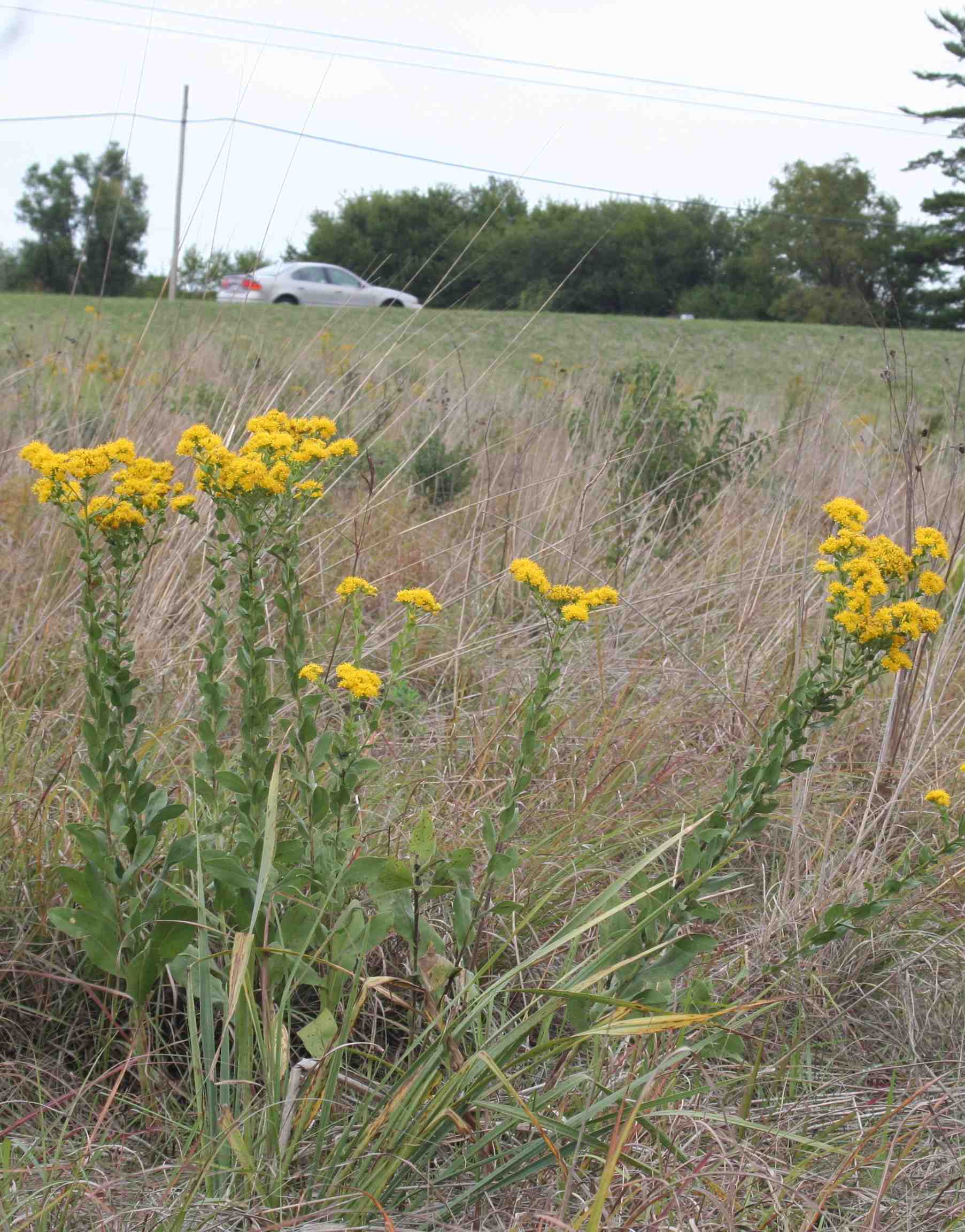
Perennial from fibrous roots; several stems arise in a clump.
Height: 1-5 ft
- Leaves and stem
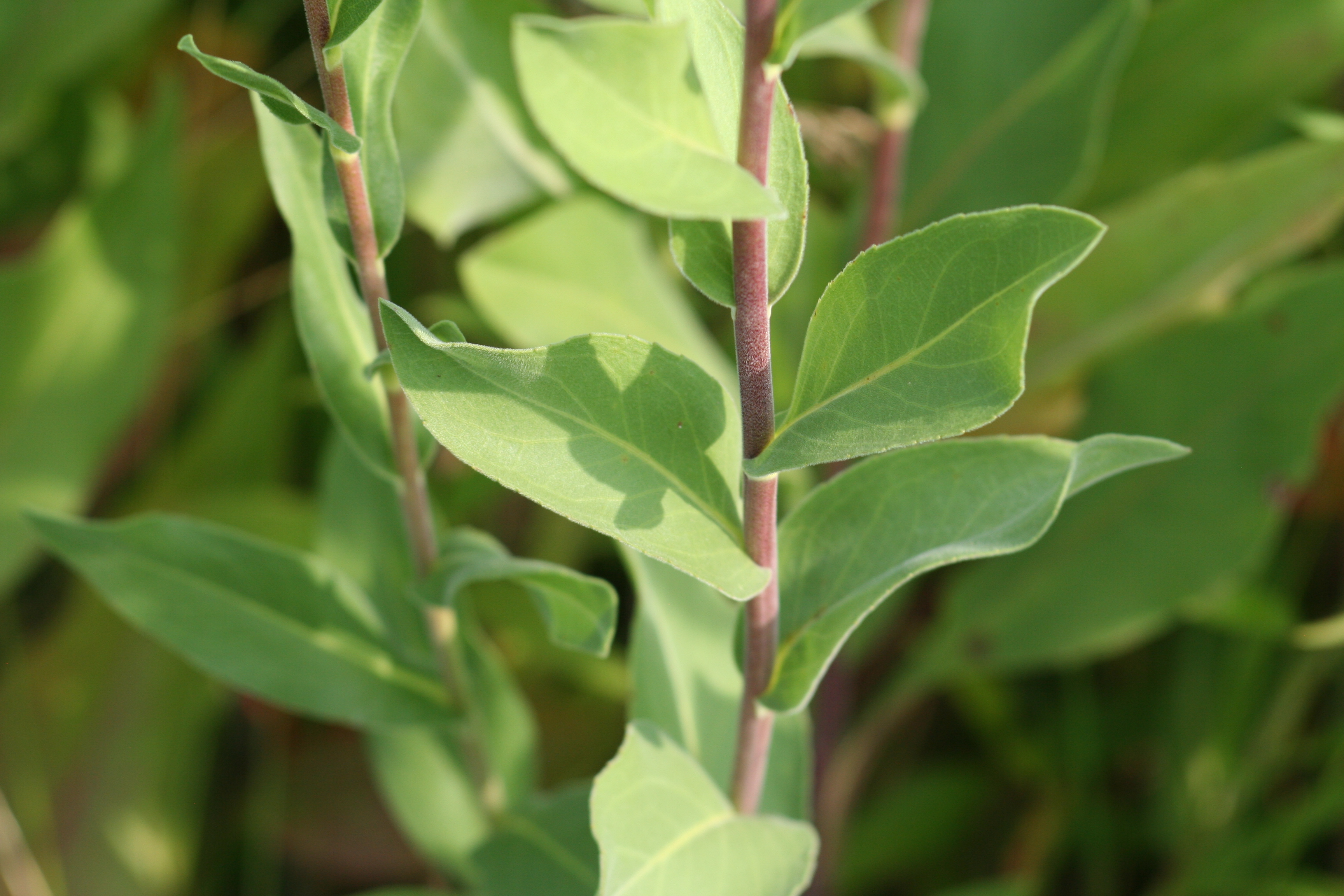
Leaves alternate, lower leaves long-stalked, upper leaves nearly clasping the stem, grayish green with short soft hairs; stem is finely hairy, unbranched.
- Flower, fruit and seedhead
Flower: Yellow flower heads, larger than typical for goldenrods, borne in a branched flat-domed cluster at top of stem.
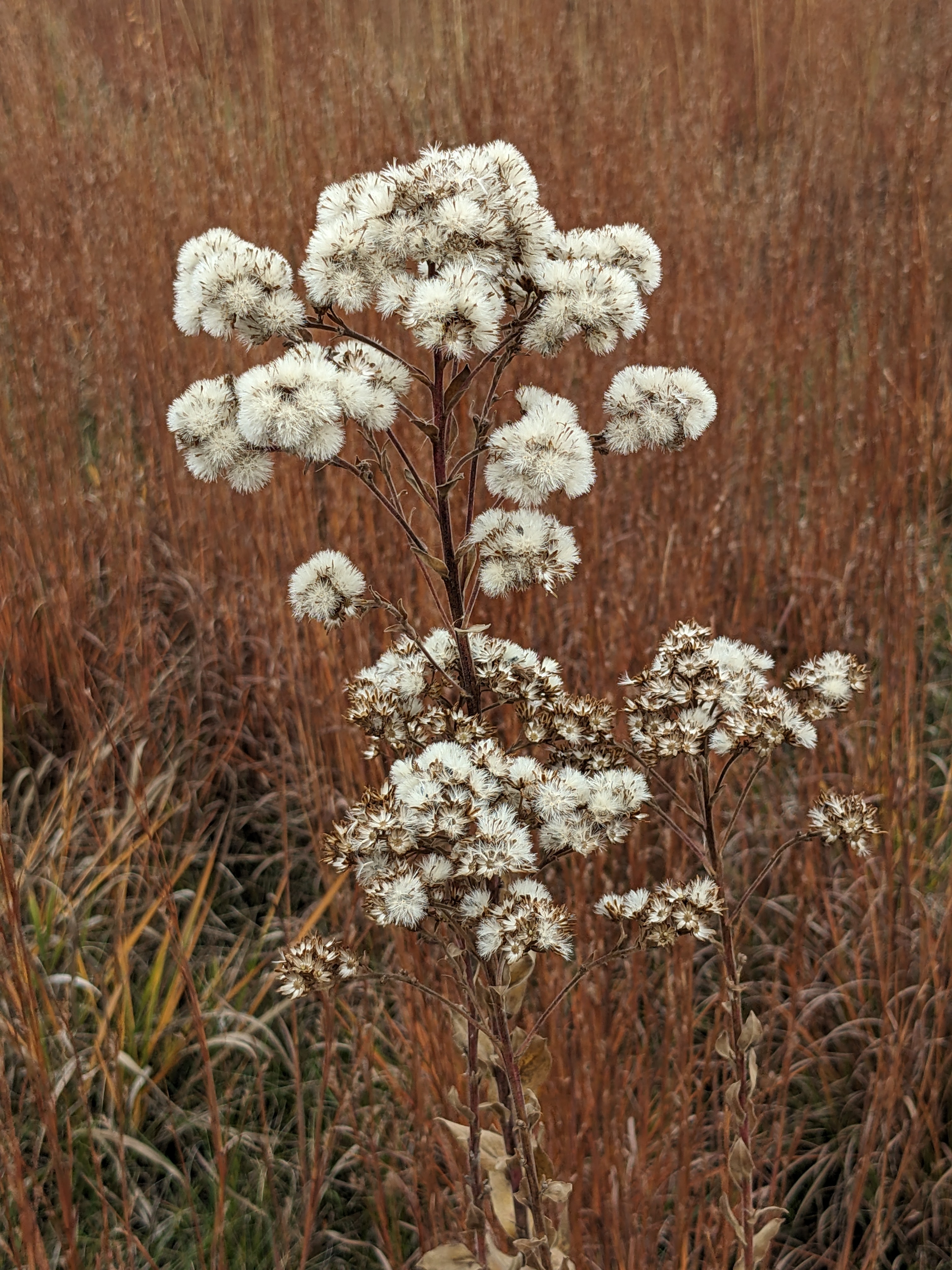
Fruit/seedhead: Seed heads are fluffy due to a tuft of white pappus on each achene, seeds dispersed by wind.
Pollination: Insects including bees, butterflies, wasps, and beetles.
- Seed
Seed characteristics
Seed weight:
Seeds per ounce: 41,000 (IA NRCS)
1000 seed weight: 0.94 g (Seed Information Database)
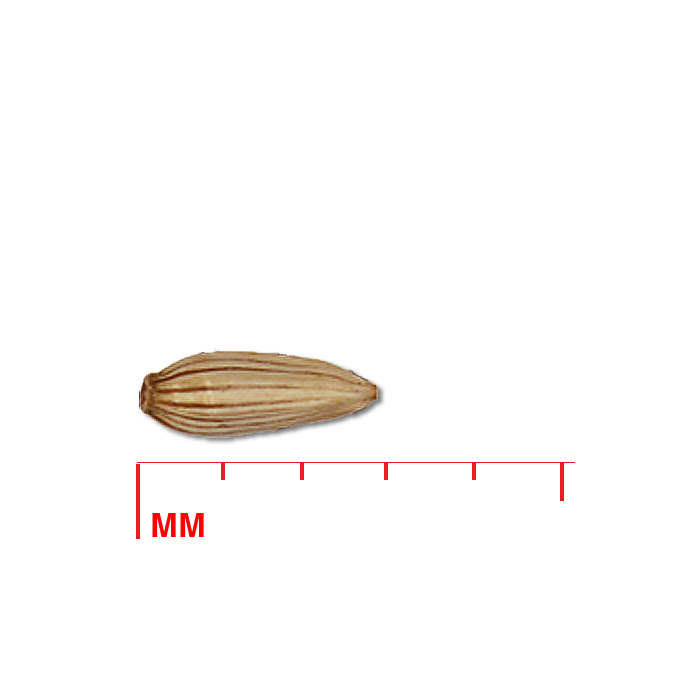
Description: Seeds are technically achenes, glabrous, bone-white, about 1/16 in long with long white plumes (pappus).
Typical seed test
PLS: 79% (n = 10)
Purity: 96% (n = 10)
Germination: 34% (n = 8)
Dormancy: 45% (n = 8)
(averages obtained from n tests of purchased seed lots)
- Habitat and range
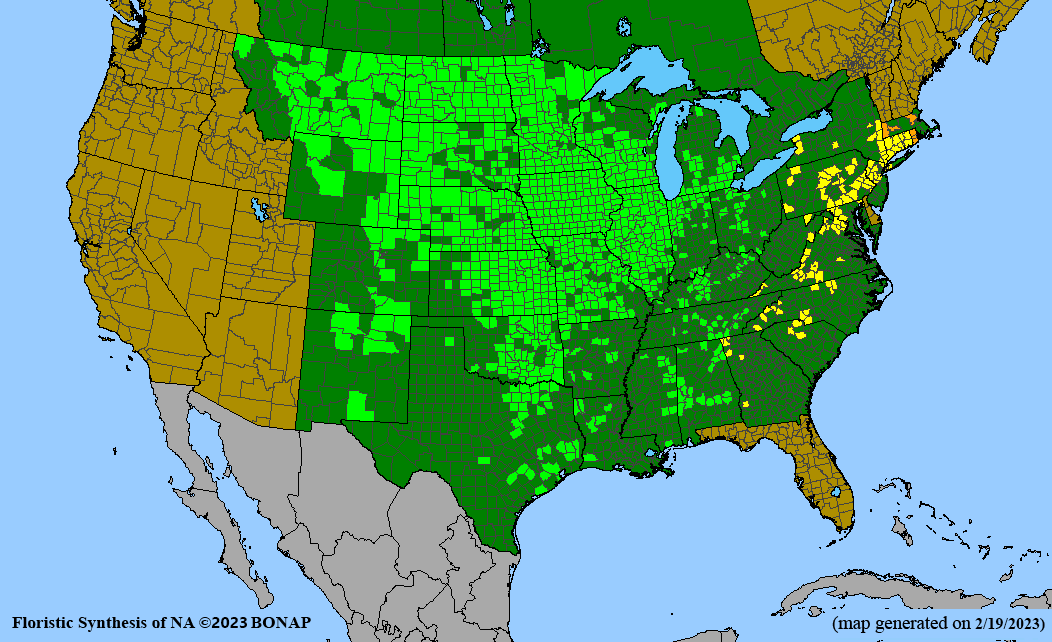
Habitat: Dry-mesic to wet-mesic soil; full sun; prairies, savannas, thickets, limestone glades, roadsides, railroads. Well-drained, loamy soils are preferred for seed production.
Conservation status: Global- G5, secure; District of Columbia- SX, presumably extirpated; Massachusetts- SH, possibly extirpated; Connecticut, Maryland, Pennsylvania, South Carolina, and West Virginia- S1, critically imperiled; New York and Virginia- S2, imperiled; Georgia and Wyoming- S3, vulnerable (NatureServe)
General Comments
Stiff goldenrod establishes readily from direct seed or transplants, and will spread from short rhizomes to form clumps. The flowers of this species are highly attractive to bees and other pollinators, including migrating monarch butterflies. The seeds are eaten by songbirds and gamebirds. Fields of this species can be combined but it is critical to harvest before plumes are dry and fluffy.
Recommendations for Seed Production
- Establishment for seed production
Direct seeding
Row spacing: 30-36 in rows
PLS pounds/acre: 1.0
Seeds per linear foot: 40
Seeding depth: 1/4 in
Seeding method: native seed drill
Seeding time: dormant season
Weed control: Prepare clean, firm, weed free seedbed prior to seeding.
Greenhouse
Seed pre-treatment: Wet stratify 8-12 weeks at 40˚ F.
Sowing: Sow seed in greenhouse two months before last frost free date.
Transplanting: Transplant into bare soil in rows convenient for tillage equipment, or into weed barrier at 8-12 in intervals after all danger of frost is past.
- Stand management
Weeds: Post emergence grass herbicide, tillage, hand roguing. If transplanted into weed barrier or plastic mulch, this provides some weed suppression.
Pests: None noted.
Diseases: Foliage may be affected by rust.
- Seed production
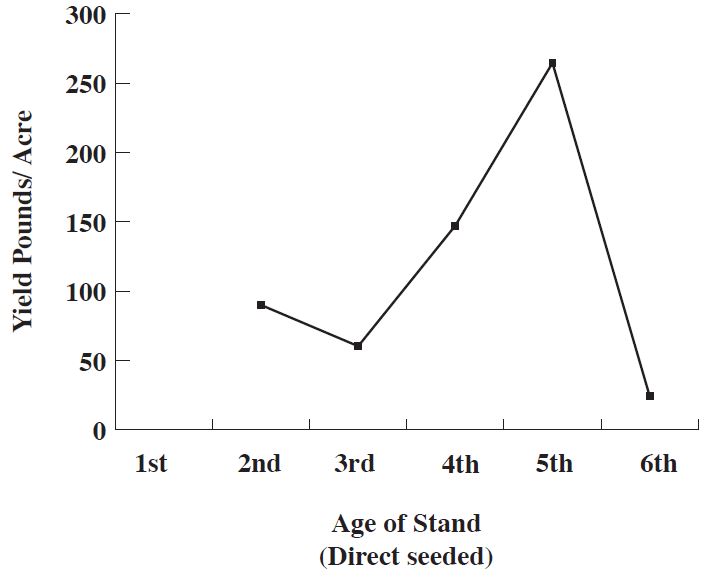 First harvest: Flowering and seed set at end of second growing season from either greenhouse grown transplants or direct seeded, well-managed stand.
Yield: 100-250 bulk pounds/acre
Stand life: Peak harvests in second to fifth growing season. Seed production declines in subsequent years.
Flowering date: mid-August - mid-September in northern Iowa
Seed maturity/Harvest date: October in northern Iowa
Seed retention: Seed is wind dispersed soon after drying of plumes (pappus).
Harvest date range at TPC (2003-2011): Oct 9 - 25
Recommended harvest method: Combine after seed maturity but before more than 10% of the seedheads have turned white and fluffy. Otherwise, combining will simply contribute to dispersal of the seed crop. Harvested material will have to be forced-air dried and turned carefully to prevent mold and decay.
- Seed cleaning and storage
Cleaning process: Pre-clean air-dried material by scalping thru 1/2 in and 1/4 in mesh to remove large particles. Remove plumes (pappus) with a debearder or brush machine, then air-screen.
Seed storage: cool/dry (33-50° F, 30-50% RH)
Released Germplasm
Source Identified material: Natural Selections/Iowa Ecotype Project Zone 1 (Northern Iowa), Zone 2 (Central Iowa),and Zone 3 (Southern Iowa)
- References
Chayka, K. (n.d.). Solidago rigida (stiff goldenrod). Minnesota Wildflowers. https://www.minnesotawildflowers.info/flower/stiff-goldenrod
Cochrane, T. S., Elliot, K., & Lipke, C. S. (2014). Stiff goldenrod. In Prairie plants of the University of Wisconsin-Madison Arboretum (3rd ed., p. 118). University of Wisconsin-Madison Arboretum.
Flora of North America. Solidago rigida Linnaeus. (n.d.). http://www.efloras.org/florataxon.aspx?flora_id=1&taxon_id=242417297 .
Hilty, J. (2019). Stiff goldenrod - Oligoneuron rigidum. Illinois Wildflowers. https://www.illinoiswildflowers.info/prairie/plantx/stf_goldenrodx.htm
Houseal, G. A. (2007). Forbs wildflowers. In G. A. Houseal (Eds.), Tallgrass Prairie Center’s native seed production manual (pp. 42–43). Tallgrass Prairie Center - University of Northern Iowa.
Kartesz, J.T., The Biota of North America Program (BONAP). 2023. North American Plant Atlas. (http://bonap.net/napa). Chapel Hill, N.C. [maps generated from Kartesz, J.T. 2023. Floristic Synthesis of North America, Version 1.0. Biota of North America Program (BONAP). (in press)]
NatureServe. 2024. NatureServe Network Biodiversity Location Data accessed through NatureServe Explorer [web application]. NatureServe, Arlington, Virginia. Available https://explorer.natureserve.org/. (Accessed: February 29, 2024).
Runkel, S. T., & Roosa, D. M. (2009). Stiff goldenrod. In Wildflowers of the tallgrass prairie: The upper Midwest (2nd ed., pp. 242–243). University of Iowa Press.
Semple, J. C., & Cook, R. E. (2020, November 6). Solidago rigida Linnaeus. Flora of North America. http://floranorthamerica.org/Solidago_rigida
USDA NRCS National Plant Data Team. (n.d.). Oligoneurin rigidum (L.) Small. USDA plants database. https://plants.usda.gov/home/plantProfile?symbol=OLRI
Species Guide Updated 12/4/2024