pale purple coneflower
pale purple coneflower dickeye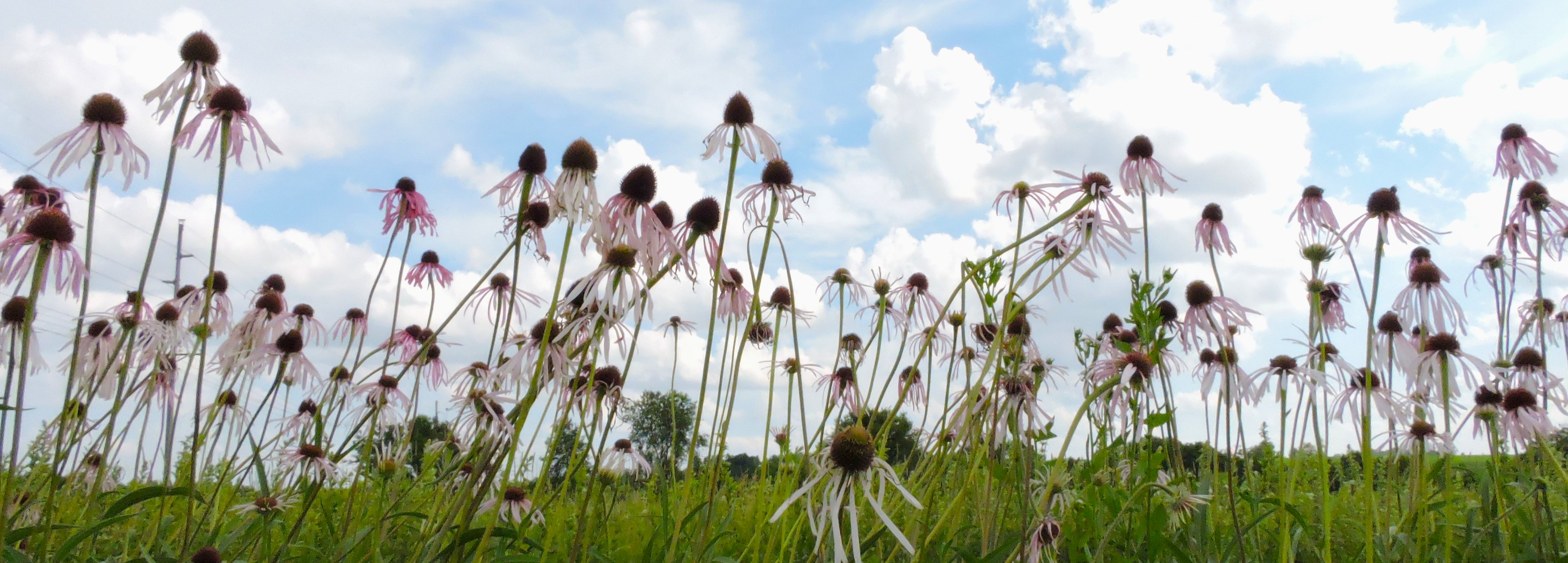
Echinacea pallida (Nutt.) Nutt.
Alternate Common Names: prairie coneflower, pale echinacea
Scientific Synonyms: Brauneria pallida (Nutt.) Britton, Rudbeckia pallida Nutt.
Family: aster family (Asteraceae)
Functional Group: forbs (wildflowers)
Description
- Life cycle and growth form
Perennial from a stout taproot.
Height: 2-3 ft
- Leaves and stem
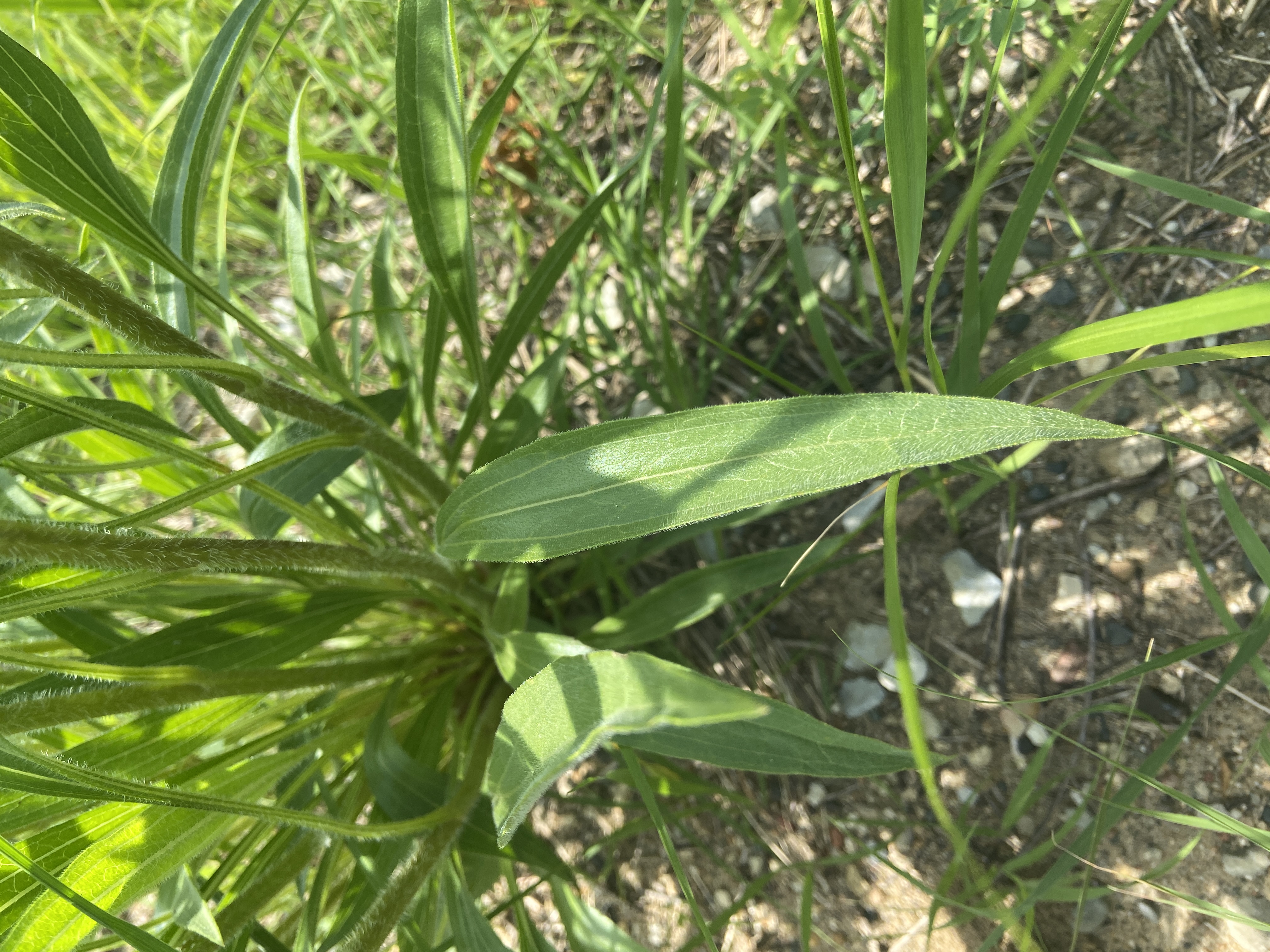
Leaves mostly basal, long tapered, coarsely hairy with three prominent parallel veins; stems grayish to reddish green, covered in coarse hairs, unbranched.
- Flower, fruit and seedhead
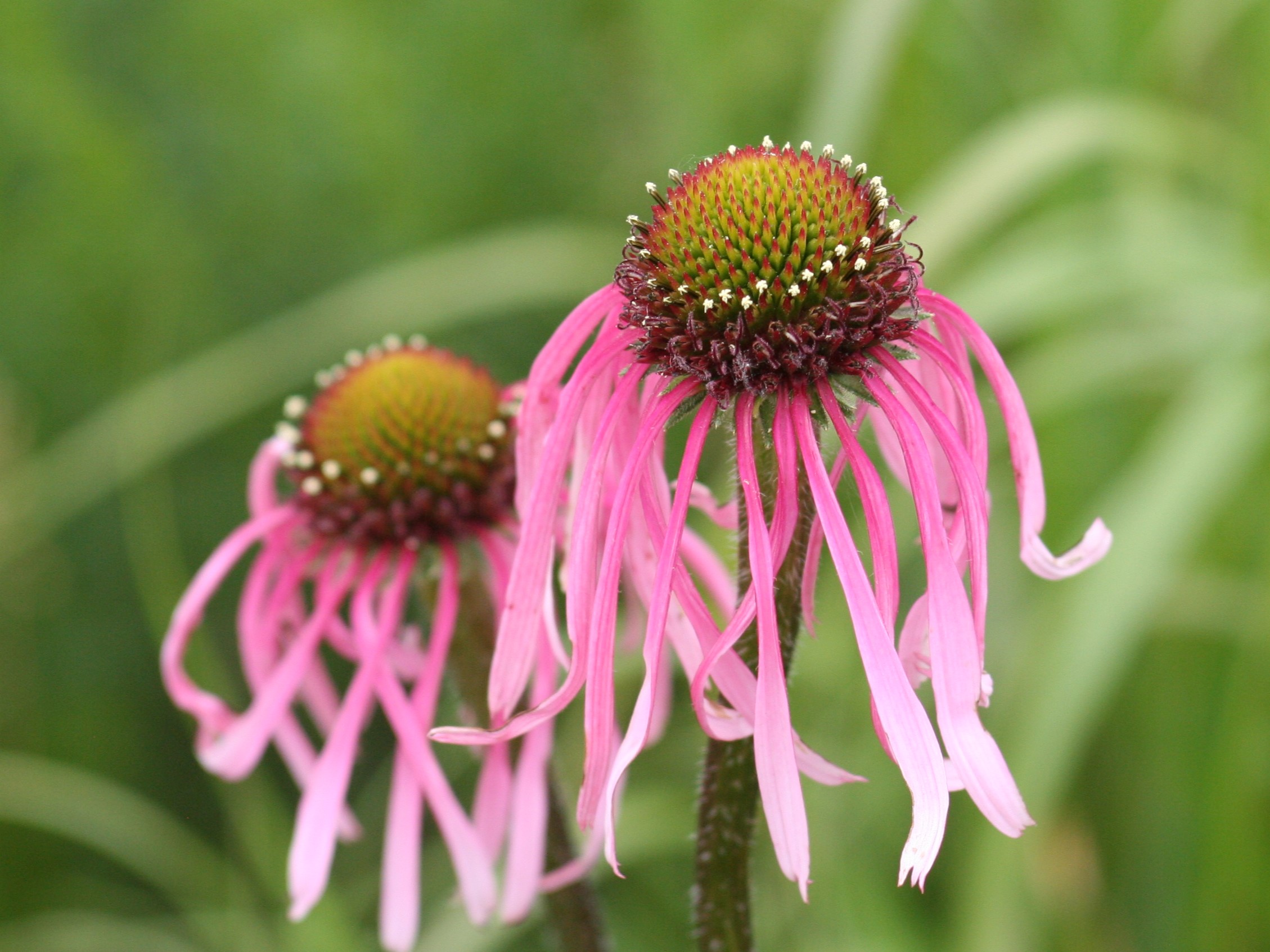
Flower: Single composite flower head at top of stem with 7 or more pink-purple (sometimes white), slender, drooping ray florets and a prominent central cone. Pollen is white.
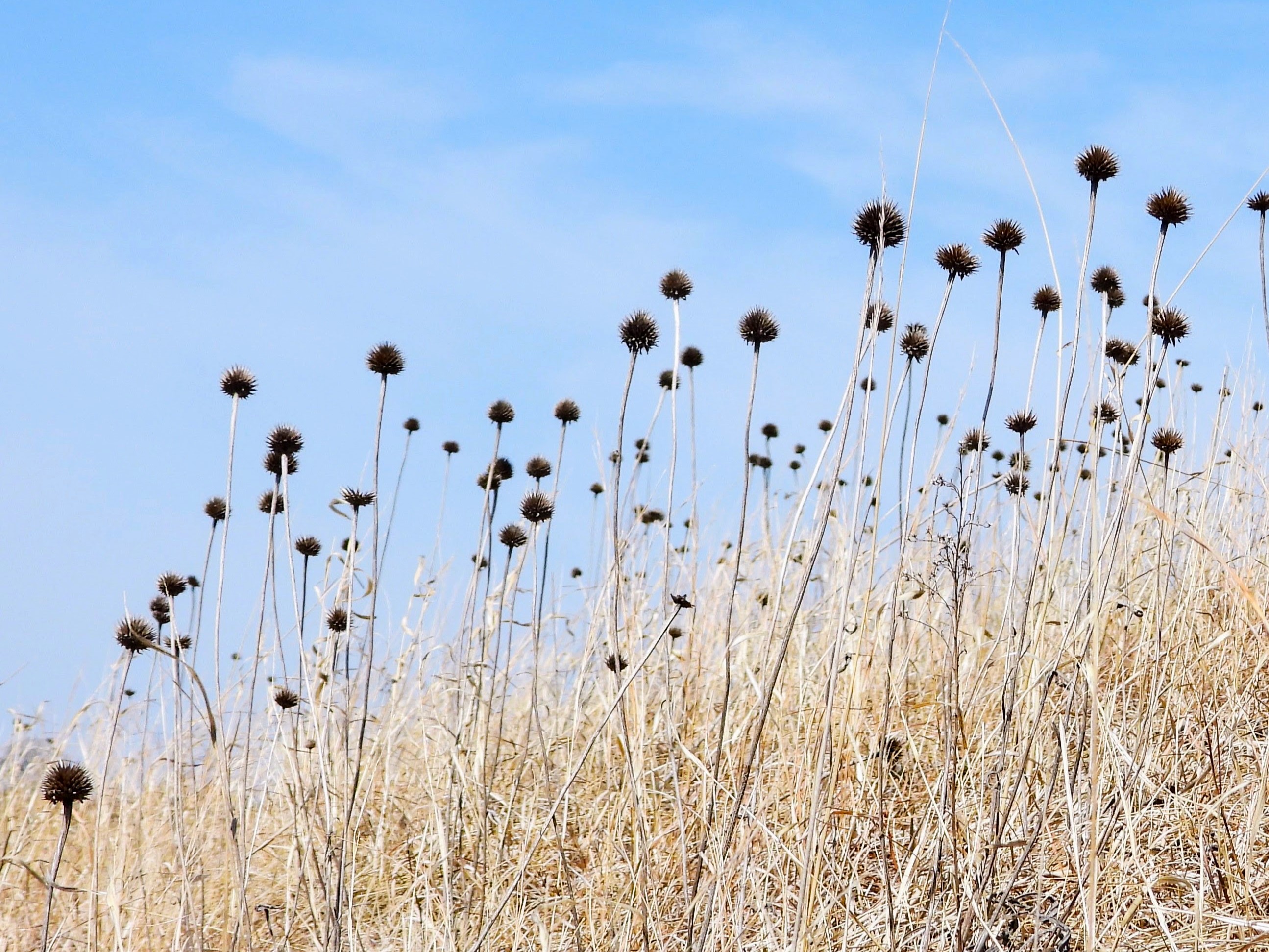
Fruit/seedhead: Seed head is a dark brown-black cone, about 1 inch in diameter. Seeds (achenes) develop from disk flowers, which bloom from the outer ring of the cone inwards.
Pollination: Insects, primarily bees and butterflies.
- Seed
Seed characteristics
Seed weight:
Seeds per ounce: 5,200 (IA NRCS)
Seeds per pound: 83,200 (IA NRCS)
1000 seed weight: 5.66 g (Seed Information Database)
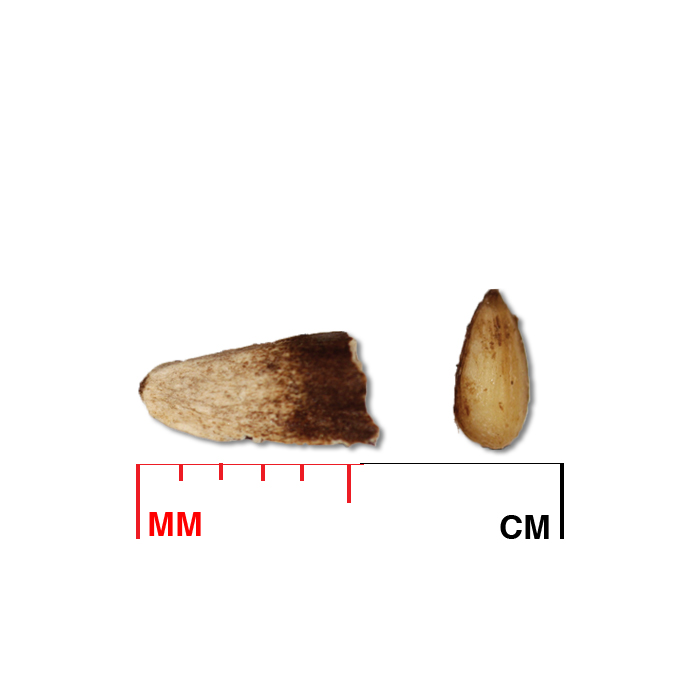
Description: The “seed unit” is a dry fruit called an achene, about 1/8 in long, with a dark brown band at the square end and pale gray from there to the pointed end. No awns or appendages to remove.
Typical seed test
PLS: 96% (n = 10)
Purity: 99% (n = 10)
Germination: 44% (n = 9)
Dormant: 52% (n = 9)
(averages obtained from n tests of purchased seed lots)
- Habitat and range
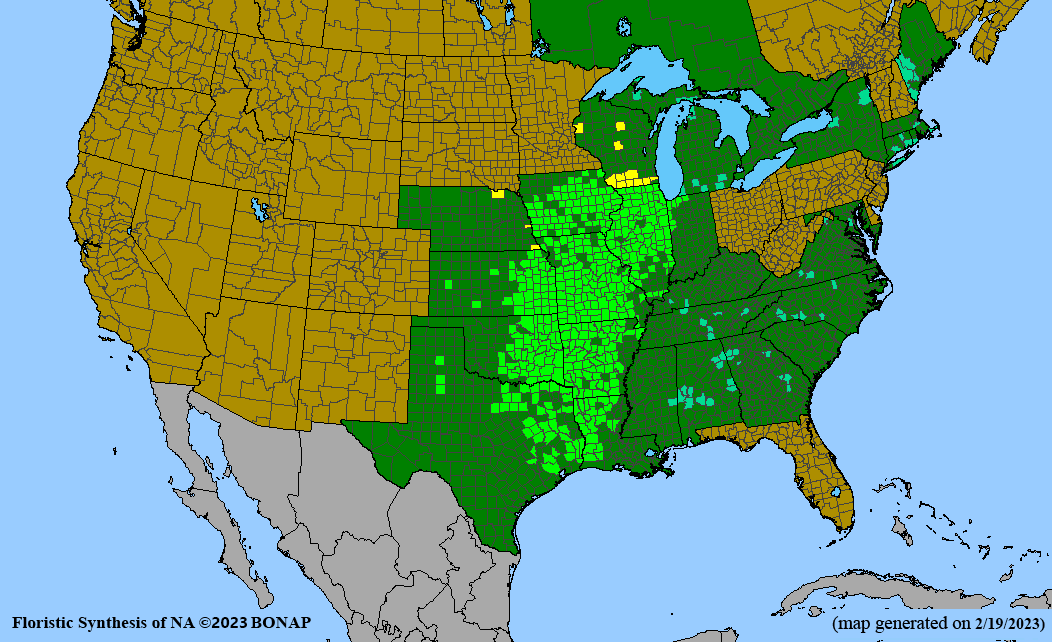
Habitat: Dry-mesic to mesic soil; prefers sites with well-drained upland soils and full sun; prairies, oak savannas, abandoned fields, dry woodland openings, along railroads. Avoid wet or poorly drained soils for seed production.
Conservation status: Global- G4, apparently secure; Georgia, Nebraska, North Carolina, and Tennessee- S1, critically imperiled; Alabama- S2, imperiled; Wisconsin- S3, vulnerable (NatureServe)
General Comments
This species is best propagated in the greenhouse and transplanted into a weed barrier or bare soil. Weed suppression is essential for good establishment and seed production. Combine harvest is fairly straightforward, since it retains seed well in the heads. All Echinacea species are known to hybridize, so proper isolation should be maintained between related species to prevent hybrid seed production (McGregor 1968).
Recommendations for Seed Production
- Establishment for seed production
Direct seeding
Row spacing: 30-36 in rows
PLS pounds/acre: 3.0-5.0
Seeds per linear foot: 40
Seeding depth: 1/8 in
Seeding method: native seed drill
Seeding time: dormant season
Weed control: Prepare clean, firm, weed free seedbed prior to seeding.
Greenhouse
Seed pre-treatment: Wet stratify 12 weeks at 40° F.
Sowing: Sow seed surface to 1/8 in deep in the greenhouse two months before last frost free date. Literature suggests this species needs light to germinate, but covering seed lightly to 1/8 in does not inhibit germination.
Transplanting: When root growth is sufficient to produce a sturdy plug, harden off, then transplant into bare soil in rows or weed barrier at 8-12 in intervals after all danger of frost.
- Stand management
Weeds: Planting into a weed barrier or plastic mulch suppresses weeds in the first growing season; hand rogue weeds, being careful not to uproot seedlings.
Pests: None noted.
Diseases: None noted.
Hybridization risk: Echinacea angustifolia, E. purpurea
- Seed production
 First harvest: Second year plants.
Yield: 55-210 bulk pounds/acre (yields extrapolated from harvests of 6 plots)
Stand life: Peak harvests second year. Good harvest third year. Stand persists, but seed production declines significantly fourth year and after.
Flowering date: mid-June to mid-July in northern Iowa
Seed maturity/Harvest date: September in northern Iowa
Seed retention: Generally holds seed well, some shattering may begin in late September and extend throughout the winter months.
Harvest date range at TPC (2003-2021): Aug 5 - Oct 25
Recommended harvest method: Combine before significant shattering occurs.
- Seed cleaning and storage
Cleaning process: Combine does a superb job of threshing seedheads. Pre-clean combined material by scalping through 1/2 in and 1/4 in mesh to remove large particles and make flowable, then air-screen. If hand harvested, seedheads need to be threshed using a hammermill or brush machine, using care not to overclean and damage the hulls of the achenes.
Seed storage: Cool/dry (33-50° F, 30-50% RH).
Released Germplasm
Source Identified material: Natural Selections/Iowa Ecotype Project Zones 1, 2, and 3; Northern Missouri Germplasm, Western Missouri Germplasm
- References
Chayka, K. (n.d.). Echinacea pallida (pale purple coneflower). Minnesota Wildflowers. https://www.minnesotawildflowers.info/flower/pale-purple-coneflower
Cochrane, T. S., Elliot, K., & Lipke, C. S. (2014). Purple coneflowers. In Prairie plants of the University of Wisconsin-Madison Arboretum (3rd ed., p. 74–75). University of Wisconsin-Madison Arboretum.
Hilty, J. (2019). Pale purple coneflower - Echinacea pallida. Illinois Wildflowers. https://www.illinoiswildflowers.info/prairie/plantx/pale_coneflowerx.ht…;
Houseal, G. A. (2007). Forbs wildflowers. In G. A. Houseal (Eds.), Tallgrass Prairie Center’s native seed production manual (pp. 32–33). Tallgrass Prairie Center - University of Northern Iowa.
Kartesz, J.T., The Biota of North America Program (BONAP). 2023. North American Plant Atlas. (http://bonap.net/napa). Chapel Hill, N.C. [maps generated from Kartesz, J.T. 2023. Floristic Synthesis of North America, Version 1.0. Biota of North America Program (BONAP). (in press)]
NatureServe. 2024. NatureServe Network Biodiversity Location Data accessed through NatureServe Explorer [web application]. NatureServe, Arlington, Virginia. Available https://explorer.natureserve.org/. (Accessed: February 29, 2024).
USDA NRCS National Plant Data Team. (n.d.). Echinacea pallida (Nutt.) Nutt. USDA plants database. https://plants.usda.gov/home/plantProfile?symbol=ECPA
Species Guide Updated 12/3/2024