Stiff tickseed
Stiff tickseed dickeye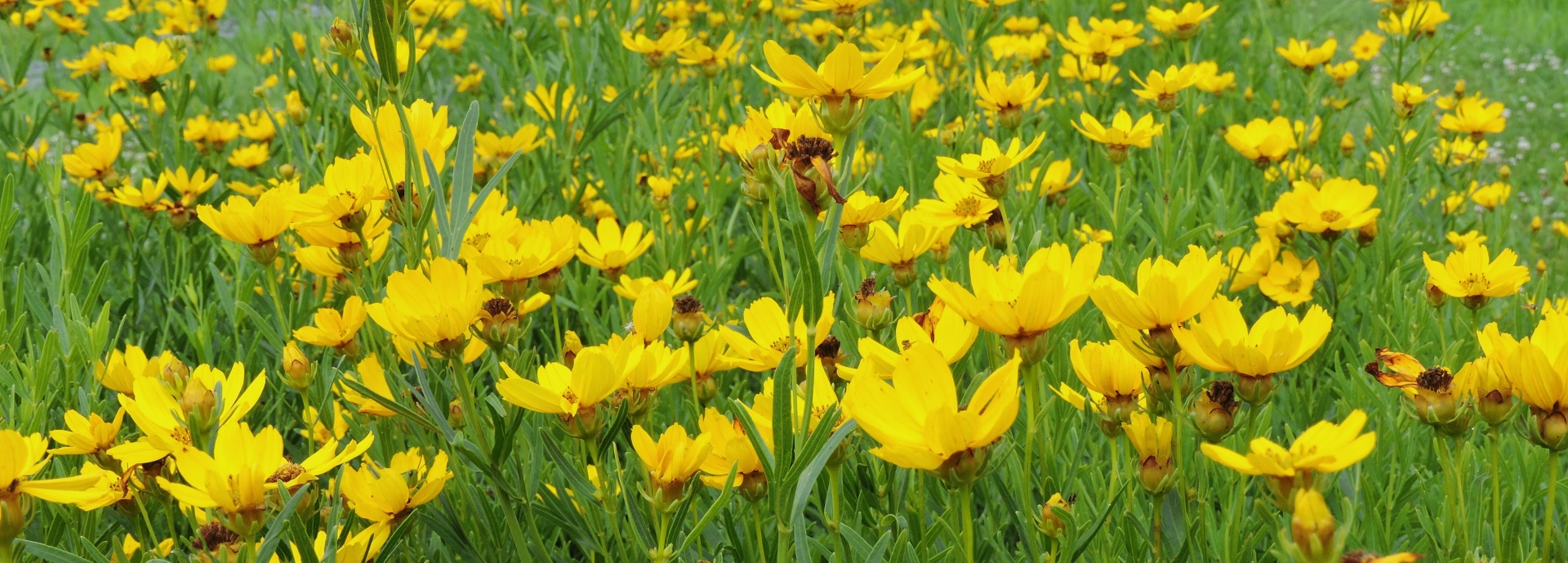
Coreopsis palmata Nutt.
Alternate Common Names: stiff coreopsis, prairie coreopsis, prairie tickseed, finger tickseed, tickseed
Family: aster or sunflower family (Asteraceae)
Functional Group: forbs (wildflowers)
Description
- Life cycle and growth form
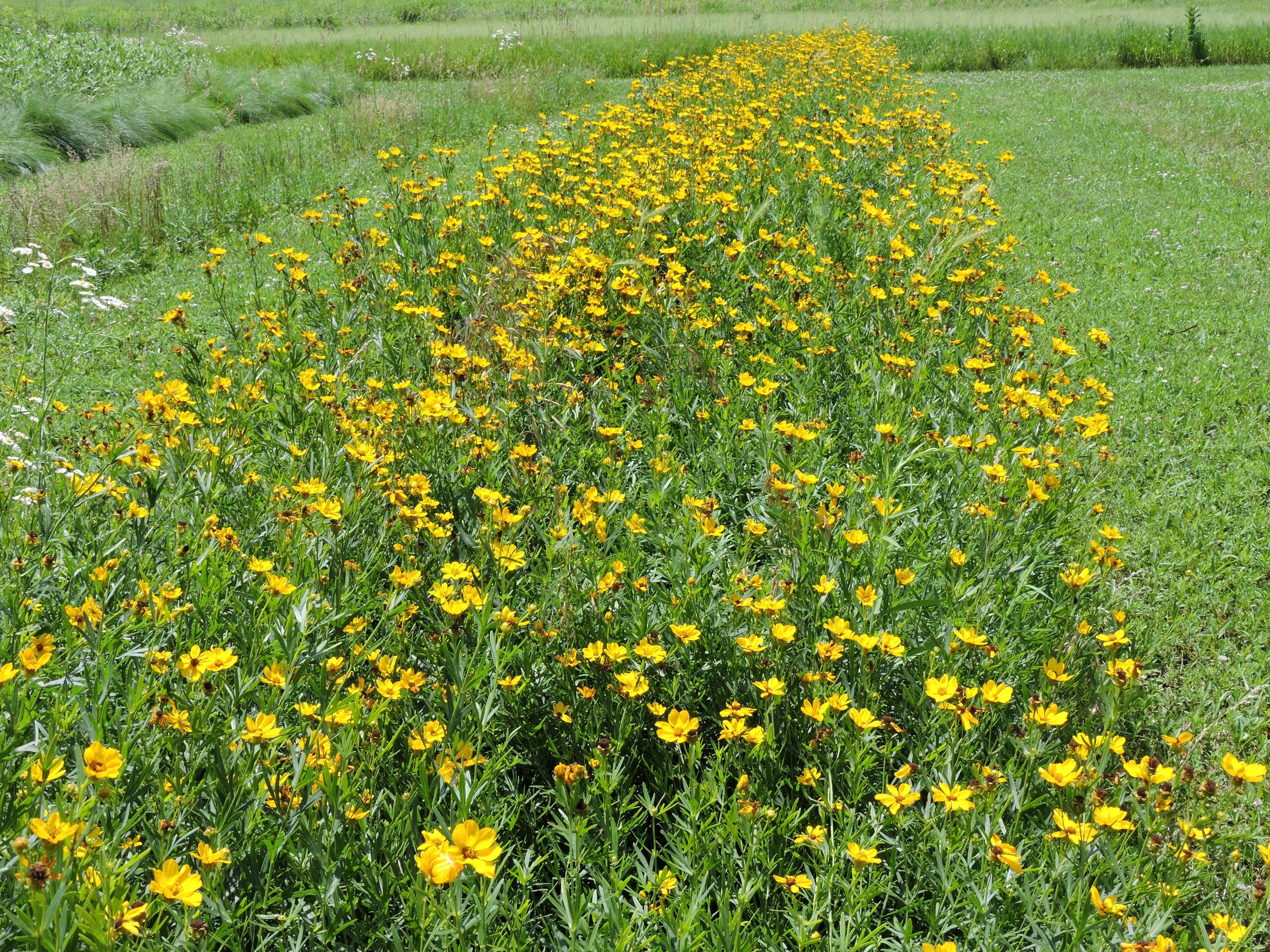
Perennial, fibrous-rooted and rhizomatous, spreads vegetatively to form clonal colonies.
Height: 1-3 ft
- Leaves and stem
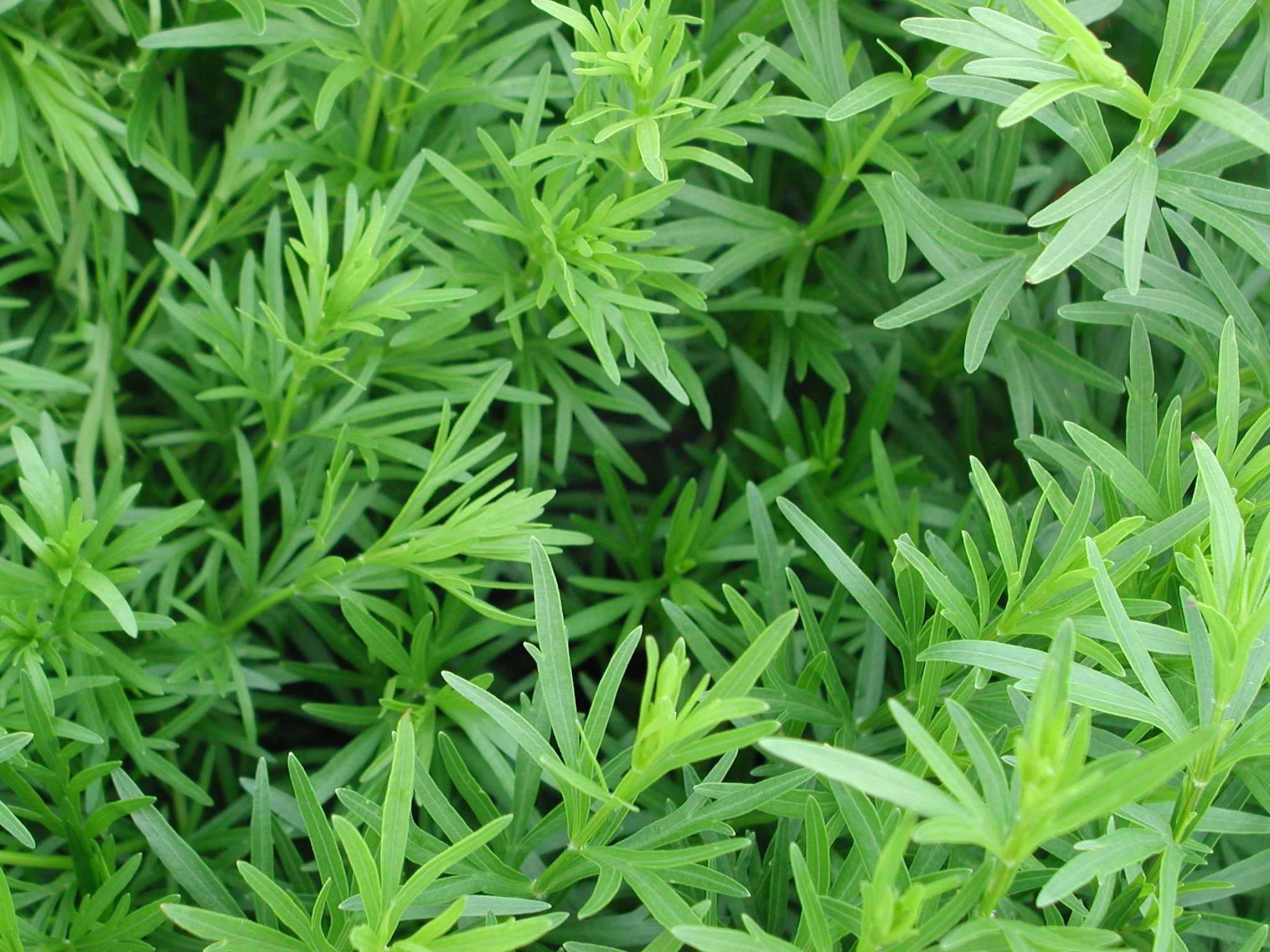
Leaves opposite, sessile on the stem, deeply divided into 3 finger-like lobes; stem is rigid and grooved, mostly hairless except at the nodes, dark green in color, leafy, typically unbranched.
- Flower, fruit and seedhead
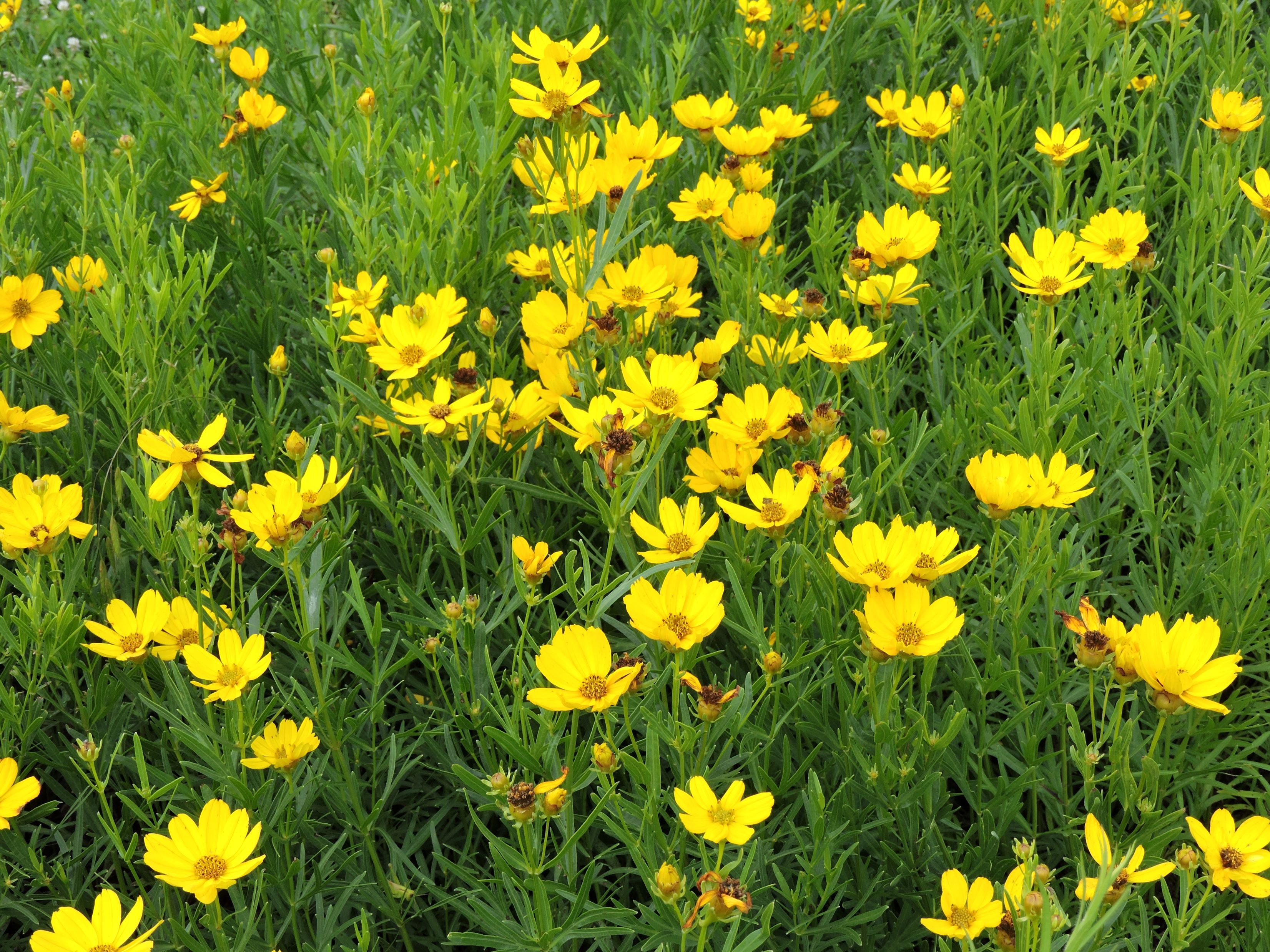
Flower: Yellow composite flower heads 1-2 in across with yellow centers that turn brown as they mature, ringed by 8-12 notched “petals” (ray florets); one to a few flower heads per stalk.
Fruit/seedhead: Center disk of head turns dark brown-black at maturity; only marginal flowers produce “seeds” (achenes).
Pollination: Insects such as bees, moths, butterflies, flies, and beetles.
- Seed
Seed characteristics
Seed weight:
Seeds per ounce: 10,000 (IA NRCS)
Seeds per pound: 160,000 (IA NRCS)
1000 seed weight: 2.13 g (Seed Information Database)
Description: Seed units are oblong, flattened, inwardly curved achenes with winged margins, 1/4 in (5 mm) long.
Typical seed test
PLS: 64% (n = 11)
Purity: 70% (n = 11)
Germination: 41% (n = 10)
Dormant: 51% (n = 10)
(averages obtained from n tests of purchased seed lots)
- Habitat and range
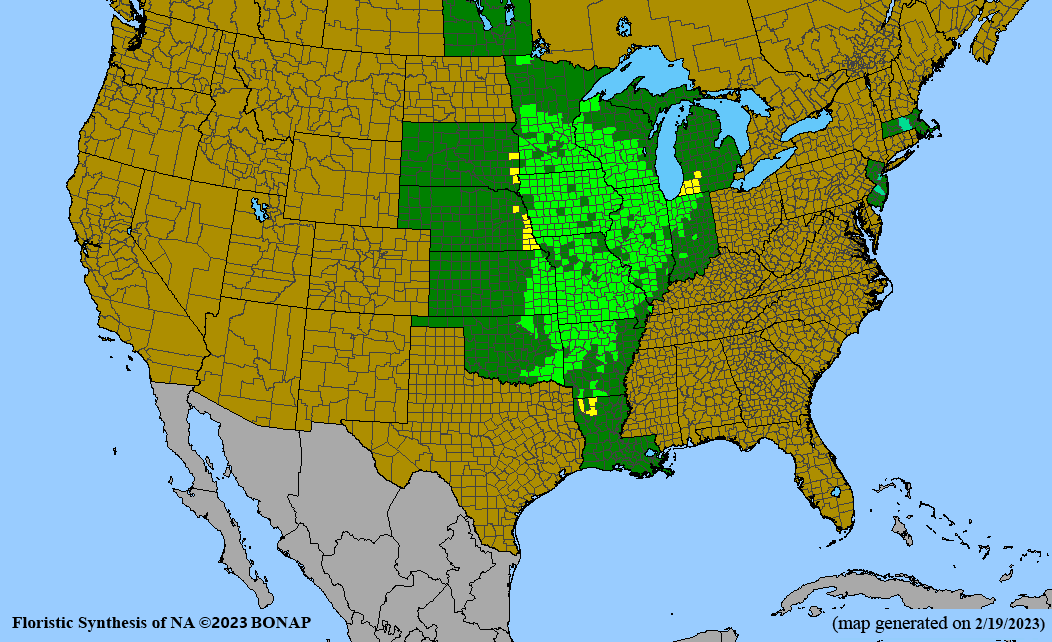
Habitat: Mesic to dry-mesic soil; full sun; medium to high quality prairie and savannas. For seed production, avoid wet or poorly drained soils.
Conservation status: Global- G5, secure; Louisiana and Michigan- S2, imperiled; Nebraska- S1/S3, critically imperiled to vulnerable; South Dakota- S3, vulnerable (NatureServe)

General Comments
Stiff tickseed typically occurs in colonies (clonal) in native prairies, spreading from rhizomes. This species supports numerous species of pollinators, including a specialist bee (Melissodes coreopsis), and herbivorous insects. Flattened, inwardly curved, winged achenes make air-screen separation of “seed” from inert plant parts difficult and this is reflected in the average purity reported from seed tests.
Recommendations for Seed Production
- Establishment for seed production
Direct seeding
Row spacing: 30-36 in rows
PLS pounds/acre: 3.0
Seeds per linear foot: 40
Seeding depth: 1/4 in
Seeding method: native seed drill
Seeding time: dormant season
Weed control: Prepare clean, firm, weed free seedbed prior to seeding.
Greenhouse
Seed pre-treatment: Wet stratify 8-12 weeks at 40° F.
Sowing: Sow seed in greenhouse at 1/4 in depth two months before last frost free date.
Transplanting: Harden off, transplant into prepared rows after all danger of frost. Permanent weed barrier is NOT recommended since this species spreads vegetatively, however, a biodegradable barrier can help reduce weed pressure during the first year. If planted into non-biodegradable plastic, holes must be opened further or plastic removed entirely in subsequent years.
- Stand management
Weeds: Weed barrier in first year can suppress many weeds. Mow or cultivate between rows. Consider post emergence grass herbicide and roguing to prevent weed seed from contaminating seed lots.
Pests: None noted.
Diseases: Crown root rot if planted in too wet soils.
- Seed production
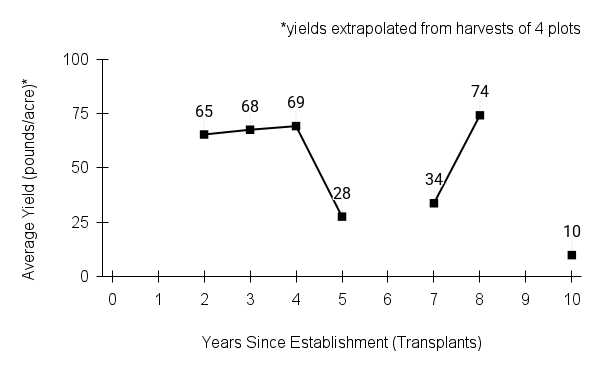 First harvest: Some flowering in the first growing season from transplants, but minimal seed production. Flowering and seed production increases in the second year.
Yield: 10-80 bulk pounds/acre (per acre yields extrapolated based on production from 4 plots)
Stand Life: Peak harvest appears to occur in the second to third year. Stand persists but seed production may decline or fluctuate in later years. Aerating the soil of the plot post-harvest with a turf aerator may enhance seed set the following season.
Flowering date: June - mid-July in northern Iowa
Seed maturity/Harvest date: October in northern Iowa
Seed retention: Relatively low risk; shattering occurs late October to early November
Harvest date range at TPC (2003-2021): Sept 11 - Nov 6
Recommended harvest method: Combine
- Seed cleaning and storage
Cleaning process: Pre-clean combined material by scalping through 1/2 in and 1/4 in mesh to remove large plant matter and brush (stiff bristles) to make flowable, then air-screen repeatedly, and indent if needed to remove small seeded weeds. Because seeds are flat, separation from leaf particles of similar size and weight requires repeated air-screen cleaning to improve purity. (No awns or appendages to remove.)
Seed storage: cool/dry (33-50° F, 30-50% RH)
Released Germplasm
Source Identified material: Natural Selections/Iowa Ecotype Project Zones 1, 2, and 3, Northern Missouri Germplasm, Western Missouri Germplasm
- References
Chayka, K. (n.d.). Coreopsis palmata (prairie coreopsis). Minnesota Wildflowers. https://www.minnesotawildflowers.info/flower/prairie-coreopsis
Cochrane, T. S., Elliot, K., & Lipke, C. S. (2014). Prairie tickseed. In Prairie plants of the University of Wisconsin-Madison Arboretum (3rd ed., p. 73). University of Wisconsin-Madison Arboretum.
Hilty, J. (2019). Praire coreopsis - Coreopsis palmata. Illinois Wildflowers. https://www.illinoiswildflowers.info/prairie/plantx/pr_coreopsisx.htm
Houseal, G. A. (2007). Forbs wildflowers. In G. A. Houseal (Eds.), Tallgrass Prairie Center’s native seed production manual (pp. 30–31). Tallgrass Prairie Center - University of Northern Iowa.
Kartesz, J.T., The Biota of North America Program (BONAP). 2023. North American Plant Atlas. (http://bonap.net/napa). Chapel Hill, N.C. [maps generated from Kartesz, J.T. 2023. Floristic Synthesis of North America, Version 1.0. Biota of North America Program (BONAP). (in press)]
NatureServe. 2024. NatureServe Network Biodiversity Location Data accessed through NatureServe Explorer [web application]. NatureServe, Arlington, Virginia. Available https://explorer.natureserve.org/. (Accessed: February 29, 2024).
Runkel, S. T., & Roosa, D. M. (2009). Prairie coreopsis. In Wildflowers of the tallgrass prairie: The upper Midwest (2nd ed., pp. 124–125). University of Iowa Press.
USDA NRCS National Plant Data Team. (n.d.). Coreopsis palmata Nutt. USDA plants database. https://plants.usda.gov/home/plantProfile?symbol=COPA10
Species Guide Updated 12/2/2024