Legumes
Legumes sagemThe Species Production Guides for legumes provide specific information about growing each of these species for seed production.
Scroll the list (alphabetized by scientific name) or press ctrl-f (or command-f) to search for any name in this page.
A printable file (pdf) is also provided on each species page for those needing a print version.
This section is a work in progress. We will continue to add new species guides as they are completed.
Amorpha canescens / leadplant
Baptisia bracteata / longbract wild indigo
Desmodium illinoense / Illinois ticktrefoil
Glycyrrhiza lepidota / American licorice
- Lespedeza capitata / roundhead lespedeza
Canadian milkvetch
Canadian milkvetch dickeye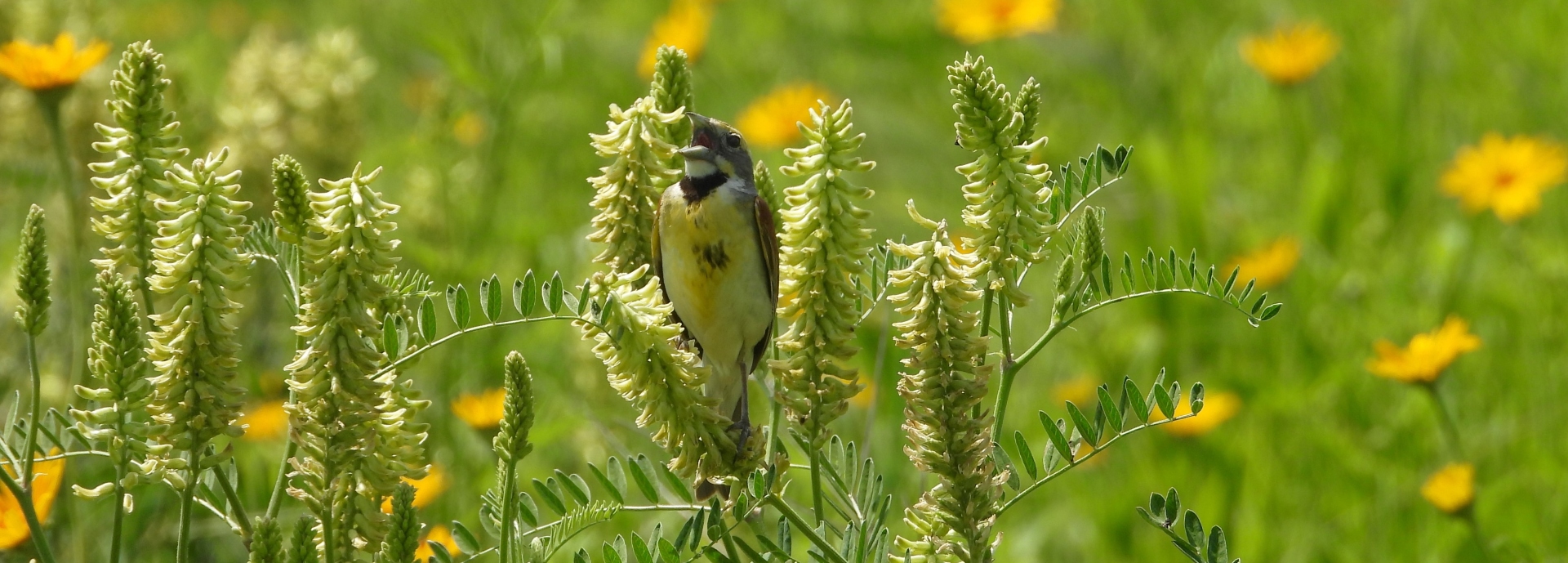
Astragalus canadensis L.
Alternate Common Names: Canada milkvetch, Canada milk-vetch, milk-vetch, little rattlepod
Family: legume and pea family (Fabaceae (Leguminosae))
Functional Group: legumes
Description
- Life cycle and growth form
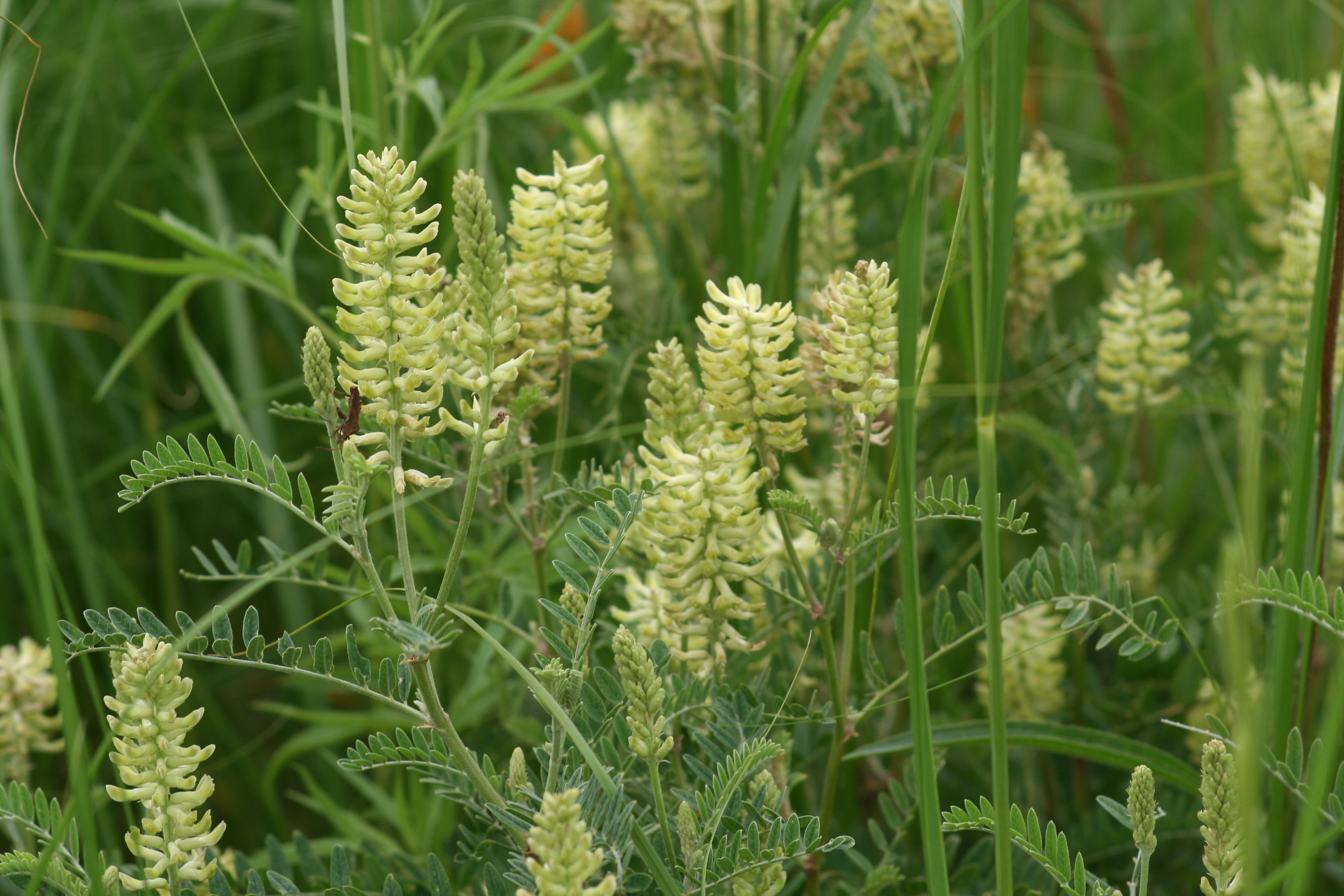
Perennial with a taproot, spreading by rhizomes.
Height: 1.5-3.5 ft
- Leaves and stem
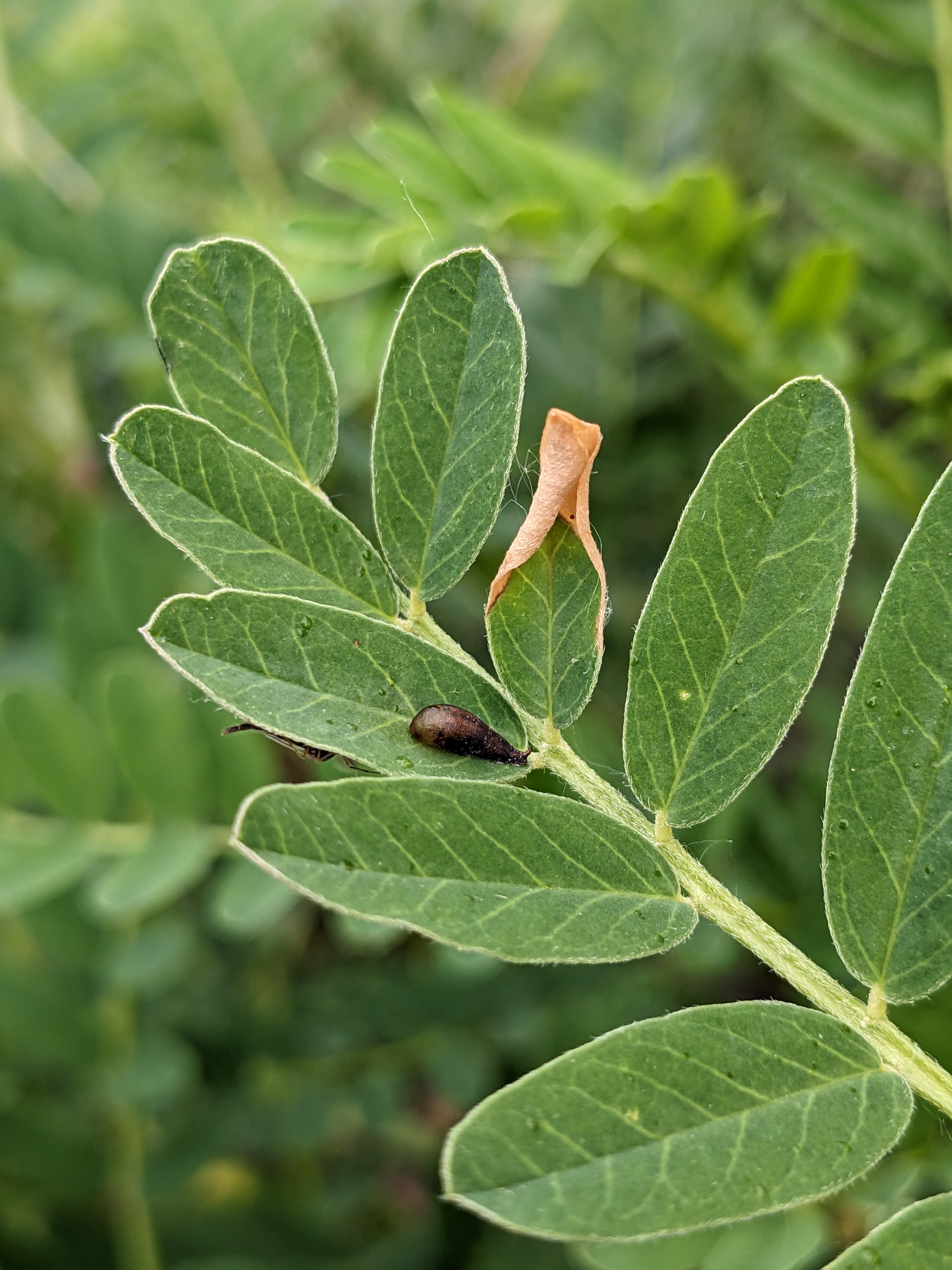
Leaves alternate, odd-pinnately compound with 15 to 31 elliptical leaflets; stems are stiff, branched above, with some hairs, reddish when exposed to high sunlight.
- Flower, fruit and seedhead
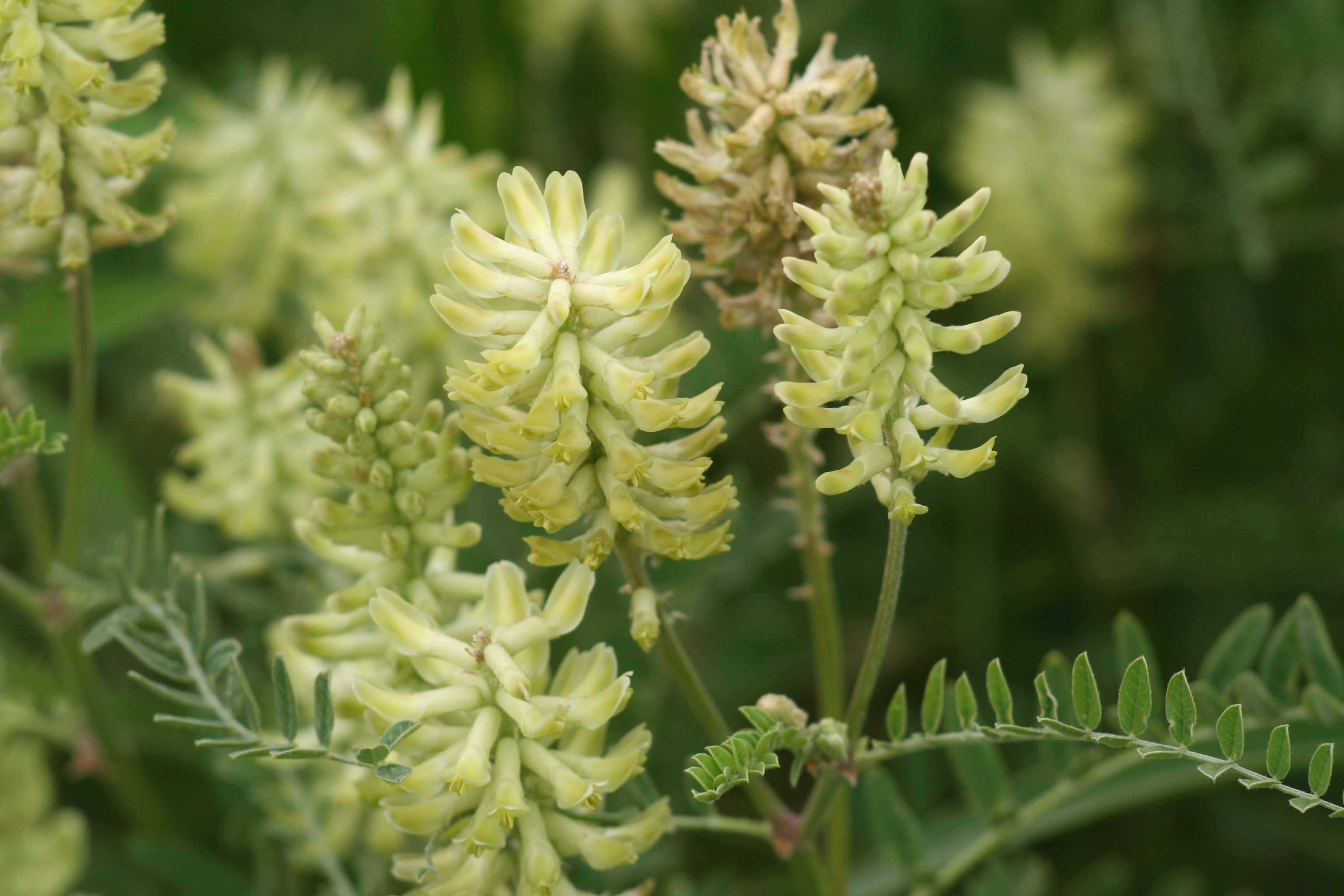
Flower: Creamy greenish-white, narrow, elongated pea-like flowers, crowded in spikelike racemes 1.5 to 7 in long at tips of leafless stalks arising from leaf axils on upper portion of plant.
Fruit/seedhead: Spikelike clusters of erect, tough, dark brown pods, each 1/2 in long, with a sharp tip; pods split open from tips when mature to release seeds.
Pollination: Bumble bees and other long-tongued bees.
- Seed
Seed characteristics
Seeds per ounce: 17,000 (IA NRCS)
Seeds per pound: 275,000 (IA NRCS)
1000 seed weight: 1.97 g (Seed Information Database)
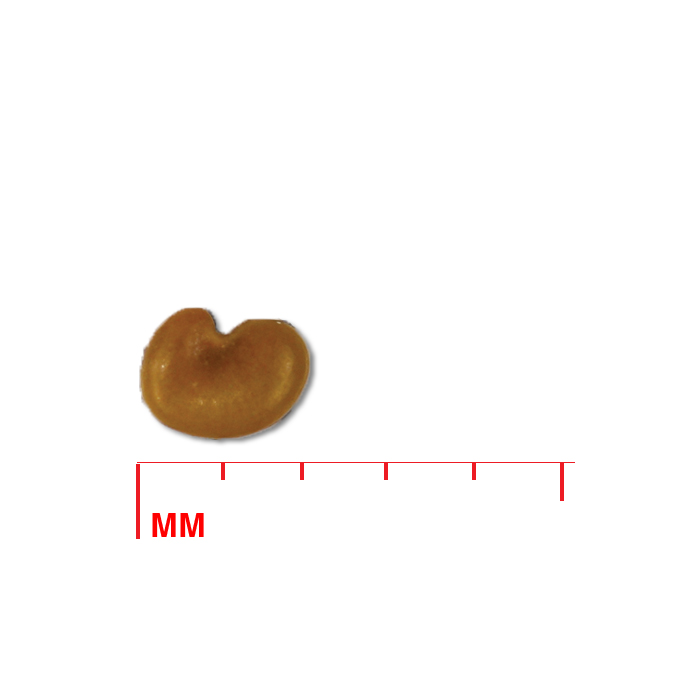
Description: Fruits are small pods containing several loose seeds. Pods are about 1 cm long (1/2 in), green at first, turning dark brown to black at maturity, splitting partially open. Seeds are a small, flat bean, about 2 mm (1/16 in) in diameter.
Typical seed test
PLS: 96% (n = 9)
Purity: 100% (n = 9)
Germination: 12% (n = 8)
Hard: 85% (n = 8)
(average of n tests of purchased seed lots)
- Habitat and range
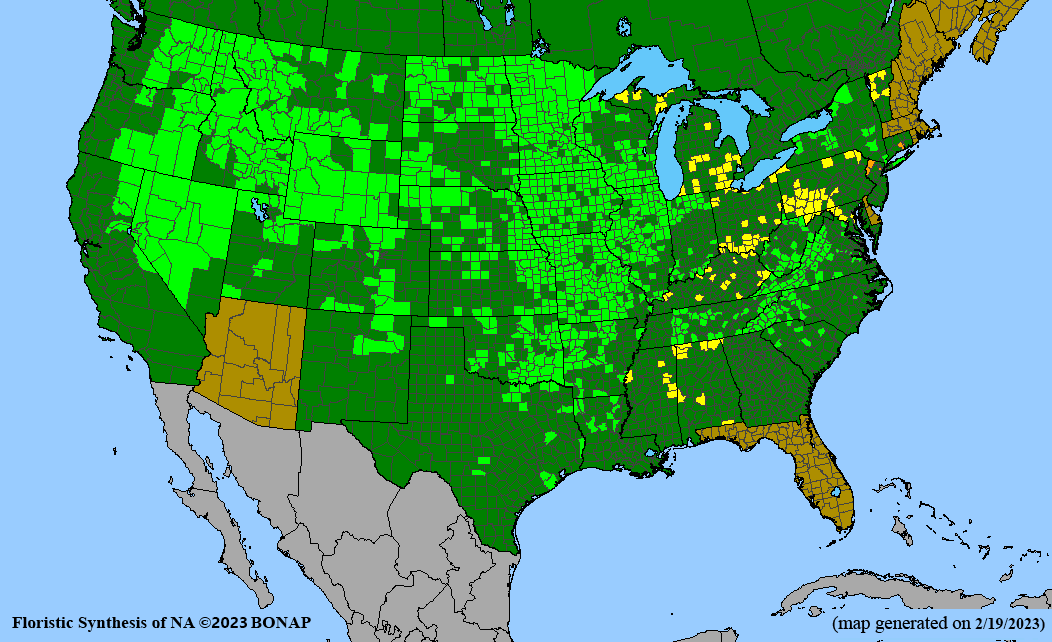
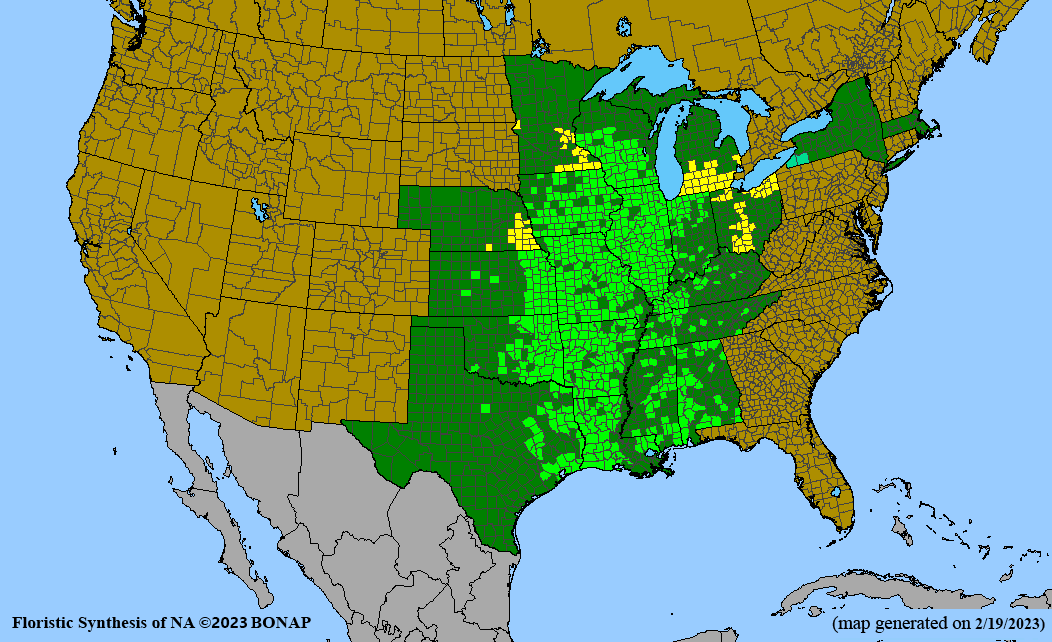
Habitat: Mesic to wet-mesic soil; full sun; prairies, woodland edges, savannas, shorelines, abandoned fields. Wetland Indicator Status is Facultative (FAC) for the Midwest. Moist, fertile, loamy soils are preferred for seed production.
Conservation status: Global- G5, secure; District of Columbia- SX, presumed extirpated; Alabama, Georgia, Maryland, Pennsylvania- S1, critically imperiled; Michigan- S1/S2, critically imperiled to imperiled; Mississippi, Ohio, Utah, and Vermont- S2, imperiled; Colorado, North Carolina, Louisiana, and Nevada- S3, vulnerable (NatureServe)
General Comments
Canadian milkvetch is a short-lived species in seed production plots, usually dying out after a few years. It spreads prolifically from rhizomes the second year after establishment. It is usually found as small, somewhat stable colonies in prairies in disturbed areas, over a few years at least. Grazing or clipping prolongs the life-span of the plant, but of course this precludes seed production.
Recommendations for Seed Production
- Establishment for seed production
Direct seeding
Row spacing: 30-36 in 7 in rows and solid stands PLS lbs/acre: 2.1 6.3 Seeds/linear foot: 40
Seeding depth: 1/4-1/2 in
Seeding method: native seed drill
Seeding time: Dormant fall seeding of unscarified seed. Scarify and inoculate seed with Astragalus (Spec 1) inoculum for early spring planting.
Weed control: Prepare clean, firm, weed free seedbed prior to seeding.
Greenhouse
Seed pre-treatment: Scarify seed (see Seed Treatments) and wet stratify 10-14 days at 40° F.
Sowing: Sow seed in greenhouse 2 months before last frost free date.
Transplanting: Transplant mature seedlings into bare soil or weed barrier in rows convenient for tillage equipment after all danger of frost is past. Use a temporary weed barrier such as paper mulch or biodegradable plastic that breaks down or can be removed before the second growing season to accommodate plant spread from rhizomes.
- Stand management
Weeds: Mow stands above seedling height during establishment year. Use tillage and hand-roguing to control weeds.
Pests: Plots may need protection from rabbits and/or deer. Plants infested with black aphids become stunted and produce fewer flowers. Insect seed predators may become a problem.
Diseases: None noted.
- Seed production
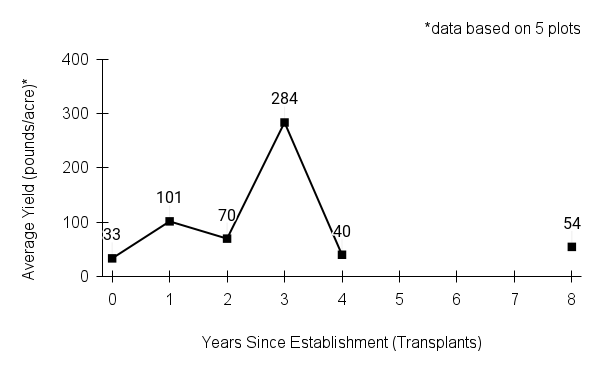
First harvest: Abundant flowering and seed set at end of second growing season from greenhouse grown transplants and well-managed direct seeded stands.
Yield: 30-280 bulk pounds/acre (averages based on 5 plots)
Stand life: Peak harvests in second to third years. Many stems die after flowering and setting seed, usually the second or third year after planting.
Flowering date: mid-July - early August in northern Iowa
Seed maturity/Harvest date: mid-August - early September in northern Iowa
Seed retention: Pods split partially open at maturity, and seeds will shake out of pods if disturbed by strong wind or passing animals.
Harvest date range at TPC (2003-2023): Aug 7 - Sept 25
Recommended harvest method: combine
- Seed cleaning and storage
Cleaning process: Pre-clean air-dried material by scalping thru 1/2 ft and 1/4 in mesh to remove large particles. If hand clipped, break up pods with beater bars in a brush machine. If combined then simply air-screen to clean (see appendix for settings).
Seed storage: cool/dry (33-50° F, 30-50% RH).
Released Germplasm
Source Identified material: Natural Selections/Iowa Ecotype Zones 1, 2, and 3
- References
Chayka, K. (n.d.). Astragalus canadensis (Canada milkvetch). Minnesota Wildflowers. https://www.minnesotawildflowers.info/flower/canada-milkvetch
Hilty, J. (2019). Canada milkvetch - Astragalus canadensis. Illinois Wildflowers. https://www.illinoiswildflowers.info/prairie/plantx/can_milkvetchx.htm
Houseal, G. A. (2007). Forbs legumes. In Tallgrass Prairie Center’s native seed production manual (pp. 56–57). Tallgrass Prairie Center - University of Northern Iowa.
Kartesz, J.T., The Biota of North America Program (BONAP). 2023. North American Plant Atlas. (http://bonap.net/napa). Chapel Hill, N.C. [maps generated from Kartesz, J.T. 2023. Floristic Synthesis of North America, Version 1.0. Biota of North America Program (BONAP). (in press)]
NatureServe. 2024. NatureServe Network Biodiversity Location Data accessed through NatureServe Explorer [web application]. NatureServe, Arlington, Virginia. Available https://explorer.natureserve.org/. (Accessed: February 29, 2024).
USDA NRCS National Plant Data Team. (n.d.). Astragalus canadensis L.. USDA plants database. https://plants.usda.gov/home/plantProfile?symbol=ASCA11
Species Guide Updated 02/13/2025
longbract wild indigo
longbract wild indigo dickeye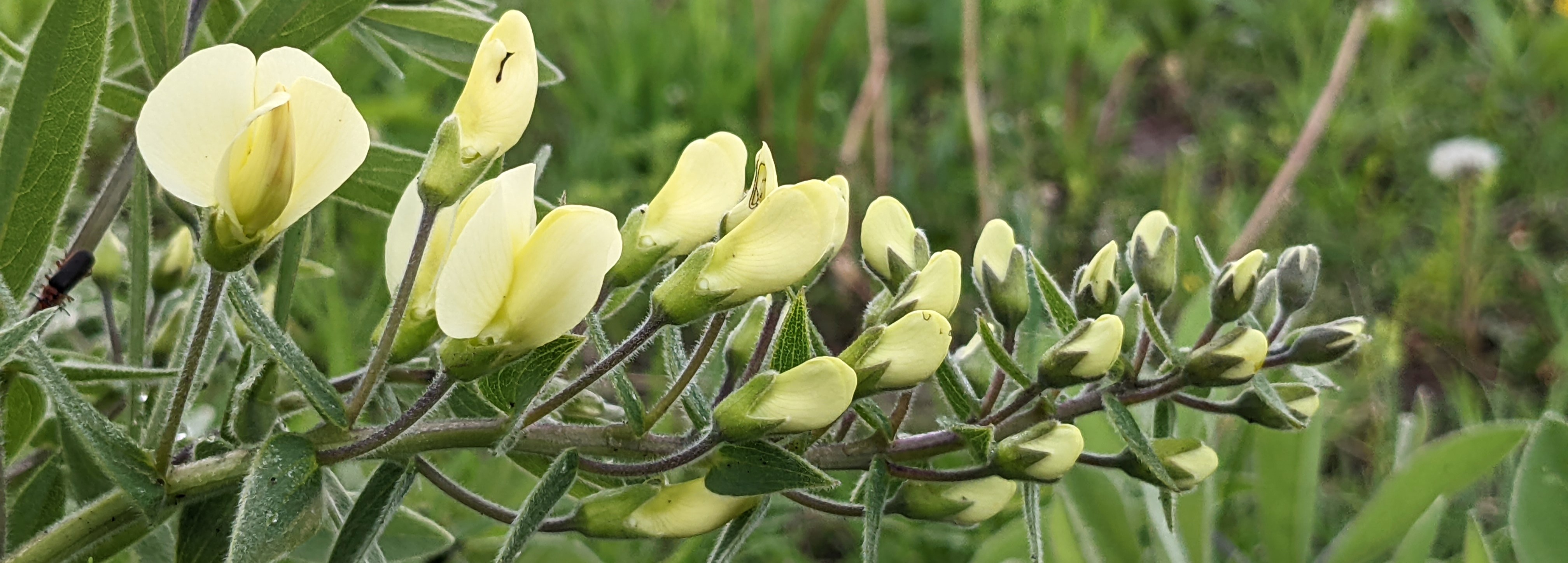
Baptisia bracteata, Muhl. ex Elliott var. leucophaea (Nutt.) Kartesz & Gandhi
Alternate Common Names: Cream-colored false indigo, plains wild indigo, large-bracted wild indigo, long-bracted wild indigo, yellowish false indigo, cream wild indigo
Scientific Synonyms: Baptisia bracteata Muhl. ex Elliott var. glabrescens (Larisey) Isely, Baptisia leucophaea Nutt., Baptisia leucophaea Nutt. var. glabrescens Larisey
Family: legume and pea family (Fabaceae (Leguminosae))
Functional Group: legumes
Description
- Life cycle and growth form
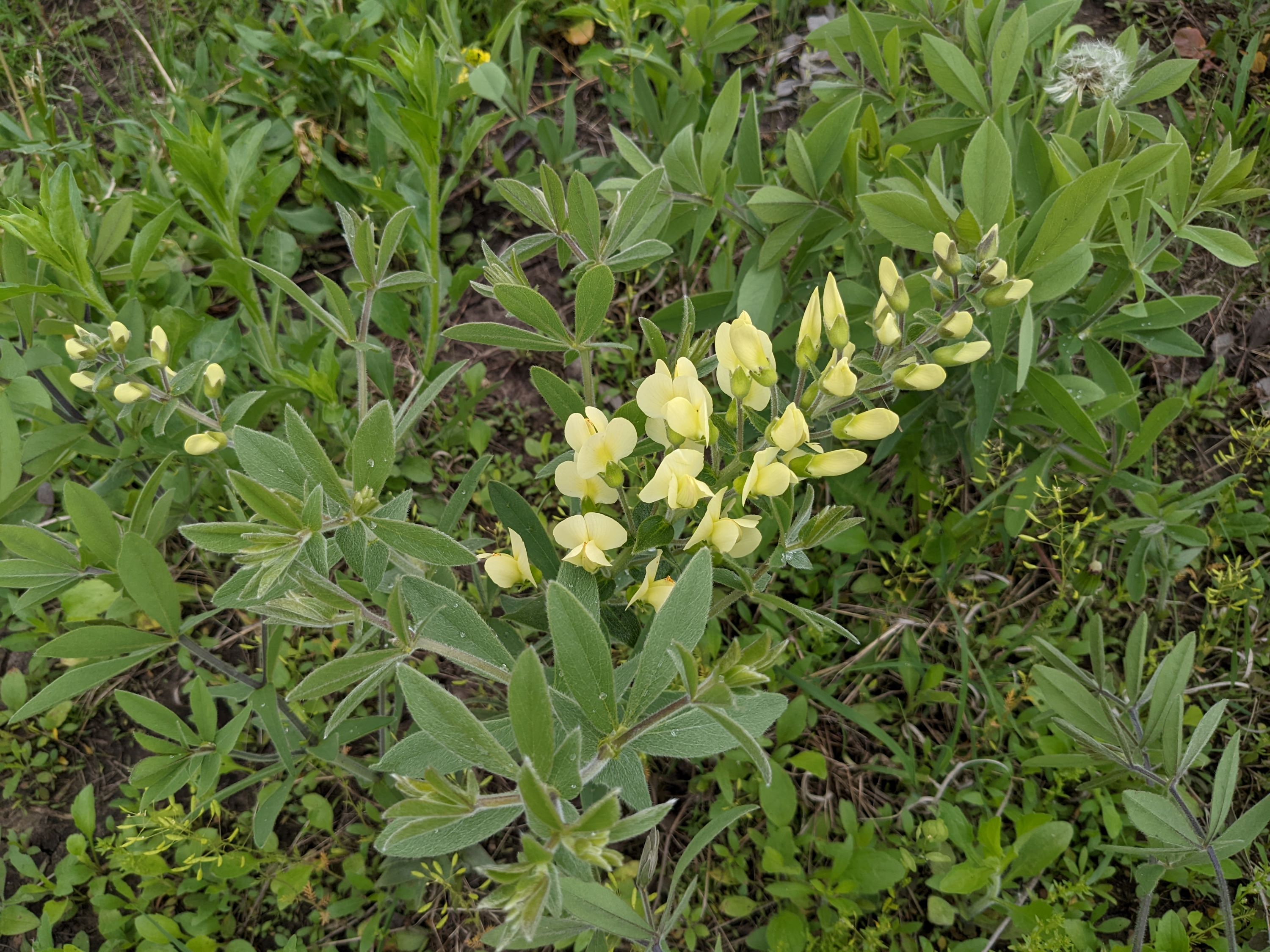
Perennial growing from a taproot; spring shoots resemble asparagus but are fuzzy; in late fall, the plant breaks off near the ground and tumbles to disperse the seeds.
Height: 1-3 ft
- Leaves and stem
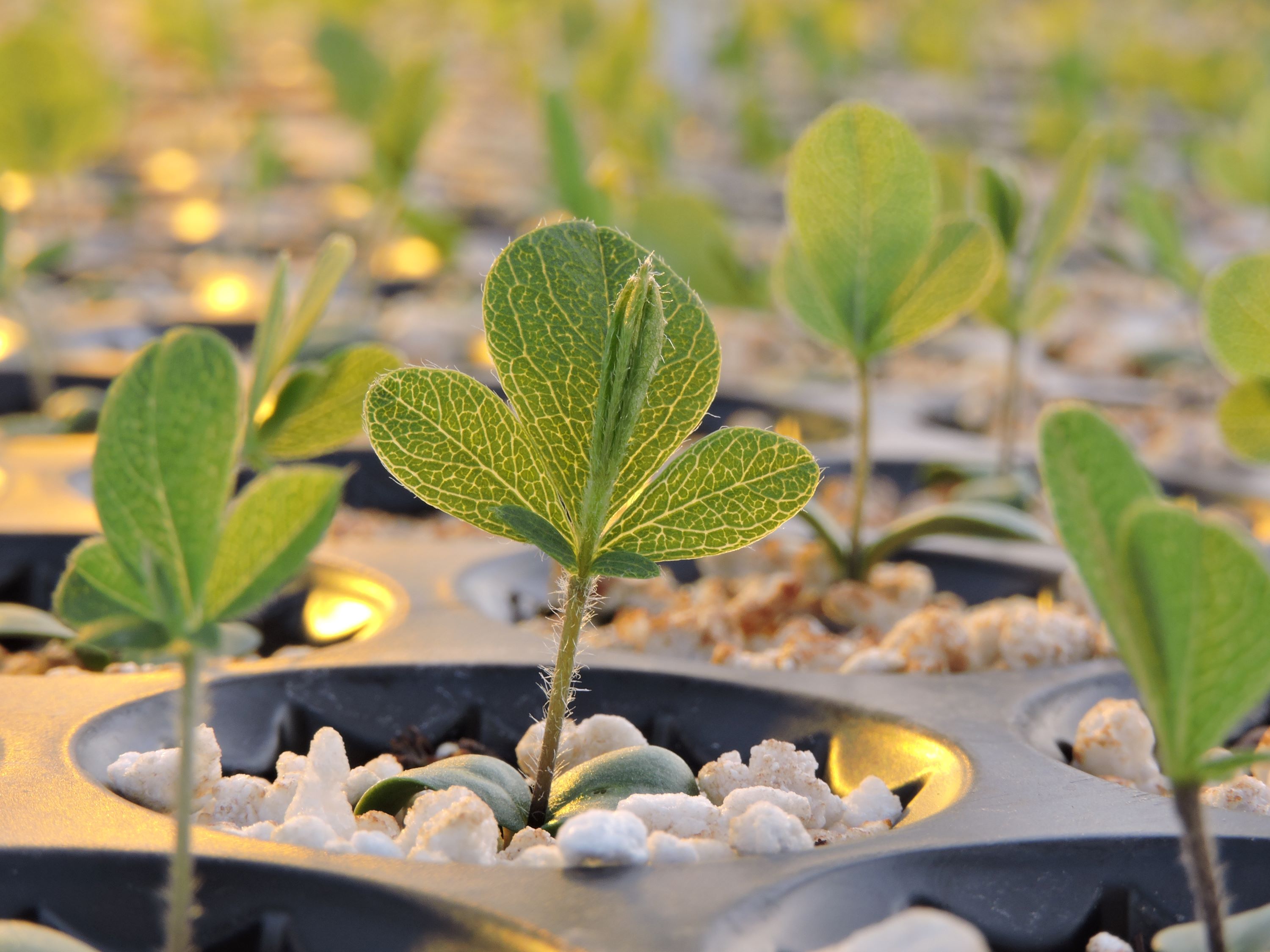
Leaves alternate, hairy, short-stalked or sessile on the stem, compound with 3 leaflets and two large, prominent stipules at the base of each leaf; stems hairy with wide-spreading branches.
- Flower, fruit and seedhead
Flower: Large, pale, creamy-yellow pea-shaped flowers in dense racemes that extend parallel to the ground or droop downward.
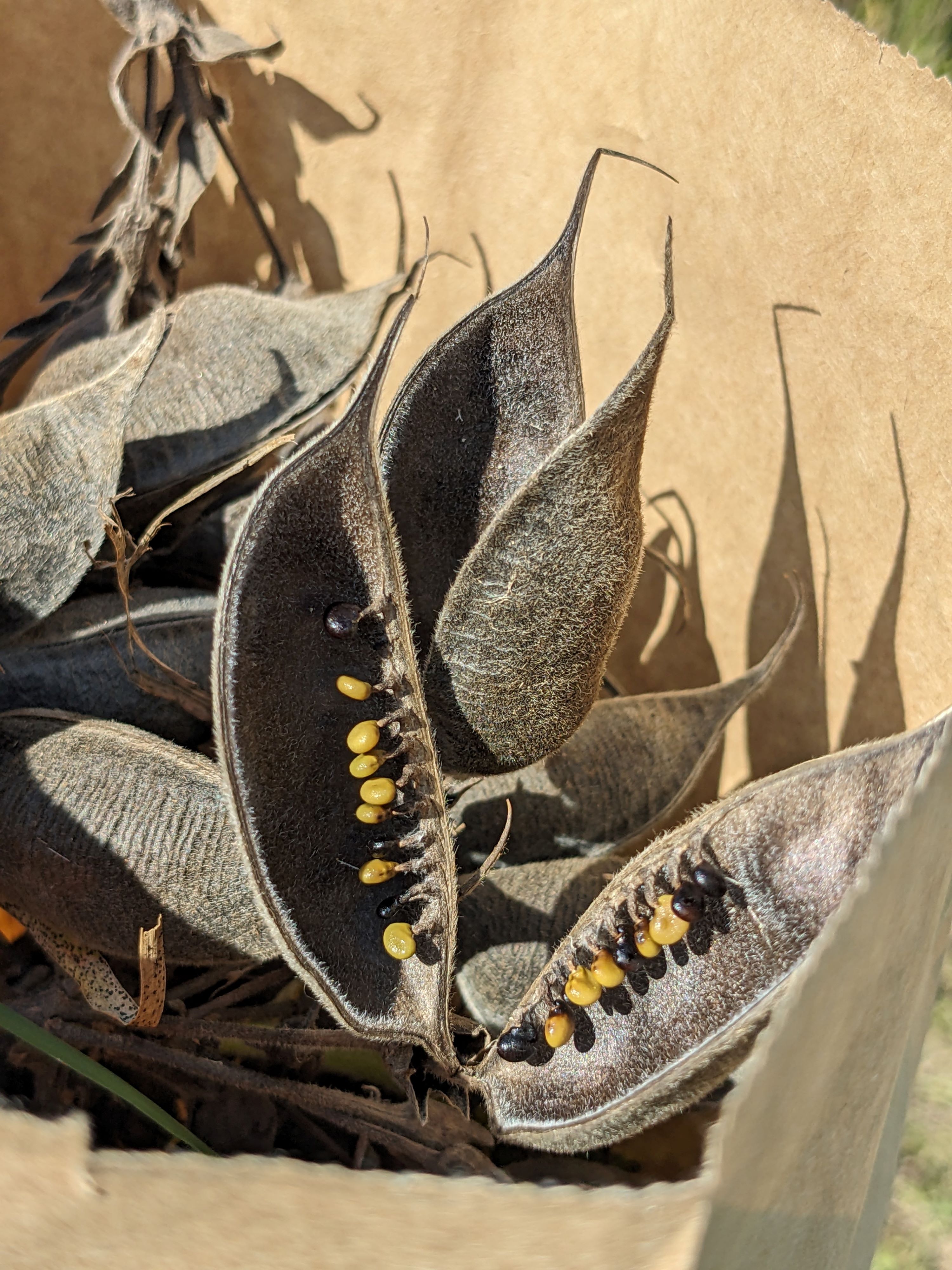
Fruit/seed head: Pods are inflated and green, turning black at maturity, 1-2 in long with pointed tips; seeds are small beans, golden-brown to olive in color
Pollination: Bumble bees and other large bodied bees.
- Seed
Seed characteristics
Seed weight:
Seeds per ounce: 1,400 seeds/oz (IA NRCS)
1000 seed weight: 11.51g (Seed Information Database)
Description: Seed is a small, plump bean about 5 mm in length, golden-brown and coated with a powdery, sticky resin.
Typical seed test
PLS: 93% (n = 6)
Purity: 100% (n = 6)
Germination: 7% (n = 4)
Dormancy: 68% (n = 4)
(averages obtained from n tests of purchased seed lots)
- Habitat and range
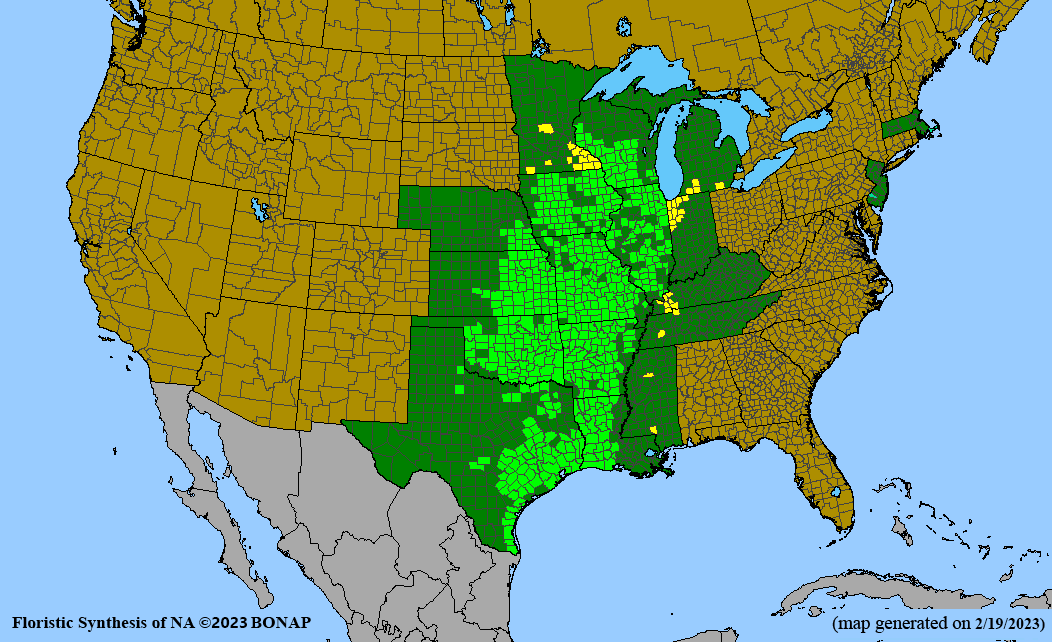
Habitat: Dry to mesic soil; full sun; prairies, savannas, woodland openings; well drained soils preferable for seed production.
Conservation status: Global- G4, apparently secure; Minnesota- S3, vulnerable; (NatureServe)

General Comments
The spring shoots of mature cream wild indigo plants come up quickly, resembling hairy asparagus, in late April in northeast Iowa. Blooms appear in May, making this large-flowered species an important source of food for new bumble bee queens. The pods blacken at maturity, and the entire plant turns charcoal-gray in fall. Pods eventually split open, revealing orderly rows of attached seeds, if they have not been devoured by the larvae of a host specific insect: the baptisia seed pod weevil. Seed yields are highly variable due to fluctuations in weevil populations. In natural populations, the stem breaks off at ground level in late fall and plants tumble with the wind, shaking out any seed remaining in the pods, aiding seed dispersal.
Recommendations for Seed Production
- Establishment for seed production
Direct seeding
We do not have experience with direct seeding this species for seed production.
Greenhouse
Seed pre-treatment: Scarify and stratify for 10-14 days in the refrigerator. Inoculate with Baptisia rhizobia if desired.
Sowing: Sow seed 1/4 in deep in plugs two months before average final frost. Damping off (fungal pathogen) can be a problem on seedlings if soil is kept too moist, or seedlings are planted too thickly. Add additional perlite to sterile potting mix to improve drainage. Avoid excess moisture on the soil surface by applying a thin layer of chick grit over the top of the soil, improving air circulation with fans, thinning seedlings, and/or watering from the bottom of the containers only. Seedlings form a fleshy taproot with few lateral roots, unless allowed to grow until taproot is air-pruned as it reaches the bottom drainage holes of the container. Plugs with vertical grooves and large bottom openings encourage air-pruning and branching of roots.
Transplanting: When seedlings are well-rooted plugs, transplant at 12 in spacing in rows mulched with plastic or other weed barrier.
- Stand management
Weeds: Adding a short, warm-season grass to production rows helps suppress weeds and provides fuel for prescribed fires.
Pests: A native, host-specific insect, the baptisia seed pod weevil, consumes nearly all seed in some years, making harvests of this species highly variable. Insecticide (permethrin) treatment may increase seed production slightly (15 more seeds per plant) (Horn and Hanula, 2004), but this must be weighed against potential damage to pollinators.
Diseases: None noted.
- Seed production
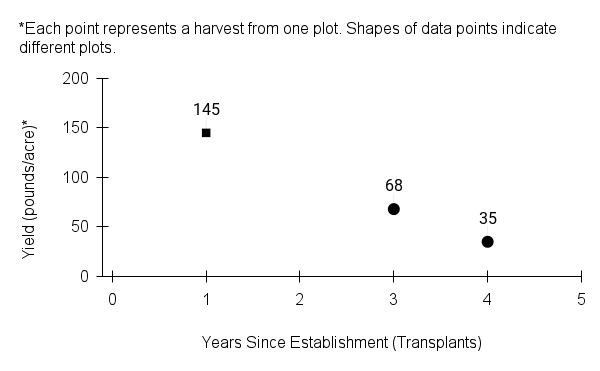 First harvest: Seed may be produced in the year following transplanting, however, yields are extremely variable depending on weevil populations. First measurable harvest in one field at TPC was in year 3.
Yield/acre: 35-145 pounds per acre (extrapolated based on harvest records of 2 plots. Note that each point on the yield graph represents a harvest from one plot. Plots were harvested only in years when weevil damage was light).
Stand life: Plants are very long-lived, persisting within a grassy matrix for 20 years or more, though they do not produce seed every year due to seed predation by weevils.
Flowering date: May in northeast Iowa
Seed maturity/harvest date: Aug - Sept
Seed retention: Not prone to shattering until late fall (October)
Harvest date range at TPC (2005-2024): Aug 4 - Oct 7
Recommended harvest method: Hand pick or combine
- Seed cleaning and storage
Cleaning process: Hand collected material may be stomped to break up pods. This step is not needed for combined material. Pre-clean air-dried material by scalping through 1/2 in mesh to remove large particles. Air-screen to clean (see Appendix C). Most black-colored seeds are non-viable and usually less dense than light-colored seeds, and most should be removed by increasing aspiration.
Seed storage: Cool/dry (33-50° F, 30-50% RH); seed may remain viable for 10 or more years
Released Germplasm
Source Identified material: Natural Selections/Iowa Ecotype Zones 1, 2, 3
- References
Chayka, K. (n.d.). Baptisia bracteata (plains wild indigo). Minnesota Wildflowers. https://www.minnesotawildflowers.info/flower/plains-wild-indigo
Cochrane, T. S., Elliot, K., & Lipke, C. S. (2014). Cream wild indigo. In Prairie plants of the University of Wisconsin-Madison Arboretum (3rd ed., p. 181). University of Wisconsin-Madison Arboretum.
Hilty, J. (n.d.). Cream wild indigo - Baptisia bracteata. Illinois Wildflowers. https://www.illinoiswildflowers.info/prairie/plantx/cr_indigox.htm
Kartesz, J.T., The Biota of North America Program (BONAP). 2023. North American Plant Atlas. (http://bonap.net/napa). Chapel Hill, N.C. [maps generated from Kartesz, J.T. 2023. Floristic Synthesis of North America, Version 1.0. Biota of North America Program (BONAP). (in press)]
NatureServe. 2024. NatureServe Network Biodiversity Location Data accessed through NatureServe Explorer [web application]. NatureServe, Arlington, Virginia. Available https://explorer.natureserve.org/. (Accessed: February 28, 2024).
Runkel, S. T., & Roosa, D. M. (2009). Cream-colored false indigo. In Wildflowers of the tallgrass prairie: The upper Midwest (2nd ed., pp. 46–47). University of Iowa Press.
USDA NRCS National Plant Data Team. (n.d.). Baptisia bracteata Muhl. ex Elliott. USDA plants database. https://plants.usda.gov/home/plantProfile?symbol=BABR2
Species Guide Updated 12/5/2025
purple prairie clover
purple prairie clover dickeye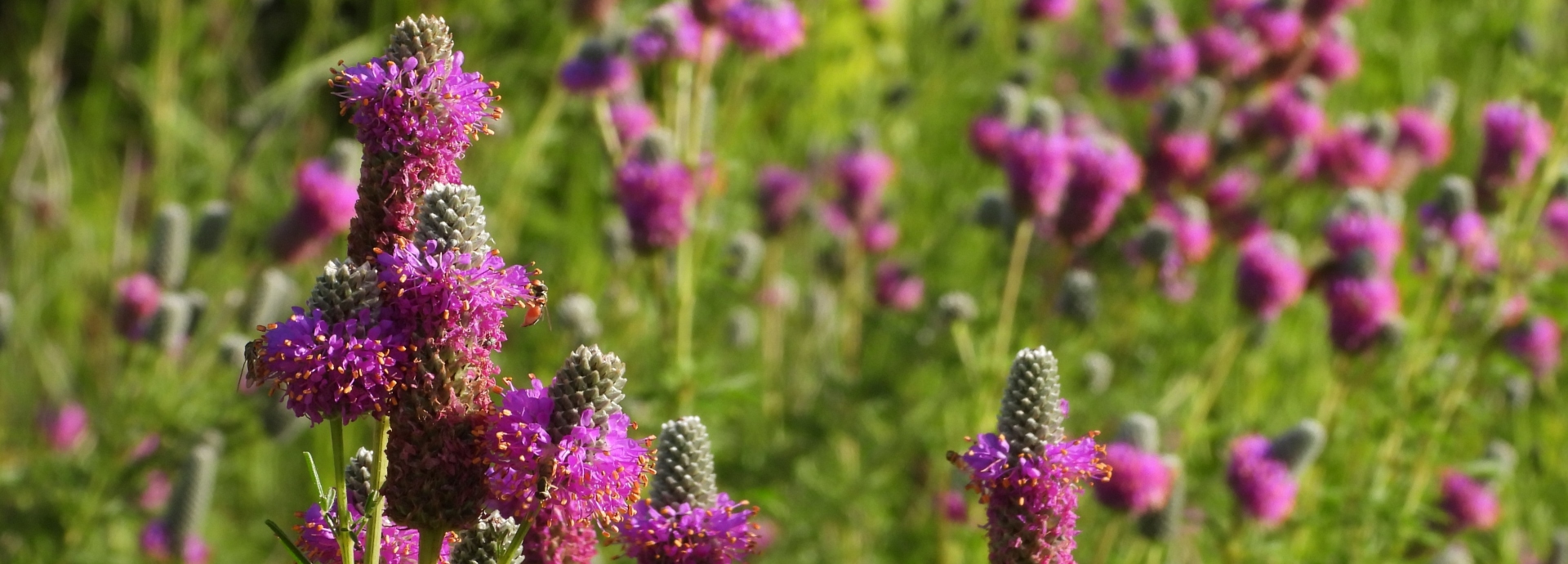
Dalea purpurea Vent.
Alternate Common Names: violet prairie clover, thimbleweed, red tassel flower, purple prairie-clover
Scientific Synonym: Petalostemum purpureum (Vent.) Rybd.
Family: legume and pea family (Fabaceae (Leguminosae))
Functional Group: legumes
Description
- Life cycle and growth form
Perennial, with woody, branched taproot.
Height: 1-3 ft
- Leaves and stem
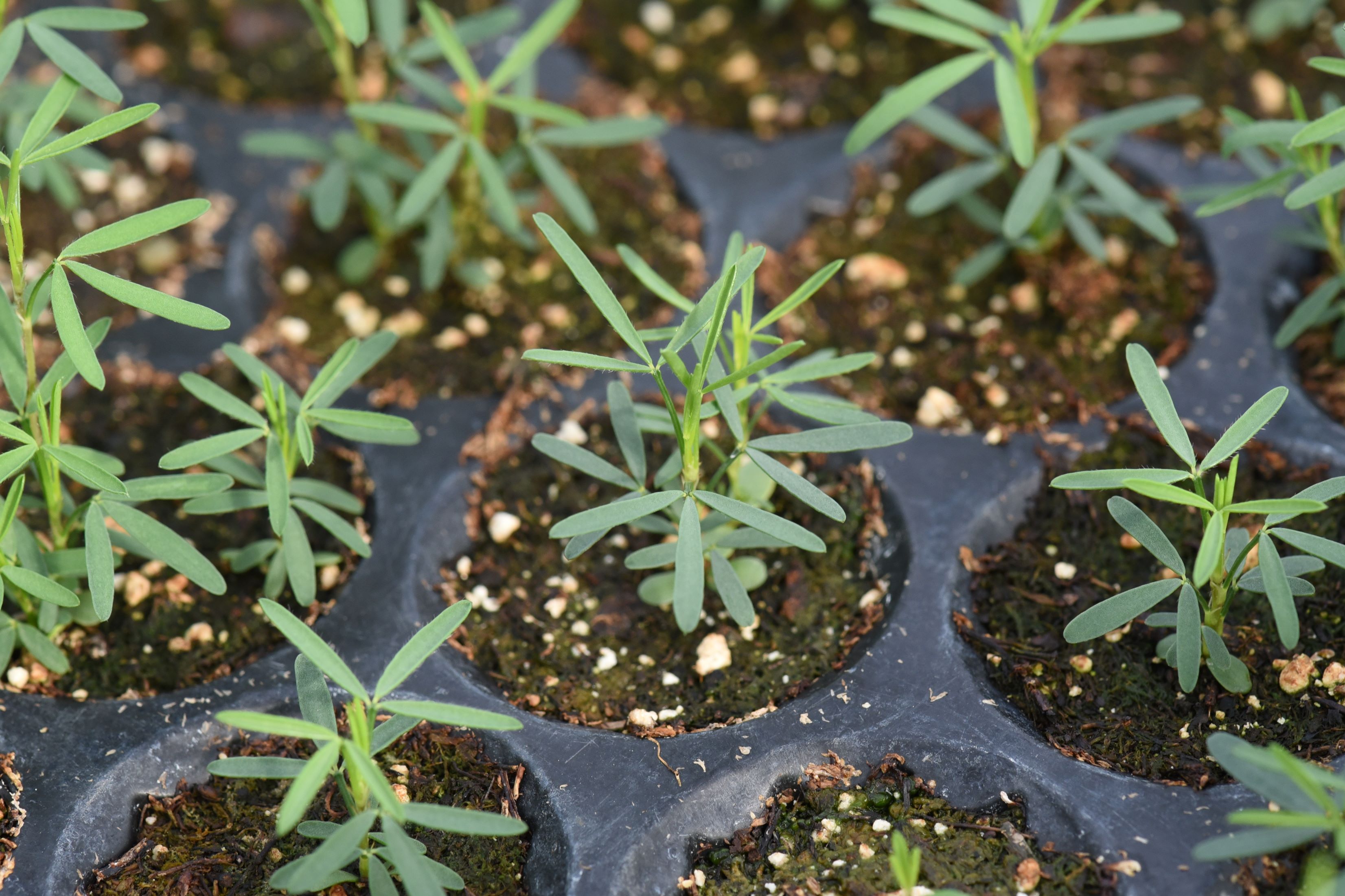
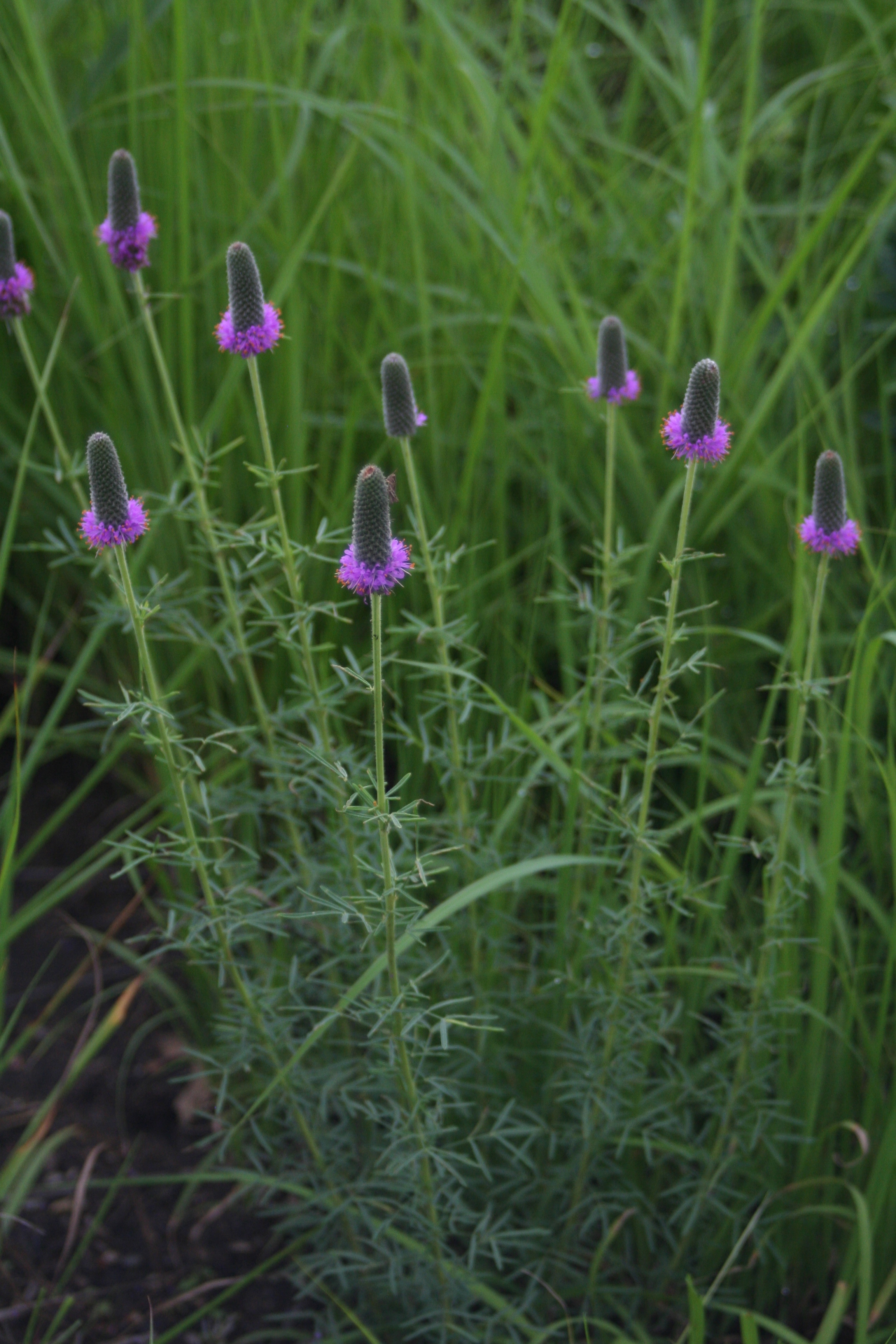
Leaves 1.5-3 in long, alternate, odd-pinnately compound with 3-7 very narrow leaflets, smooth but with black dots on lower leaf surface and a strong citrus odor when crushed; stems hairless to hairy and slightly ribbed when dry.
- Flower, fruit and seedhead
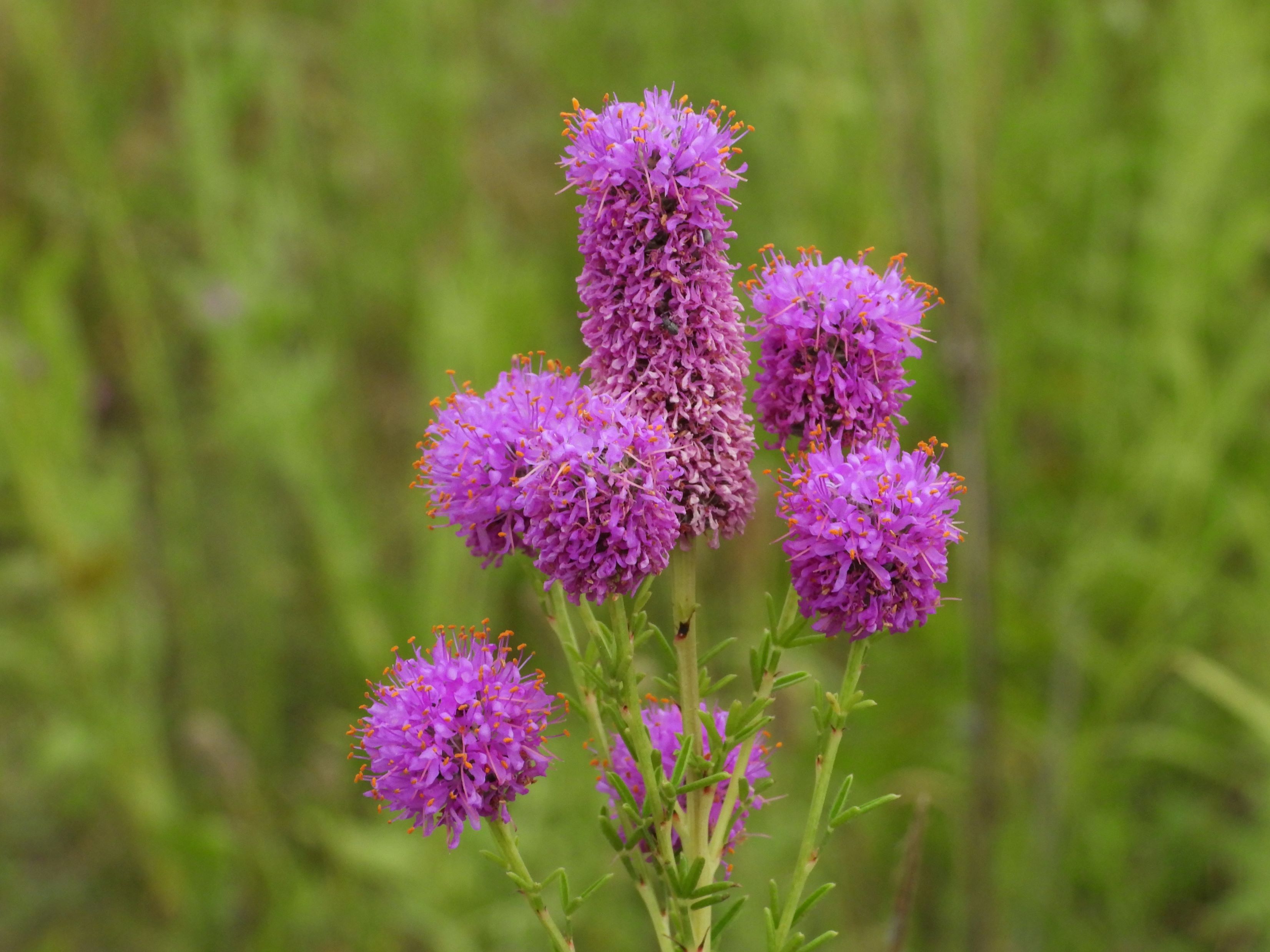
Flower: Individual flowers densely packed into a cylindrical spike about 1/2-3 in long; flowers open in whorls from the bottom to the top; tiny, 5-part flowers have purple petals and prominent, golden stamens.
Fruit/seedhead: Seed head is an elongate, compact head at the stem tip, composed of numerous dry, hairless pods which stay attached to the calyx until dislodged; strong scent when crushed.
Pollination: Insects, particularly bees, wasps, small butterflies, skippers, and beetles.
- Seed
Seed characteristics
Seed weight:
Seeds per ounce: 18,000 (IA NRCS)
Seeds per pound: 288,000 (IA NRCS)
1000 seed weight: 3.19 g (Seed Information Database)
Description: Fruits are a 1-2 seeded legume. Seeds are small beans, about 2 mm (1/16 in) long, olive green to tan or brown.
Typical seed test
PLS: 97% (n = 11)
Purity: 100% (n = 11)
Germination: 83% (n = 10)
Hard: 14% (n = 10)
(averages obtained from n tests of purchased seed lots)
- Habitat and range
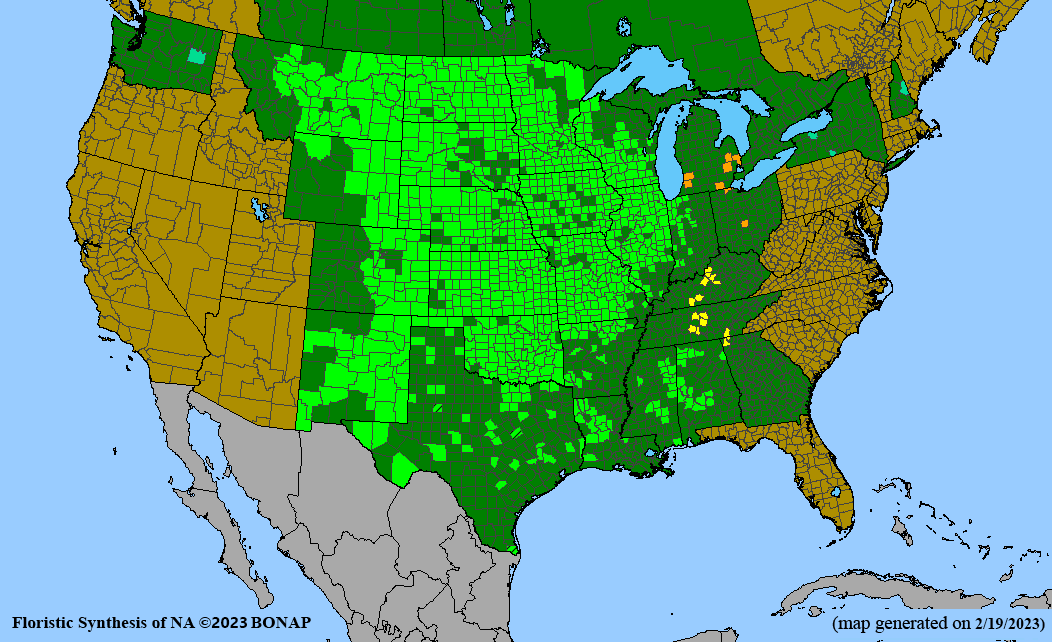
Habitat: Dry to mesic, rocky or sandy soil; full sun; prairies, dunes, savannas. Very well-drained, loamy soils are preferred for seed production.
Conservation status: Global- G5, secure; Michigan and Ohio- SX, presumed extirpated; Georgia and Tennessee- S1, critically imperiled; Kentucky- S2, imperiled; Indiana- S3, vulnerable (NatureServe)

General Comments
Purple prairie clover is an important component of mesic to dry upland prairies. It tends to increase following spring burning (Bidwell 1990), though burning production fields is usually not an option because of a lack of continuous grass fuels to carry fire. Purple prairie clover seed should be dehulled when cleaned for the commercial market. Seed tests are more accurate on a dehulled seed, and seed count per pound is higher.
Recommendations for Seed Production
- Establishment for seed production
Direct seeding
Row spacing: 30-36 in 7 in rows or solid stand PLS lbs/acre: 2 6 Seeding depth: 1/4 in
Seeding method: native seed drill
Seeding time: Dormant fall seeding of unscarified seed. Scarify and inoculate seed (Dalea, F inoculum) for spring planting.
Weed control: Prepare clean, firm, weed free seedbed prior to seeding.
Greenhouse
Seed pre-treatment: Scarify seed (see General Information: Propagation of Native Species). Moist stratification is not required, but seed should be stored in cold, dry conditions until planting time. A short stratification of 10-14 days may result in faster, more uniform germination.
Sowing: Sow seed 1/4 in deep in the greenhouse 2 months before the last frost free date. Damping off (fungal pathogen) can be a problem for seedlings if soil is kept too moist, or seedlings are planted too thickly. Avoid excess moisture on the soil surface by adding additional perlite to the sterile soil medium, applying a thin layer of chick grit (crushed quartzite or granite) over the top of the soil, improving air circulation with fans, thinning seedlings, and/or watering from the bottom of the containers only.
Transplanting: When root growth is sufficient to produce sturdy plugs, transplant seedlings into bare soil in rows convenient for tillage equipment or into a weed barrier at 8-12 in intervals after all danger of frost is past.
- Stand management
Weeds: Mow stands above prairie clover seedling height during establishment year. Poast (sethoxydim) or Prowl (pendimethalin) herbicide after establishment can be used to control weedy grasses. Plateau is labeled for pre- and post-emergence application. Note: These herbicides may not be labeled for this species in your state, always check the label and follow recommendations.
Pests: Herbivory by rabbits or deer may be a problem. Voles can kill many plants within a plot by feeding on the roots. Weevils may infest seed heads, reducing seed yield.
Diseases: None noted under field conditions. Damping off can be serious in a greenhouse environment (see above).
- Seed production
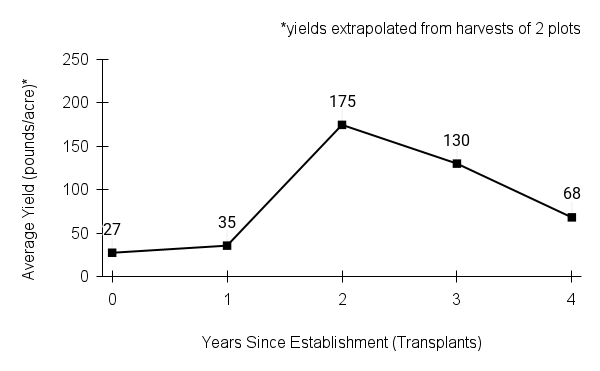 First harvest: Flowering and seed set occur at end of second growing season from greenhouse grown transplants and well-managed direct seeded stand.
 Yield: 27-175 bulk pounds/acre (extrapolated from harvests of 2 plots)
Stand life: 5-10 years. Peak harvest third year.
Flowering date: July - early August in northern Iowa
Seed maturity/Harvest date: September in northern Iowa
Seed retention: Shattering potential is low. Seed heads hold seed into October.
Harvest date range at TPC (2004-2023): Sept 5 - Nov 5
Recommended harvest method: Combine. If plants still retain green leaves, do not cut any lower than necessary to harvest seed heads.
- Seed cleaning and storage
Cleaning process: Pre-clean air-dried material by scalping through 1/2 in and 1/4 in mesh to remove large particles. Use a brush machine with stiff bristles to remove hulls, then air-screen. Re-brush any seed still in the hull, if necessary, and air-screen.
Seed storage: cool/dry (33-50° F, 30-50% RH)
Released Germplasm
Source Identified material: Natural Selections/Iowa Ecotype Project Zones 1, 2, and 3
Selected Germplasm: Bismarck Germplasm (SD), Cuero Germplasm (TX).
Cultivated variety (cultivars): Kaneb (KS)
- References
Chayka, K. (n.d.). Dalea purpurea (purple prairie clover). Minnesota Wildflowers. https://www.minnesotawildflowers.info/flower/purple-prairie-clove
Cochrane, T. S., Elliot, K., & Lipke, C. S. (2014). Purple prairie-clover. In Prairie plants of the University of Wisconsin-Madison Arboretum (3rd ed., p. 183). University of Wisconsin-Madison Arboretum.
Hilty, J. (2019). Purple prairie clover - Dalea purpurea. Illinois Wildflowers. https://www.illinoiswildflowers.info/prairie/plantx/ppr_cloverx.htm
Houseal, G. A. (2007). Forbs wildflowers. In G. A. Houseal (Eds.), Tallgrass Prairie Center’s native seed production manual (pp. 60–61). Tallgrass Prairie Center - University of Northern Iowa.
Kartesz, J.T., The Biota of North America Program (BONAP). 2023. North American Plant Atlas. (http://bonap.net/napa). Chapel Hill, N.C. [maps generated from Kartesz, J.T. 2023. Floristic Synthesis of North America, Version 1.0. Biota of North America Program (BONAP). (in press)]
NatureServe. 2024. NatureServe Network Biodiversity Location Data accessed through NatureServe Explorer [web application]. NatureServe, Arlington, Virginia. Available https://explorer.natureserve.org/. (Accessed: February 29, 2024).
Runkel, S. T., & Roosa, D. M. (2009). Purple prairie clover - White prairie clover. In Wildflowers of the tallgrass prairie: The upper Midwest (2nd ed., pp. 176–177). University of Iowa Press.
USDA-NRCS. (n.d.). Conservation plant releases. Natural Resources Conservation Service. https://www.nrcs.usda.gov/plant-materials/cp/releases
USDA NRCS National Plant Data Team. (n.d.). Dalea purpurea Vent. USDA plants database. https://plants.usda.gov/home/plantProfile?symbol=DAPU5
Species Guide Updated 12/3/2024
roundheaded lespedeza
roundheaded lespedeza dickeye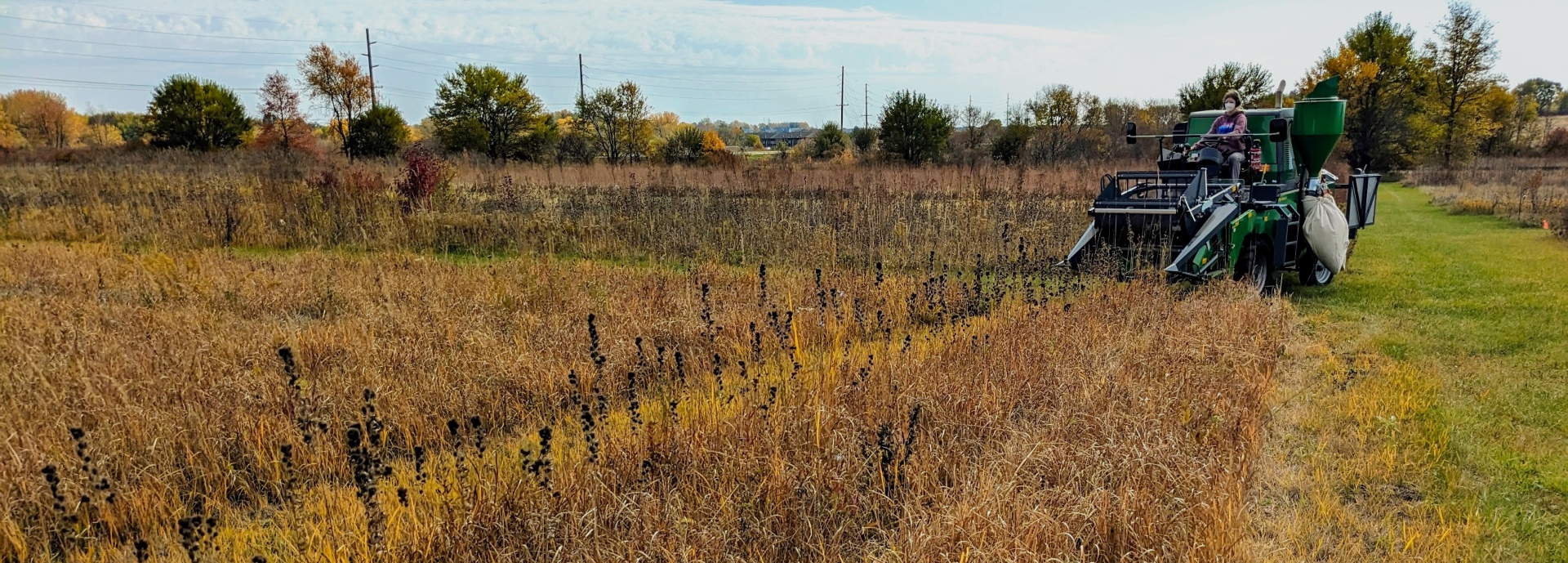
Lespedeza capitata Michx.
Alternate Common Names: rabbit foot, round-headed bush clover, round-headed bush-clover, dusty clover
Scientific Synonyms: Lespedeza bicknellii House, Lespedeza capitata Michx var. stenophylla Bissell & Fernald, Lespedeza capitata Michx. var. velutina (E.P. Bicknell) Fernald, Lespedeza capitata Michx. var. Vulgaris Torr. & A. Gray
Family: legume and pea family (Fabaceae (Leguminosae))
Functional Group: legumes
Description
- Life cycle and growth form
Perennial from a central taproot.
Height: 2-5 ft
- Leaves and stem
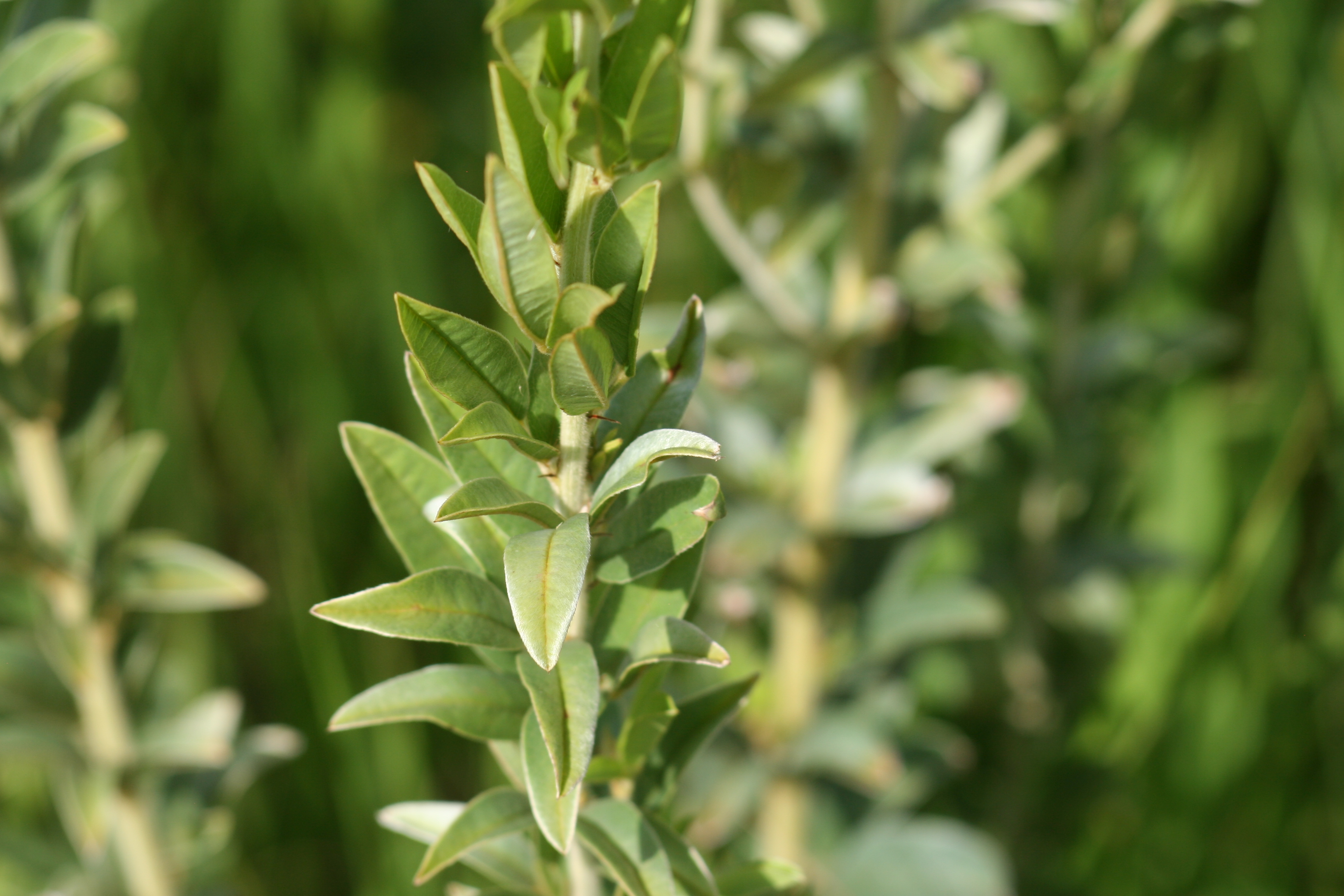
Leaves alternate and compound, divided into three leaflets with prominent mid-veins and silky hairs; stem is erect, densely covered in stiff white hairs, usually unbranched; may be multiple stems from the base.
- Flower, fruit and seedhead
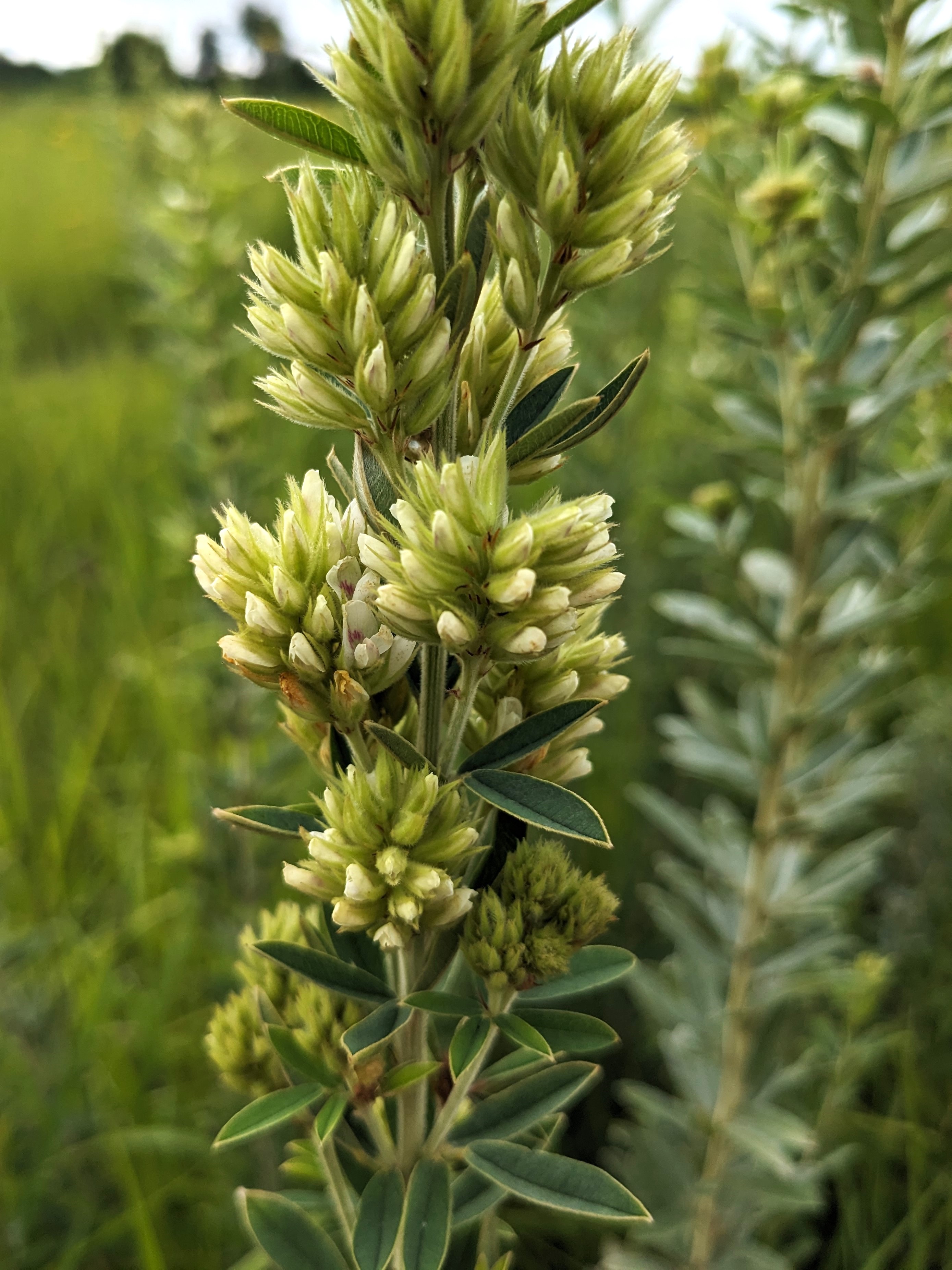
Flower: Small cream to white petals with purple spots at the throat, clustered into greenish, rounded heads at stem tip and in upper leaf axils.
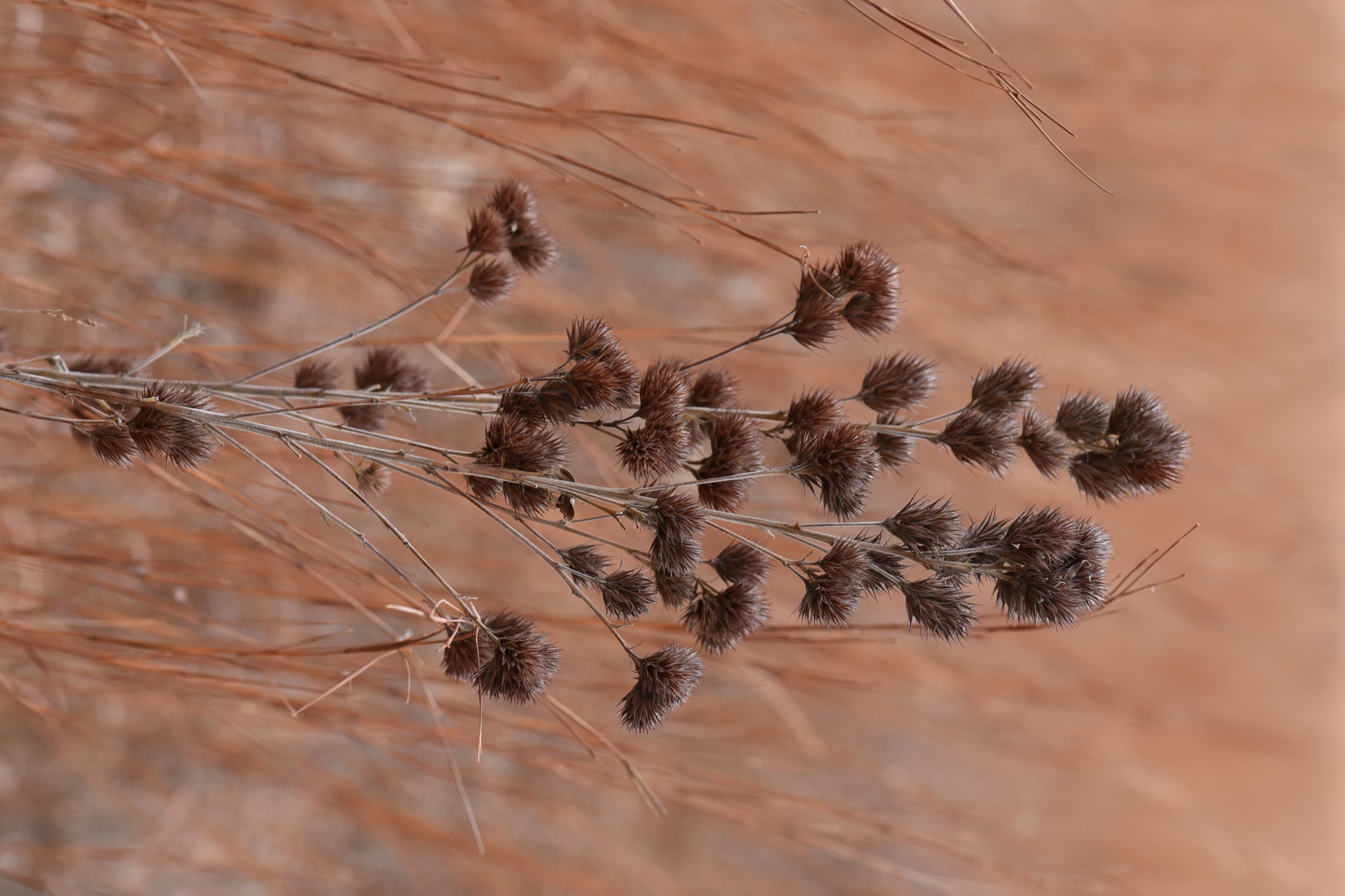
Fruit/seedhead: Brown seed heads last through winter though seed is shed in fall; fruit is a fuzzy one-seeded pod.
Pollination: bees
- Seed
Seed characteristics
Seed weight:
Seeds per ounce: 8,000 (IA NRCS)
1000 seed weight: 2.87 g (Seed Information Database)
Description: Fruits are a one-seeded legume, seeds are a small bean, 4-5 mm (about 3/16 in) long.
Typical seed test
PLS: 95% (n = 11)
Purity: 99% (n = 11)
Germination: 79% (n = 10)
Dormancy: 7% (n = 10)
(averages obtained from n tests of purchased seed lots)
- Habitat and range
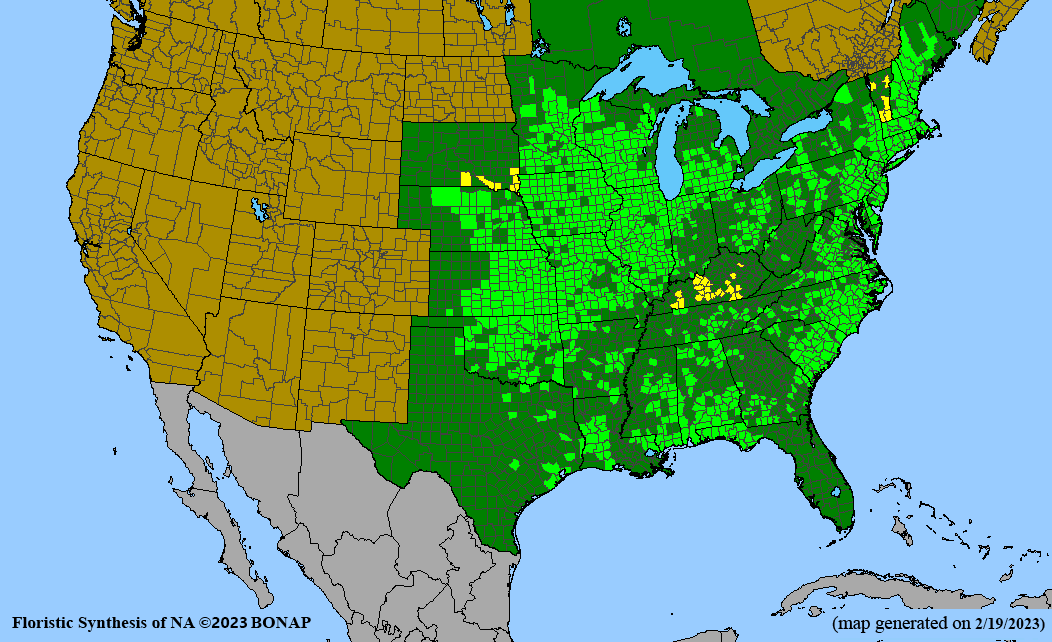
Habitat: Dry to mesic, sandy soil; full sun; prairies, loamy or sandy savannas, dunes, roadsides, along railroads. Wetland Indicator Status is Facultative Upland (FACU) for the Midwest. Very well-drained loamy soils are preferred for seed production.
Conservation status: Global- G5, secure; West Virginia- SH, possibly extirpated; South Dakota- S2, imperiled; Kentucky and Vermont- S3, vulnerable (NatureServe)

General Comments
Roundhead lespedeza is commonly encountered in remnant prairies and establishes reliably in prairie plantings. It has high wildlife value, providing forage for mammalian herbivores, seed for songbirds and gamebirds, and floral resources for pollinators.
Recommendations for Seed Production
- Establishment for seed production
Direct seeding
Row spacing: 30-36 in rows
PLS pounds/acre: 4.0
Seeding depth: 1/4-1/2 in
Seeding method: native seed drill
Seeding time: Dormant fall seeding of unscarified seed. Scarify and inoculate seed (EL inoculum) for early spring planting.
Weed control: Prepare clean, firm, weed free seedbed prior to seeding.
Greenhouse
Seed pre-treatment: Scarify seed (see Propagation of Native Species: Seed Treatments) and wet stratify 10 days to 2 weeks at 40˚ F.
Sowing: Sow inoculated seed in the greenhouse two months before the last frost free date. Damping off (fungal pathogen) can be a problem on seedlings if soil is kept too moist, or seedlings are planted too thickly. Avoid excess moisture on the soil surface by amending the sterile potting mix with additional perlite, applying a thin layer of chick grit over the top of the soil, improving air circulation with fans, thinning seedlings, and/or watering from the bottom of the containers only. Seedlings form a fleshy taproot with few lateral roots, unless allowed to grow until taproot is air-pruned as it reaches the bottom drainage holes of the container. Plug trays with vertical grooves and wide drainage holes encourage root pruning and plug development.
Transplanting: When seedlings have sufficient root growth to form robust plugs and danger of frost is past, transplant into bare soil in rows convenient for tillage equipment or into a weed barrier at 8-12 in intervals. We have also had success transplanting seedlings into an existing Indiangrass stand that was weakened by mowing.
- Stand management
Weeds: Mow stands above seedling height during establishment year. Poast (sethoxydim) herbicide can be used to control weedy grasses. Prowl (pendimethalin) after establishment for grass control. Plateau should NOT be used on this species. Always read and follow label directions. Roundhead lespedeza can be planted with a warm-season grass such as Indiangrass for weed suppression and to support prescribed fire.
Pests: Herbivory may be a problem.
Diseases: Damping off can be serious in a greenhouse environment (see above).
- Seed production
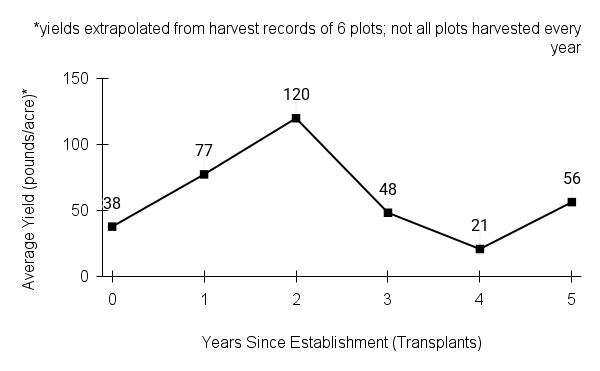 First harvest: Though some plants may flower the first year, two growing seasons are required for stand establishment and seed production. Peak production at TPC has been in the second and third years after planting.
Yield: 20-120 bulk pounds/acre (yields extrapolated from harvest records of 6 plots)
Stand life: 5-10 years; seed production typically decreases after 5 years.
Flowering date: mid-August - early September in northern Iowa
Seed maturity/Harvest date: October in northern Iowa
Seed retention: Shattering begins in late October into November
Harvest date range at TPC (2005-2023): Sept 26 - Oct 27
Recommended harvest method: combine
- Seed cleaning and storage
Cleaning process: Use brush machine/huller-scarifier to remove hulls, then air-screen (see Appendix C for settings).
Seed storage: cool/dry (33-50° F, 30-50% RH)
Released Germplasm
Source Identified material: Natural Selections/Iowa Ecotype Project Zone 1 (Northern Iowa), Zone 2 (Central Iowa), and Zone 3 (Southern Iowa)
Cultivated variety (cultivars): Kanoka (KS)
- References
Chayka, K. (n.d.). Lespedeza capitata (round-headed bush clover). Minnesota Wildflowers. https://www.minnesotawildflowers.info/flower/round-headed-bush-clover
Cochrane, T. S., Elliot, K., & Lipke, C. S. (2014).Round-headed bush-clover. In Prairie plants of the University of Wisconsin-Madison Arboretum (3rd ed., p. 188). University of Wisconsin-Madison Arboretum.
Hilty, J. (2019). Round-headed bush clover - Lespedeza capitata. Illinois Wildflowers. https://www.illinoiswildflowers.info/prairie/plantx/rh_bushcloverx.htm
Houseal, G. A. (2007). Forbs legumes. In G. A. Houseal (Eds.), Tallgrass Prairie Center’s native seed production manual (pp. 64–65). Tallgrass Prairie Center - University of Northern Iowa.
Kartesz, J.T., The Biota of North America Program (BONAP). 2023. North American Plant Atlas. (http://bonap.net/napa). Chapel Hill, N.C. [maps generated from Kartesz, J.T. 2023. Floristic Synthesis of North America, Version 1.0. Biota of North America Program (BONAP). (in press)]
NatureServe. 2024. NatureServe Network Biodiversity Location Data accessed through NatureServe Explorer [web application]. NatureServe, Arlington, Virginia. Available https://explorer.natureserve.org/. (Accessed: February 29, 2024).
Runkel, S. T., & Roosa, D. M. (2009). Roundhead lespedeza. In Wildflowers of the tallgrass prairie: The upper Midwest (2nd ed., pp. 228–229). University of Iowa Press.
USDA NRCS National Plant Data Team. (n.d.). Lespedeza capitata Michx. USDA plants database. https://plants.usda.gov/home/plantProfile?symbol=LECA8
Species Guide Updated 12/4/2025
showy ticktrefoil
showy ticktrefoil dickeye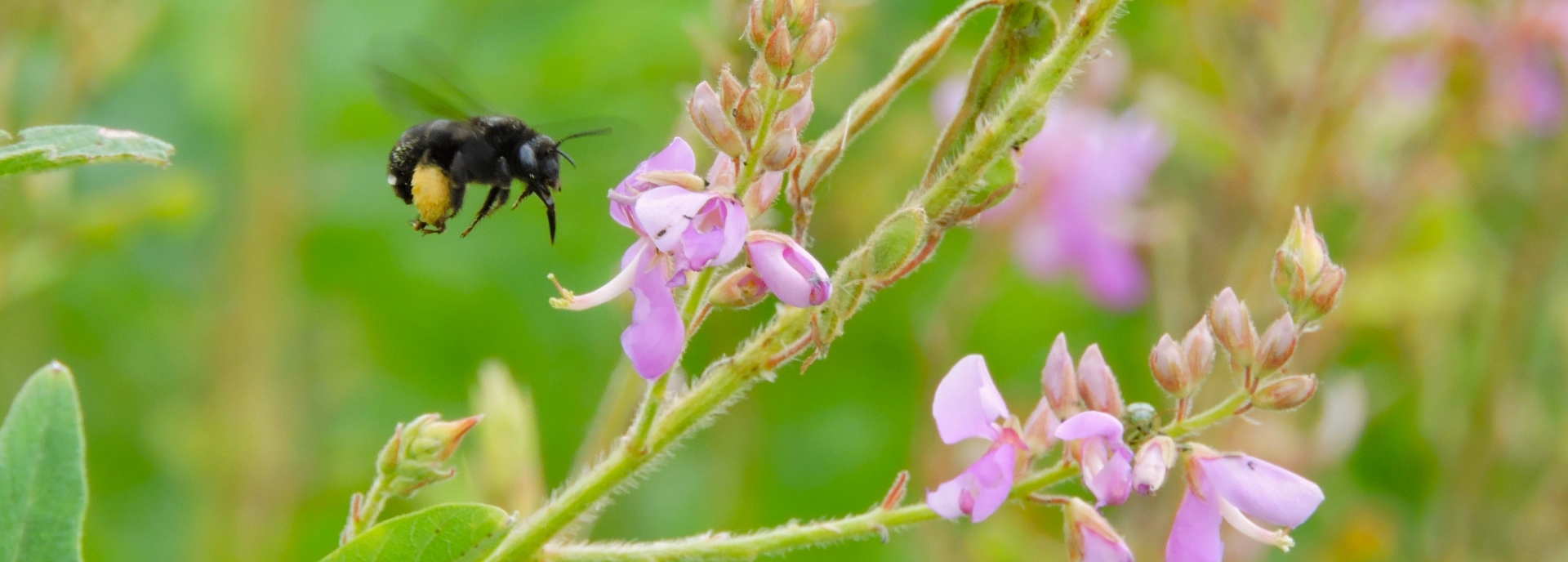
Desmodium canadense (L.) DC.
Alternate Common Names: tick clover, Canadian tick trefoil, showy tick-trefoil, Canadian tick-trefoil, Canada ticklover
Scientific Synonym: Meibomia canadensis (L.) Kuntze
Family: legume and pea family (Fabaceae (Leguminosae))
Functional Group: legumes
Description
- Life cycle and growth form
Perennial from a woody taproot.
Height: 2-6 ft
- Leaves and stem
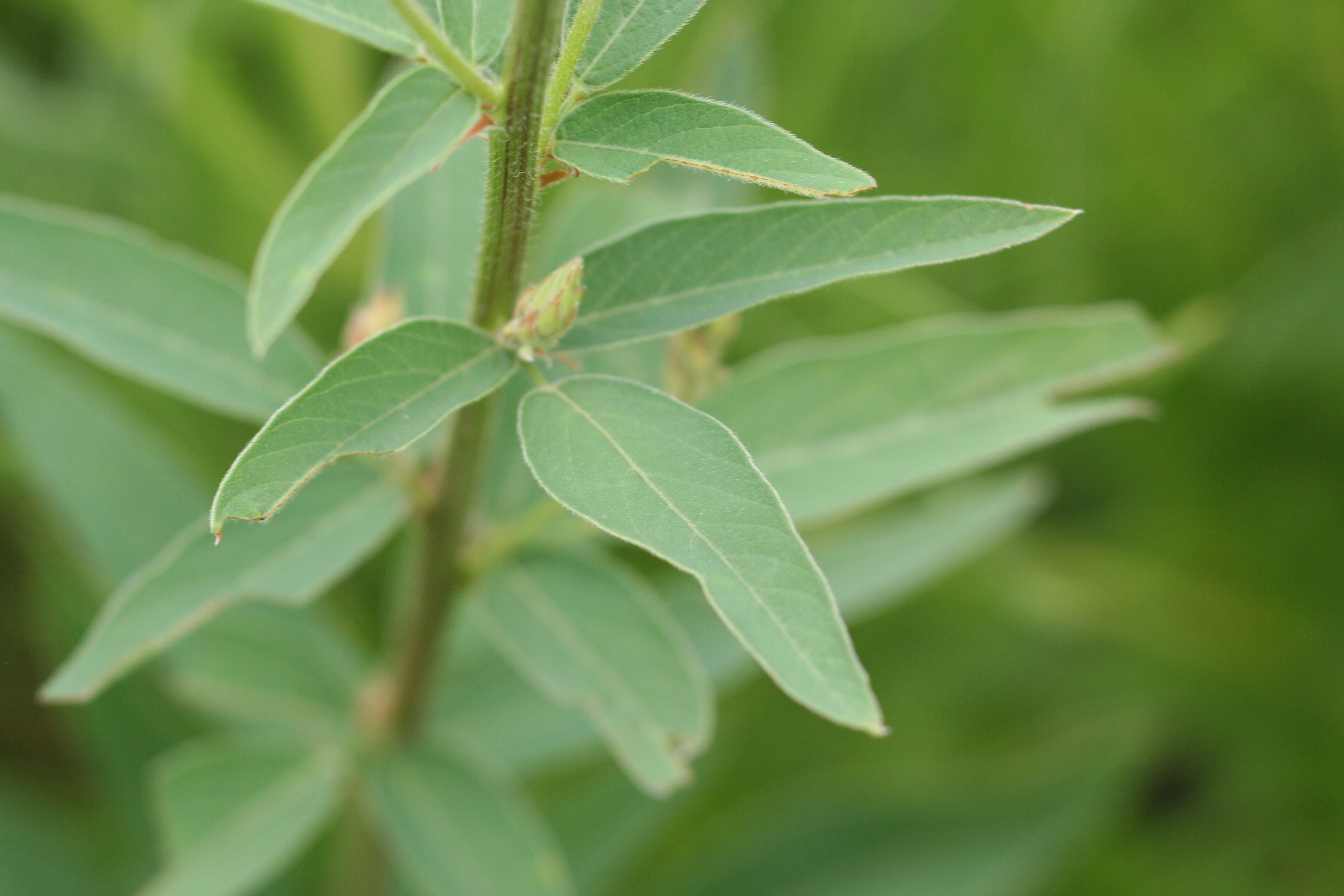
Leaves alternate, divided into three leaflets with rounded base and pointed tips, with sticky (hooked) hairs on undersides and narrow pointed bracts (stipules) on either side of the leaf petiole. Petiole is shorter than the stalk of the terminal leaflet (in contrast to Illinois ticktrefoil). Stem is usually unbranched, hairy.
- Flower, fruit and seedhead
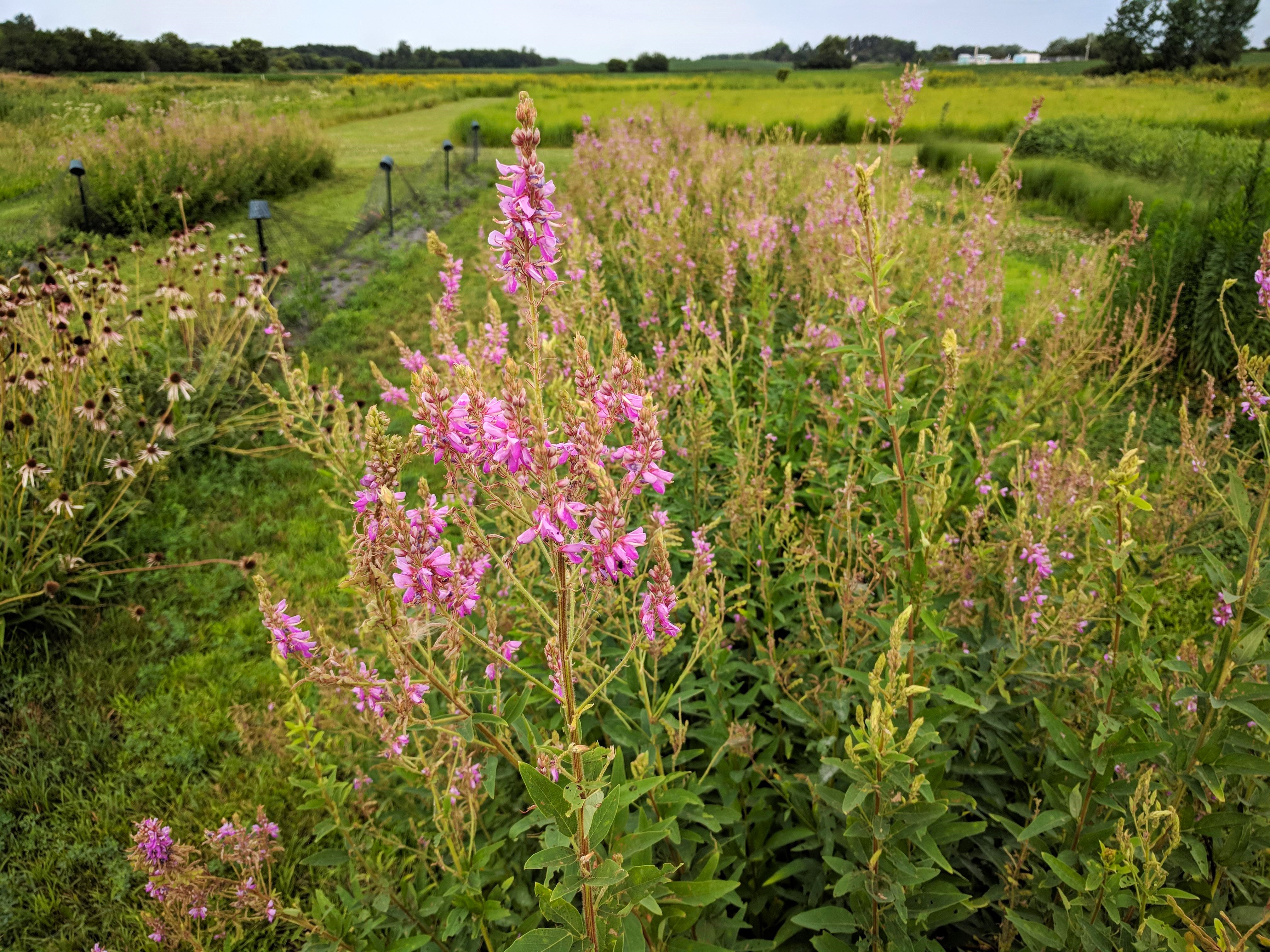
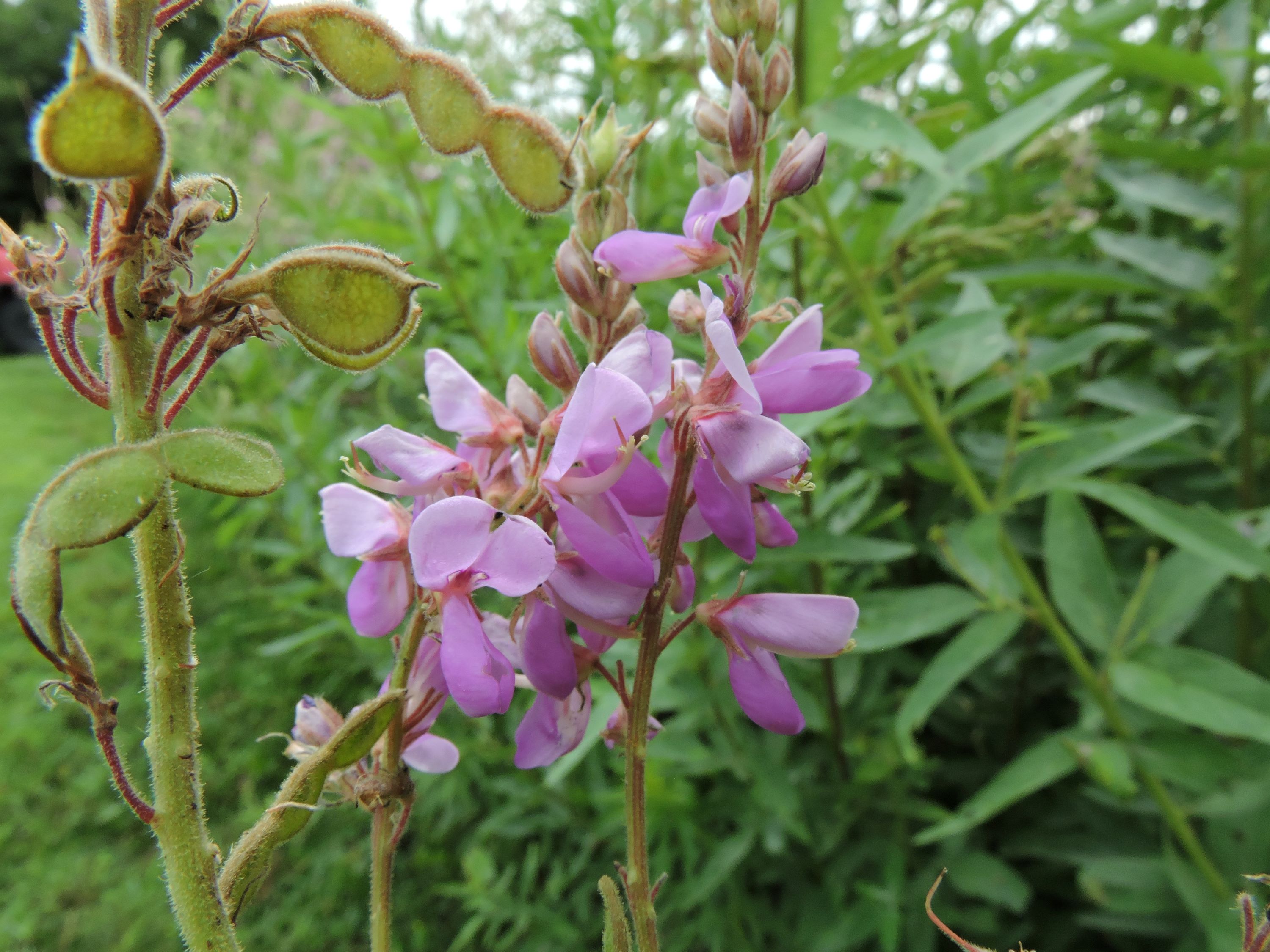
Flower: Irregular, pea-shaped, 1/2 in long flowers, pink-purple with 2 yellow spots near the base of the upper lobe, arranged in spike-like racemes from stem tip and upper leaf axils.
Fruit/seedhead: Fruits are jointed pods called loments, 1-2.5 in long, covered in tiny hooked hairs to latch onto passing mammals, with 3-5 sections each containing one bean-like seed.
Pollination: bees
- Seed
Seed characteristics
Seed weight:
Seeds per ounce: 5,500 (IA NRCS)
Seeds per pound: 88,000 (IA NRCS)
1000 seed weight: 5.11 g (Seed Information Database)
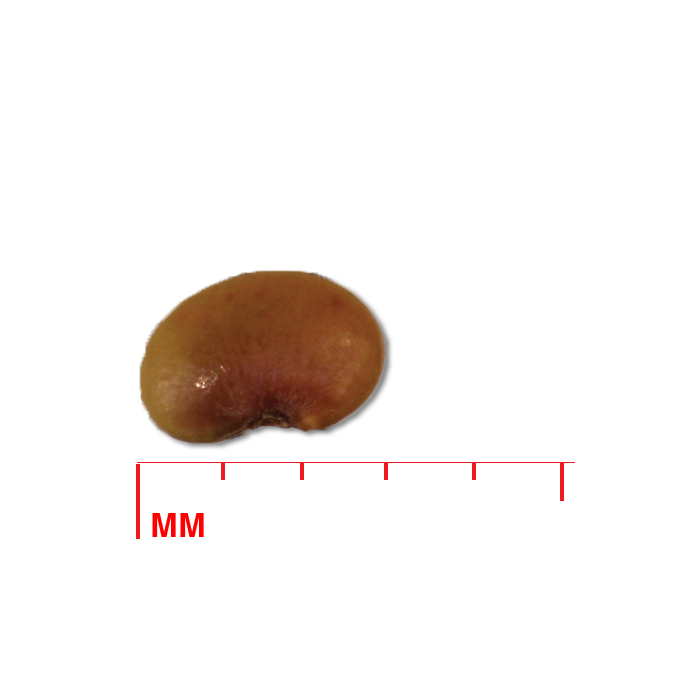
Description: Seeds are small beans, about 2.5-3 mm (about 1/8 in), olive green to tan.
Typical seed test
PLS: 95% (n = 11)
Purity: 100% (n = 11)
Germination: 76% (n = 10)
Hard: 10% (n = 10)
(averages obtained from n tests of purchased seed lots)
- Habitat and range
Habitat: Dry-mesic to wet-mesic soil; full sun; prairies, shorelines, woodland openings, roadsides, prairie remnants. Wetland Indicator Status is Facultative Upland (FACU) for the Midwest. Moist, fertile, well-drained loamy soils are preferred for seed production.
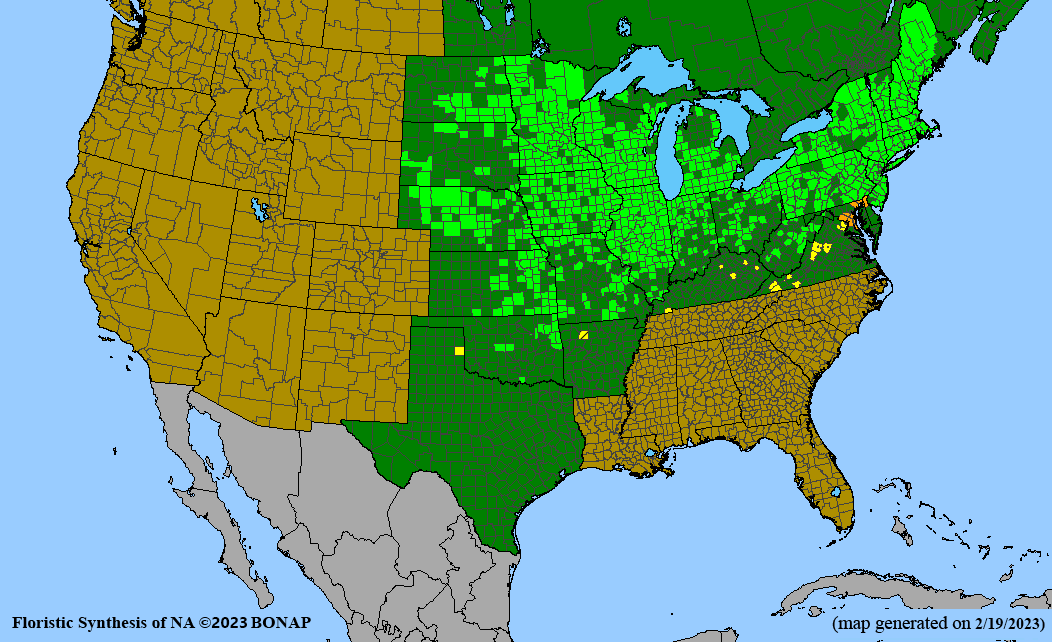
Conservation status: Global- G5, secure; Delaware and Maryland- SH, possibly extirpated; Virginia- S1, critically imperiled; Kansas- S3, vulnerable (NatureServe)
General Comments
Showy ticktrefoil is an important component of black soil prairies, increasing with spring burning. Its seeds are an important food source for upland game birds.
Recommendations for Seed Production
- Establishment for seed production
Direct seeding
Row spacing: 30-36 in 7 in and solid stand PLS lbs/acre: 2.0 6.0 Seeding depth: 1/4 in
Seeding method: native seed drill
Seeding time: Dormant fall seeding of unscarified seed. Scarify and inoculate seed for spring planting (Desmodium EL inoculum).
Weed Control: Prepare clean, firm, weed free seedbed prior to seeding.
Greenhouse
Seed pre-treatment: Scarify seed (see Propagation of Native Species: Seed Treatments). Moist stratification generally isn’t required, but seed should be stored in dry, cold conditions until sowing.
Sowing: Sow seed in greenhouse two months before last frost free date. Inoculate seed with appropriate rhizobium at time of sowing, if desired. Seedlings form a fleshy taproot with few lateral roots unless allowed to grow until taproot is air-pruned as it reaches the bottom drainage holes of the container. Plug flats with vertical grooves and wide drainage holes facilitate air-pruning.
Transplanting: When plants have sufficient root development to form sturdy plugs and danger of frost is past, transplant into bare soil in rows convenient for tillage equipment or into a weed barrier at 8-12 in intervals. Use care when transplanting to keep soil intact around the root system.
- Stand management
Weeds: For direct seedings, mow stand above showy ticktrefoil seedling height during establishment year to reduce weed competition and increase light to seedlings. Poast (sethoxydim) herbicide can be used for annual grass control, post emergence. Pursuit (imazethapry) can be used post-seeding for broadleaf weed control. Note: These herbicides may not be labeled for this species in your state, always check the label and follow recommendations.
Pests: Invasive Japanese beetles form feeding clusters on the inflorescences and in bad years can decimate flowering and seed production. For small scale production systems, a perimeter of beetle traps spaced about 5 m apart surrounding the plot can reduce damage. Traps are constructed of pheromone lures in funnels mounted atop 5-gallon buckets of soapy water. Seed weevils may infest and seriously curtail seed production. Aphids cause distortion of shoot tip growth and may inhibit flowering. Herbivory by deer, rabbits, and groundhogs may be an issue on young plants.
Diseases: Powdery mildew may affect foliage.
- Seed production
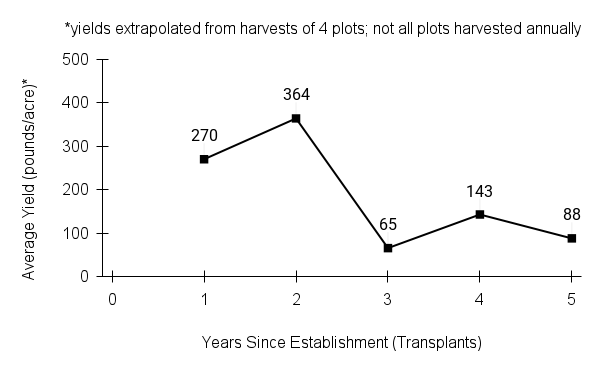 First harvest: Seedling growth is vigorous, and flowering and seed set may occur at end of first growing season from greenhouse grown transplants and well managed direct seeded stands.
Yield: 60-360 bulk pounds/acre (extrapolated from harvests of 4 plots; not all plots harvested annually)
Stand life: Stand may persist for 5 -10 years.
Flowering date: mid-July - mid-August in northern Iowa
Seed maturity/Harvest date: September in northern Iowa
Seed retention: Low risk of shattering; most seed loss begins late September into October
Harvest date range at TPC (2003-2021): Sept 1 - Oct 10
Recommended harvest method: Combine. Devise a system for collecting clumps of the sticky pods that don’t pass through the sieves and are ejected out the back of the combine.
- Seed cleaning and storage
Cleaning process: Use a brush machine to remove hulls (loments). Re-brush any seed still in the hull, if necessary. Airscreen to clean (see Appendix C for settings).
Seed storage: Cool/dry (33-50° F, 30-50% RH)
Released Germplasm
Source Identified material: Natural Selections/Iowa Ecotype Project Zone 1 (northern Iowa), Zone 2 (central Iowa), and Zone 3 (southern Iowa)
Selected germplasm: Alexander Germplasm (IL).
- References
Chayka, K. (n.d.). Desmodium canadense (showy tick-trefoil). Minnesota Wildflowers. https://minnesotawildflowers.info/flower/showy-tick-trefoil
Cochrane, T. S., Elliot, K., & Lipke, C. S. (2014). Canadian tick-trefoil. In Prairie plants of the University of Wisconsin-Madison Arboretum (3rd ed., p. 184). University of Wisconsin-Madison Arboretum.
Great Plains Flora Association. (1991). Bean family. In T. M. Barkley, R. E. Brooks, & E. K. Schofield (Eds.), Flora of the Great Plains (2nd ed., p. 446). University Press of Kansas.
Hilty, J. (2019). Showy tick trefoil - Desmodium canadense. Illinois Wildflowers. https://www.illinoiswildflowers.info/prairie/plantx/shw_trefoilx.htm
Houseal, G. A. (2007). Forbs legumes. In G. A. Houseal (Eds.), Tallgrass Prairie Center’s native seed production manual (pp. 62–63). Tallgrass Prairie Center - University of Northern Iowa.
Kartesz, J.T., The Biota of North America Program (BONAP). 2023. North American Plant Atlas. (http://bonap.net/napa). Chapel Hill, N.C. [maps generated from Kartesz, J.T. 2023. Floristic Synthesis of North America, Version 1.0. Biota of North America Program (BONAP). (in press)]
NatureServe. 2024. NatureServe Network Biodiversity Location Data accessed through NatureServe Explorer [web application]. NatureServe, Arlington, Virginia. Available https://explorer.natureserve.org/. (Accessed: February 29, 2024).
USDA NRCS National Plant Data Team. (n.d.). Desmodium canadense (L.) DC. USDA plants database. https://plants.usda.gov/home/plantProfile?symbol=DECA7
Species Guide Updated 12/4/2025
white wild indigo
white wild indigo dickeye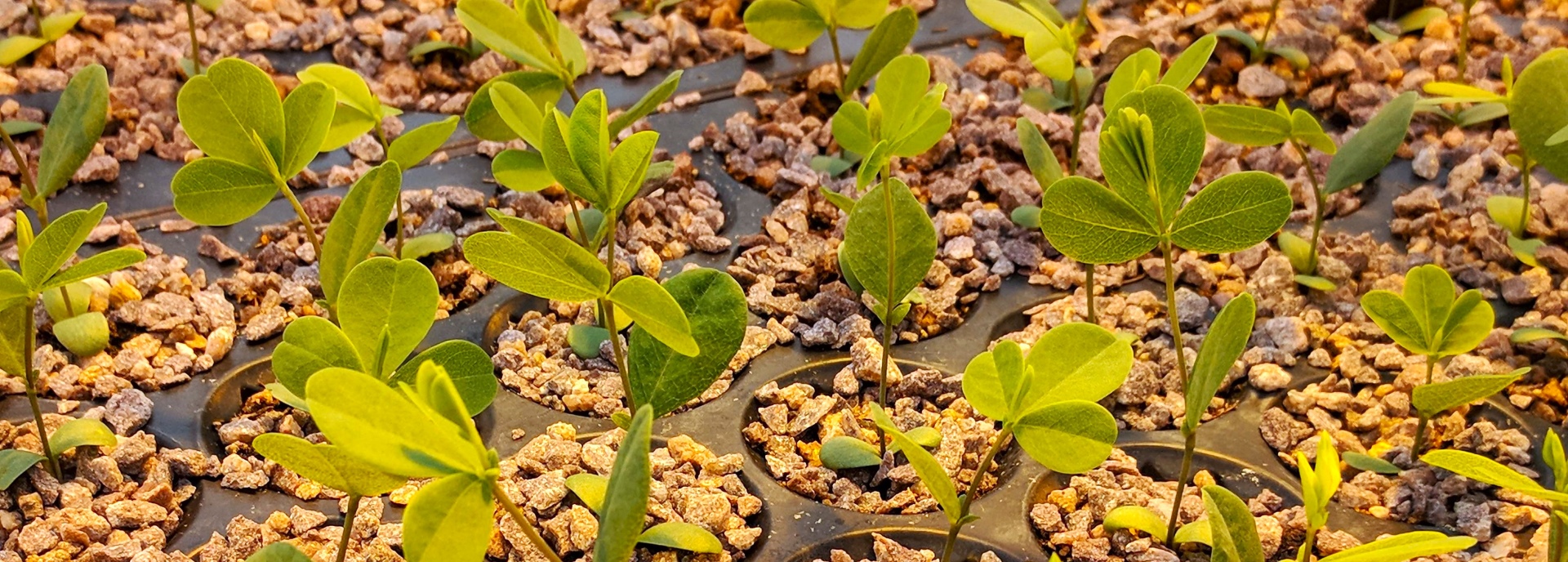
Baptisia alba (L.) Vent.
Alternate Common Names: white false indigo, large leaf wild indigo, large-leaved wild indigo, milky wild indigo, prairie false indigo
Scientific Synonyms: Baptisia lactea (Raf.) Thieret, Baptisia leucantha Torr. & A. Gray, Baptisia pendula Larisey var. macrophylla
Family: legume and pea family (Fabaceae (Leguminosae))
Functional Group: legumes
Description
- Life cycle and growth form
Perennial with a thick, deep taproot.
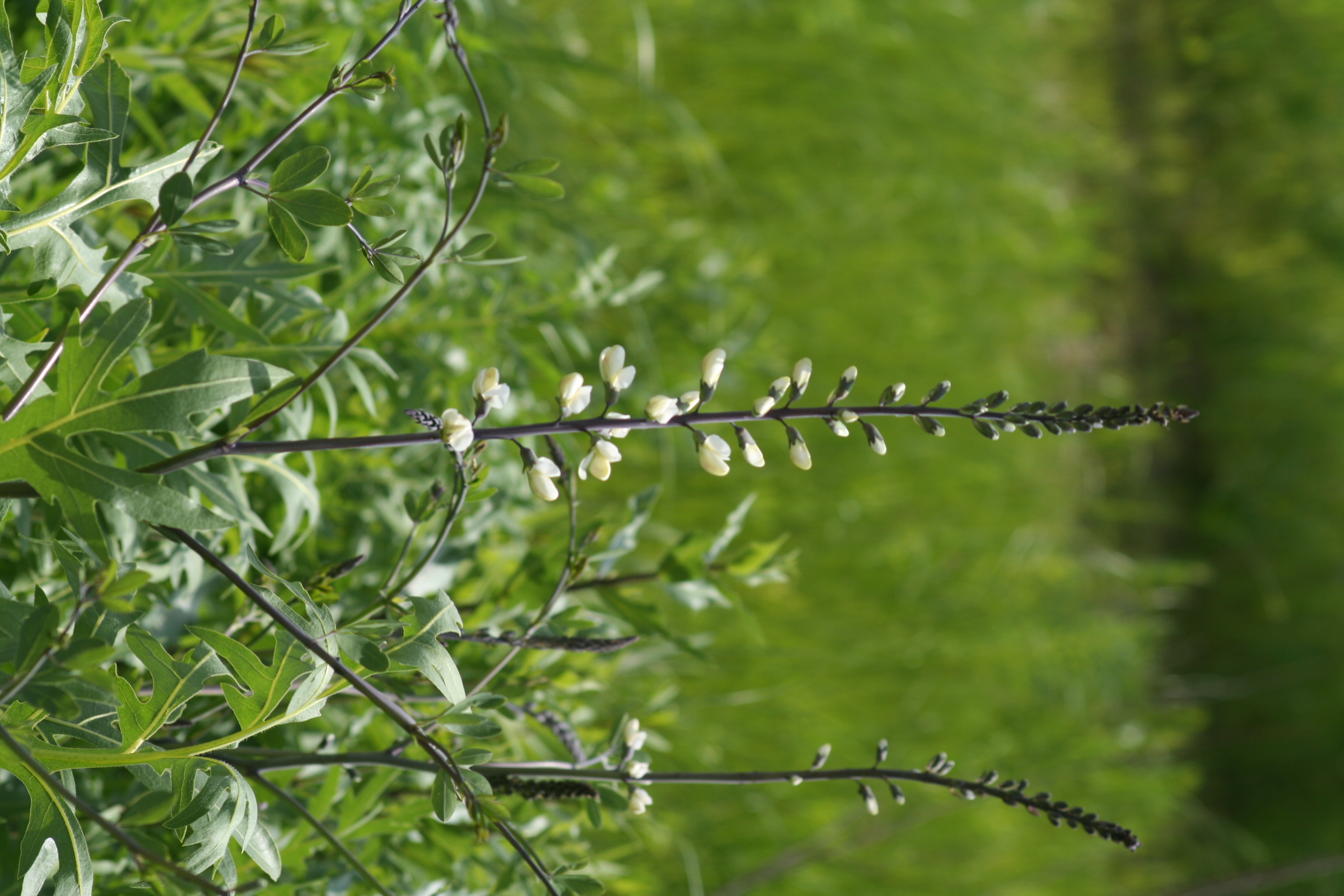
Height: 2-4 ft
- Leaves and stem
Leaves are alternate and compound with three smooth leaflets; stems are waxy and erect, multi-branched, and purplish; leaves and stems turn black after first frost.
- Flower, fruit and seedhead
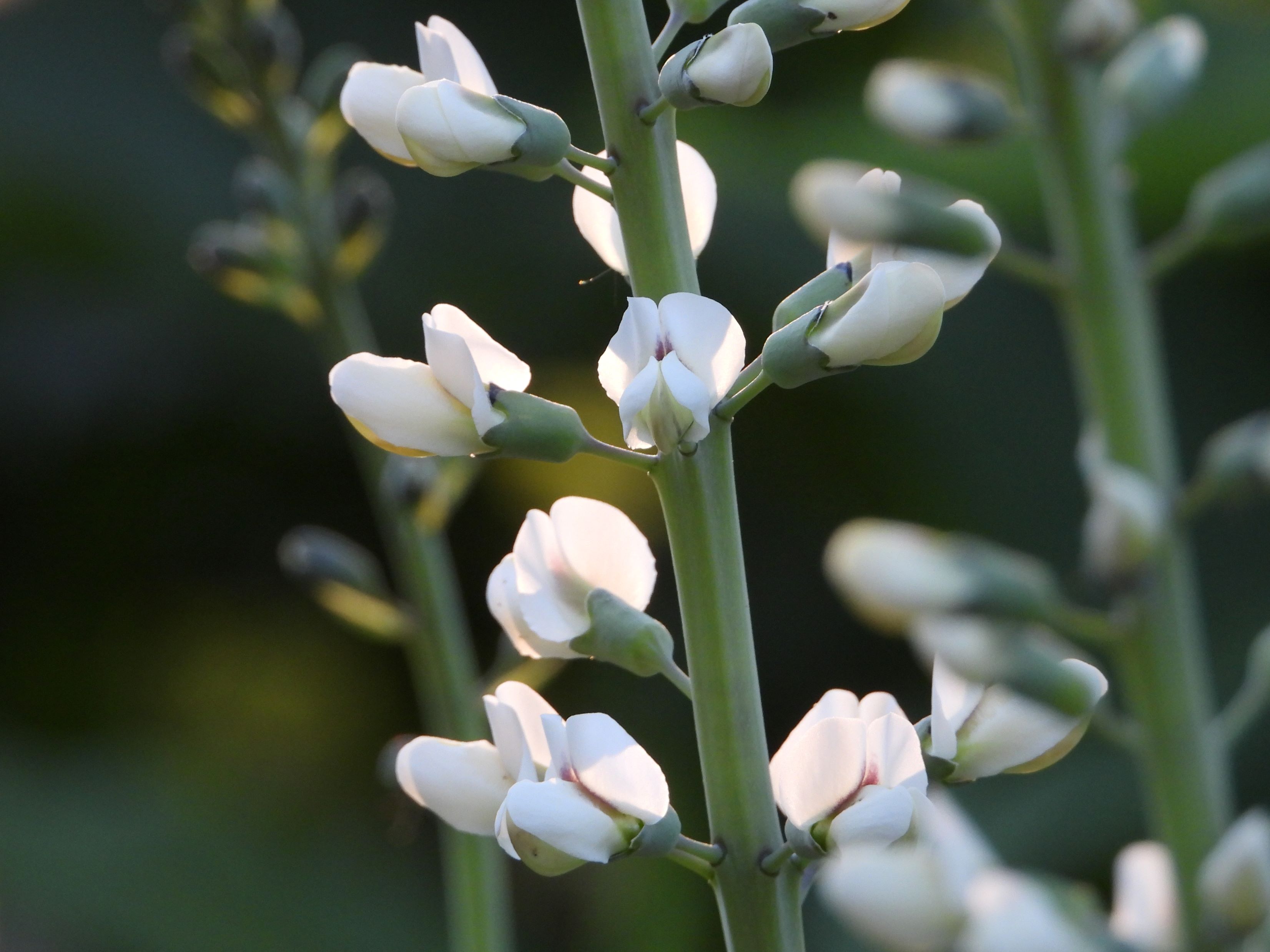
Flower: Large, white, pea-like blossoms on erect racemes up to 2 ft long. Secondary racemes may also be present. Petals drop after pollination.
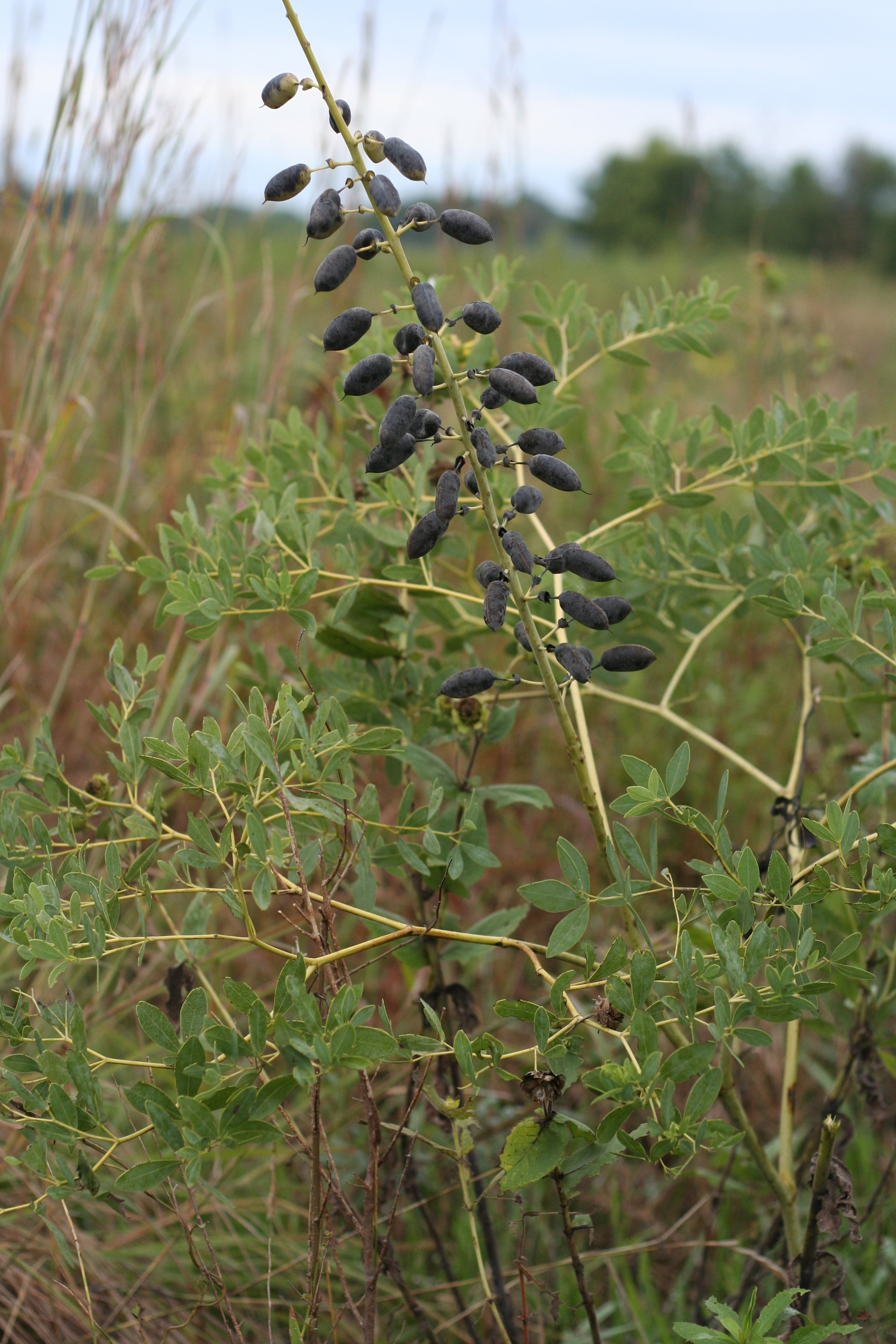
Fruit/seedhead: Inflated, cylindrical seed pods start out green but turn black when ripe, seeds are golden.
Pollination: Bumblebees
- Seed
Seed characteristics
Seed weight:
Seeds per ounce: 1,700 (IA NRCS)
Seeds per pound: 27,200 (IA NRCS)
1000 seed weight: 16.42 g (Seed Information Database)
Description: Seeds are a bean about 4-5 mm long (1/4 in), covered with a sticky resin when freshly mature.
Typical seed test
PLS: 95% (n = 11)
Purity: 100% (n = 11)
Germination: 9% (n = 9)
Hard: 88% (n = 10)
(averages obtained from n tests of purchased seed lots)
- Habitat and range
Habitat: Dry to wet-mesic soil; full sun; black soil or sand prairies, marsh and lake edges, thickets, limestone glades. Wetland Indicator Status is Facultative Upland (FACU) for the Midwest. Moist, well-drained soils are preferred for seed production.
Conservation status: Global- G5, secure; North Carolina- S2, imperiled (NatureServe)

General Comments
The spring shoots of mature white wild indigo plants come up quickly, resembling asparagus, in late spring when soil temperatures warm. The tissues expand quickly, becoming shrub-like in form and blooming by early to mid June. Tissues turn black if bruised, as do seed pods at maturity. The entire plant blackens with fall dormancy. Pods eventually split open, revealing orderly rows of attached seeds, if they have not been devoured by the larvae of a host specific insect: the baptisia seed pod weevil. Seeds are somewhat sticky, initially. Stem breaks off at ground level in late fall and plants will tumble with the wind, shaking out any seed remaining in the pods, aiding seed dispersal.
Recommendations for Seed Production
- Establishment for seed production
Direct seeding
Not recommended for this species
Greenhouse
Seed pre-treatment: Scarify seed (see General Information: Propagation of Native Plants) and wet stratify 10 days to 2 weeks at 40° F. Inoculate seed with a Baptisia inoculum, if desired.
Sowing: Sow seed in greenhouse two months before last frost free date. Damping off (fungal pathogen) can be a problem on seedlings if soil is kept too moist, or seedlings are planted too thickly. Add additional perlite to sterile potting mix. Avoid excess moisture on the soil surface by applying a thin layer of chick grit over the top of the soil, improving air circulation with fans, thinning seedlings, and/or watering from the bottom of the containers only. Seedlings form a fleshy taproot with few lateral roots, unless allowed to grow until taproot is air-pruned as it reaches the bottom drainage holes of the container. Plugs with vertical grooves and large bottom openings encourage air-pruning and branching of roots.
Transplanting: Use care when transplanting to keep soil intact around the root system. Transplant healthy, well-rooted seedlings into bare soil in rows convenient for tillage equipment or into a weed barrier at 12 in intervals after all danger of frost is past.
- Stand management
Weeds: Mow stands above seedling height during establishment year. Control weeds with tillage and hand roguing. It may be desirable to overseed with a shorter growing warm season grass as a companion crop to reduce competition from weeds and to provide a fuel matrix for annual burning, which enhances seed production and seems to reduce seed predation by weevils.
Pests: Seed production can be curtailed or even eliminated in some years by a seed-eating weevil (Apion rostrum). The weevil oviposits eggs in the developing fruit, and the larvae emerge a few days later inside the sealed pods and feed on the developing seeds. Plants may also selectively abort pods containing fewer seeds due to seed predation. It may take a few years for weevils to find and colonize a new production field. Deer are known to eat the entire inflorescence while in bud.
Diseases: None noted.
Hybridization risk: Maintain separation between plots of Baptisia alba and other species in the genus: B. australis, B. bracteata.
- Seed production
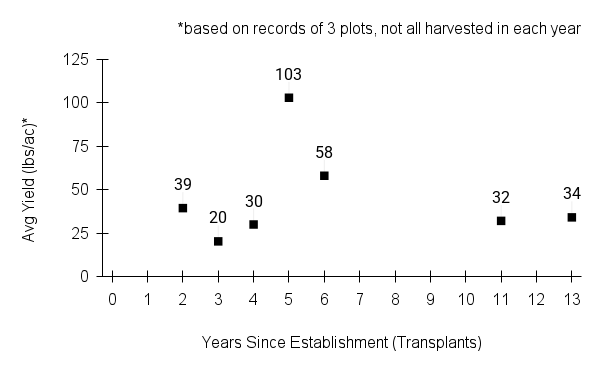 First Harvest: Plants are slow to reach reproductive maturity. Some flowering and seed set may occur in the third growing season under optimal conditions, but it may require 4 to 5 years for a full harvest.
Yield: 20-100 bulk pounds/acre (yields extrapolated based on harvest records from 3 plots)
Stand life: Plants appear to be long-lived, estimated stand life of at least 10 years.
Flowering date: mid-June - mid-July in northern Iowa
Seed maturity/Harvest date: September in northern Iowa.
Seed retention: Shattering occurs gradually through September into October.
Harvest date range at TPC (2004-2015): Aug 13 - Oct 21
Recommended harvest method: Combine or hand strip pods at maturity.
- Seed cleaning and storage
Cleaning process: Hand collected material may be stomped to break up pods. This step is not needed for combined material. Pre-clean air-dried material by scalping through 1/2 in mesh to remove large particles. Air-screen to clean (see Appendix C). Most black-colored seeds are non-viable and usually less dense than yellowish-colored seeds, and most should be removed by increasing aspiration.
Seed storage: Cool/dry (33-50° F, 30-50% RH)
Released Germplasm
Source identified material: Natural Selections/Iowa Ecotype Project Zones 1 (northern Iowa), 2 (central Iowa), and 3 (southern Iowa)
Cultivated variety (cultivars): Horticultural varieties may also exist.
- References
Chayka, K. (n.d.). Baptisia lactea (white wild indigo). Minnesota Wildflowers. https://www.minnesotawildflowers.info/flower/white-wild-indigo
Cochrane, T. S., Elliot, K., & Lipke, C. S. (2014). White wild indigo. In Prairie plants of the University of Wisconsin-Madison Arboretum (3rd ed., p. 180). University of Wisconsin-Madison Arboretum.
Hilty, J. (2019). White wild indigo - Baptisia alba macrophylla. Illinois Wildflowers. https://www.illinoiswildflowers.info/prairie/plantx/ww_indigox.htm
Houseal, G. A. (2007). Forbs legumes. In G. A. Houseal (Eds.), Tallgrass Prairie Center’s native seed production manual (pp. 58–59). Tallgrass Prairie Center - University of Northern Iowa.
Kartesz, J.T., The Biota of North America Program (BONAP). 2023. North American Plant Atlas. (http://bonap.net/napa). Chapel Hill, N.C. [maps generated from Kartesz, J.T. 2023. Floristic Synthesis of North America, Version 1.0. Biota of North America Program (BONAP). (in press)]
NatureServe. 2024. NatureServe Network Biodiversity Location Data accessed through NatureServe Explorer [web application]. NatureServe, Arlington, Virginia. Available https://explorer.natureserve.org/. (Accessed: February 29, 2024).
USDA NRCS National Plant Data Team. (n.d.). Baptisia alba (L.) Vent.. USDA plants database. https://plants.usda.gov/home/plantProfile?symbol=BAAL
Species Guide Updated 12/2/2024